Meta Muse can research products and make purchases with a shopper’s approval. A practical Meta Muse dropshipping strategy starts with relevant products, accurate Shopify listings, and dependable fulfillment.
As AI shopping agents reshape ecommerce, AI shopping agents dropshipping strategies increasingly need to account for product discovery, listing accuracy, competitive pricing, and reliable fulfillment. Sell The Trend’s product research and competitor analysis help merchants assess demand, pricing, and differentiation before selecting products to test.
AI shopping agents introduce another product discovery channel by helping shoppers research offers that match their needs.
Sell The Trend’s NEXUS AI and Store Intelligence support product selection through demand signals, competitor research, and pricing insights.
Sell The Trend’s Shopify imports and automation support listing management, while accurate product details help shoppers and AI agents evaluate offers.
Predictive analytics can inform product testing and advertising decisions, although campaign performance alone does not prove that Muse recommends a product.
Reliable suppliers, sustainable margins, and ongoing measurement provide a practical foundation for adapting to developments in AI shopping.
Meta’s personal AI agent researches offers and can complete approved purchases on a shopper’s behalf. Meta launched Muse on September 8, 2026, giving dropshippers another route to customers. The opportunity is to present relevant, verifiable offers that the assistant can understand and the merchant can fulfill.
Your five-step merchant workflow:
Shortlist candidates with NEXUS AI → assess competing offers with Store Intelligence → verify suppliers and margins → prepare accurate listings → check channel eligibility and record results.
The Muse app is available on mobile devices and the web, with WhatsApp access and a US App Store listing.
Muse shops across the open web using its own browser and available connections. It can navigate checkout and request permission to spend money, turning a product recommendation into a potential transaction.
Meta says Muse launched with access to the entire Shopify Catalog. At Meta Connect, Mark Zuckerberg presented further developments, including announced connections with Walmart, Best Buy, Sephora, and additional retailers; catalog access should not be confused with every item being purchasable everywhere.
Personal context matters too. With permitted access, saved posts can inform a task, such as turning an Instagram recipe reel into a grocery list. A save action may reveal interest, but Meta has not published evidence that saving a product automatically raises its recommendation ranking.
Shopper Trust in Agentic Commerce
Each user needs confidence in the payment process, the merchant, and their ability to stay in control. For a small business, clear policies and realistic promises support that confidence. Treat privacy and purchase approval as parts of the shopping experience, alongside product suitability and price.
Vogue Business’s March–April 2026 survey of 251 Vogue, Vogue Business, and GQ readers in the UK, US, and Europe found the following attitudes.
Survey response
Share of respondents
Would not share card details
72%
Would not share browsing history
46%
Would not share location data
40%
Would outsource shopping if the agent knew their taste and purchase history
31%
These describe that readership sample, not all consumers or Muse customers.
Meta gives each person an isolated, private virtual machine, while retaining access when necessary to run or secure the service. Stripe’s Link supports approved payments, using saved payment methods at participating businesses or a single-use card restricted to the approved purchase elsewhere.
Meta describes Muse as the first AI agent covered by Link’s purchase protections, including eligible damaged or lost items and price drops. Those protections have conditions; your store still needs clear returns and support information.
No title
Pro Tip: Can your supplier support the promise on your page? Check warehouse location, delivery options, and item availability before publishing an estimate. Start your Sell The Trend free trial to investigate suppliers for your target market.
Navigating Agentic Commerce with Sell The Trend
Sell The Trend is an all-in-one dropshipping platform for product research, supplier sourcing, and store automation. It helps merchants prepare for purchases handled by AI assistants. Start with NEXUS AI, assess competing offers through Store Intelligence, and verify specifications, delivery terms, and margins before importing a listing.
Separate three decisions before listing a product.
Access determines whether a channel can discover or transact with the offer.
Relevance concerns whether the item satisfies the buyer’s requirements.
Profitability determines whether fulfilling the order makes business sense.
An accessible listing can still be unsuitable, and an attractive offer can still make a loss. This is a planning framework, not a disclosed Meta ranking formula.
Sell The Trend tool
Documented scope
Merchant application
NEXUS AI
11 million+ products across 83 niches
Screen candidates for a defined audience
Store Intelligence
Competitor products, pricing, and estimated revenue
Identify a difference worth validating
Supplier filters
US, EU, and global sourcing options
Investigate fulfillment for the destination
1-Click Push to Store
Product import into a connected storefront
Prepare an editable listing
Revenue estimates are directional, and a supplier’s region alone does not guarantee delivery speed.
Sell The Trend’s State of AI Dropshipping 2026 reports up to 85% less research time in its internal analysis. The report does not disclose a sample size, so treat the figure as a vendor benchmark, not an expected result or a measure of Muse recommendations.
Enhancing Product Discovery with NEXUS AI
NEXUS AI helps screen products using demand, competition, sourcing, and margin signals. A defensible price connects a real customer benefit with costs your business can sustain. Pair research with verified product differences, such as measurable fit, suitable materials, or dependable delivery, before deciding which candidates deserve a test.
Sell The Trend’s Dropshipping Product Research Tool evaluates 26+ signals. Its purpose here is to narrow the field; it does not reveal the shopper’s private preferences or forecast a particular Muse answer.
Start with a buyer request such as “Find a washable organizer under $35 that fits a 25-centimeter backpack pocket, arrives in Chicago by Friday, and comes from a seller with clear returns.” Price, dimensions, delivery, and merchant information become facts to verify, not assumed ranking weights.
Assistants can bring prices, customer reviews, and merchant information into one comparison, although the available evidence varies. Fast shipping matters when a deadline is part of the request; transparent pricing lets the shopper assess the full cost of meeting it.
Use this sequence to link market evidence with an offer.
Write the intended use. Record the customer, problem, budget, and delivery destination.
Screen market signals. Look for sustained interest and manageable competition rather than relying on one viral post.
Inspect alternatives. Use Store Intelligence to investigate competing prices and positioning, then verify the live listings.
Check the physical item. Measure samples and confirm materials, compatibility, packaging, and care instructions.
Calculate the cost of fulfillment. Include supplier charges, shipping, payment fees, expected returns, and acquisition costs.
For an illustrative $34.95 organizer, assume $12 sourcing, $5 shipping, $1.35 processing, and $1.60 for returns and support. That leaves $15 before acquisition, or $6 after an assumed $9 acquisition cost, excluding overhead and taxes.
A $5 discount would reduce that remaining contribution to $1 if those assumptions stayed fixed. Differentiation matters because the cheapest offer may leave too little room to serve customers reliably.
The stronger research question is “Which buyer requirement can this product prove it meets?” That approach aligns product selection with the information an assistant needs to evaluate suitability, without pretending to know its hidden weighting.
NEXUS AI Product Validation in Practice
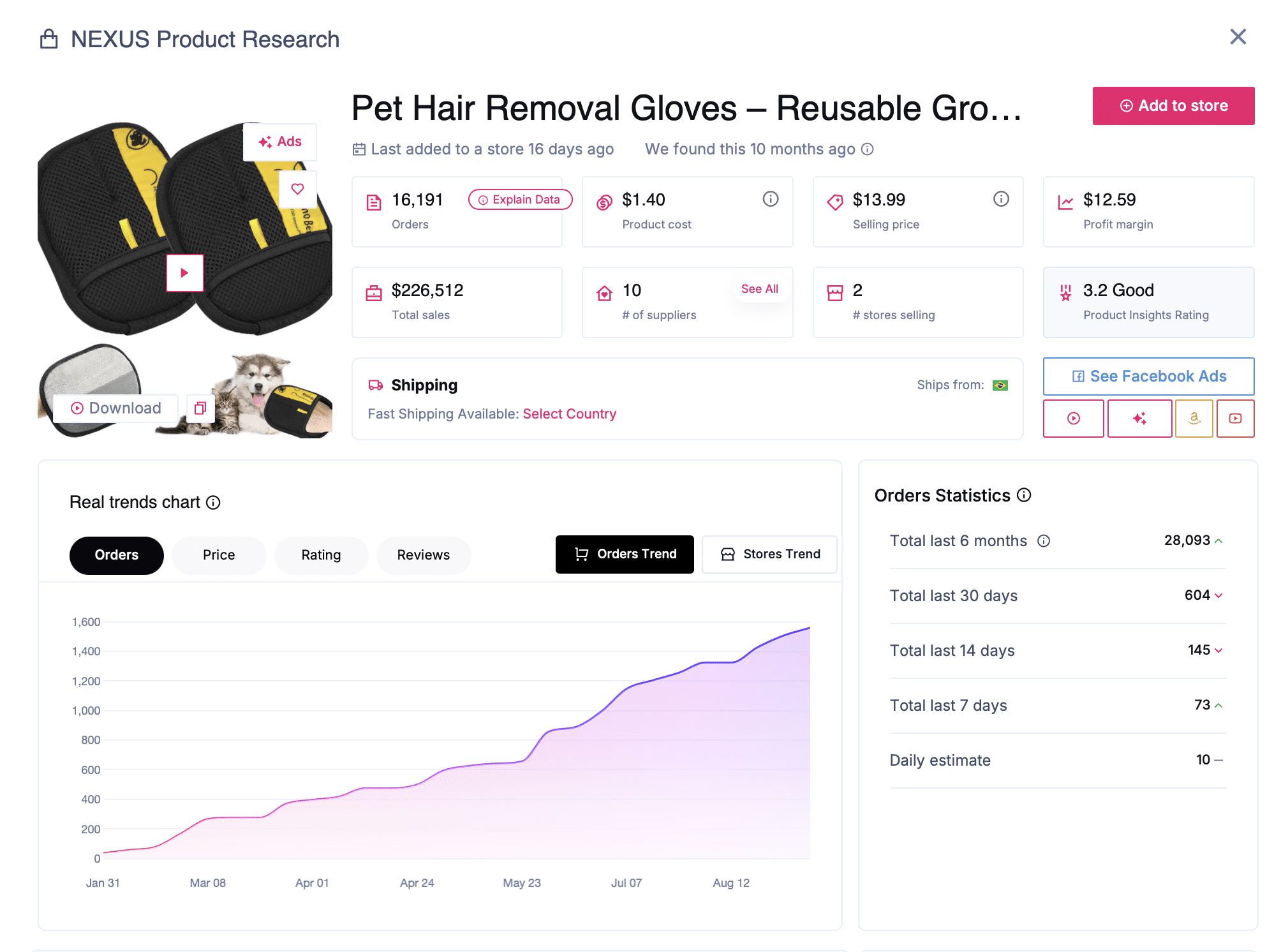
Sell The Trend’s product validation guide describes pet-hair removal gloves with 604 orders over the displayed 30 days and 10 supplier options. It also notes a downward indicator beside recent orders. The practical decision is to investigate current momentum before approving the item for a limited test.
The displayed $1.40 sourcing price and $13.99 selling price leave a $12.59 difference before delivery, processing, advertising, and refunds. These are figures reported in the guide, without verification of a merchant’s net earnings.
Based on those figures, hold the candidate for further validation. Before listing it, verify suitable surfaces, glove sizing, care instructions, and destination-specific delivery, then replace generic claims with those confirmed details.
Pro Tip: Does the evidence justify adding this item?Start your Sell The Trend free trial to investigate demand, competing offers, and supplier options for your own shortlist.
Optimizing Shopify Listings for AI Agents
Prepare listings with clear identity, complete attributes, current availability, and verifiable policies. Sell The Trend can accelerate importing, but each claim still needs review. Your own site and connected channels should receive the same product data, so the price, variant, and delivery promise remain consistent wherever someone encounters the offer.
For merchants researching a Muse shopping agent Shopify integration, the first step is to review Shopify’s available Agentic channel settings, confirm store eligibility, and ensure product data and purchasing options are accurate.
In your Shopify store, replace vague descriptions with details that answer the questions shoppers actually ask. Shopify recommends useful descriptions and images, accurate variants, appropriate identifiers, and complete policies.
Identity and fit should specify dimensions, materials, capacity, compatibility, and included accessories.
Pricing should identify currency, variant cost, shipping charges, and applicable conditions.
Availability and delivery should reflect stock, processing time, destination, and supported estimates.
Trust information should include genuine reviews, contact details, returns, and the limits of your claims.
An example title is “Washable Travel Organizer, 22 × 15 × 8 cm, Two Compartments.” Those specifications are illustrative and should only be published if the supplied item matches them.
Product structured data and merchant feeds give search engines machine-readable information. They support clearer interpretation, but no markup format guarantees placement in an assistant’s answer; keep visible information and machine-readable fields aligned.
Sell The Trend’s importing tool serves existing stores, while SellShop Store Builder provides a separate hosted storefront. Choosing the latter does not automatically activate Shopify’s channel settings.
Route
What it provides
Important limit
Sell The Trend with Shopify
Product imports, inventory synchronization, and 1-click order fulfillment
Channel eligibility requires separate review
SellShop
A separate store-building and hosting platform
It is not a Shopify integration
After importing, configure inventory synchronization and 1-click order fulfillment for supported supplier connections. Synchronization updates availability; fulfillment sends customer orders to suppliers. Verify variant mappings and delivery options, then check a test order and its tracking before scaling.
The Essential plan is listed at US$49.97 per month, billed every 30 days, for up to 500 product listings and one store, with price and stock monitoring. This subscription is separate from Shopify charges and other operating expenses.
Pro Tip: What needs checking after an import? Verify measurements, images, variants, and supplier terms before publishing. Start your Sell The Trend free trial to prepare listings faster, then review the facts behind each offer.
Selling on Meta Muse
Merchants looking to sell on Meta Muse should first confirm their store’s eligibility and review Shopify’s available Agentic channel settings.
Shopify announced Meta as an AI channel on September 8, 2026, with product sharing enabled by default through its catalog. Eligible stores may also receive orders through supported purchase flows. Review the Agentic settings in your admin to understand which features are enabled for your products and customers.
Sign in and open Sales channels → Agentic → Meta AI and Muse.
Shopify documents in-channel purchasing as active by default for eligible stores serving customers in the United States, Canada, or Mexico. That is not the same as automatic eligibility for every US merchant.
Its current guidance says Shop Pay can appear in Muse when available. Meta also announced PayPal among its payment connections, but neither announcement means every customer can use every method for every item.
Catalog distribution is one route to discovery; Muse can also browse websites. Even after a merchant disables catalog access, external crawling may still surface its pages.
Website permission matters too. Amazon blocked Muse after it asked Meta to remove Amazon from the experience; its warning described an “unauthorized AI agent.” That reported dispute shows why access to marketplace listings cannot be assumed.
Leveraging Predictive Analytics for Marketing Success
Predictive signals help prioritize products and audiences for controlled tests, while actual orders determine whether the offer works commercially. Sell The Trend’s research and marketing tools support those decisions. Better advertising results do not establish a causal increase in organic recommendations, so campaign and assistant-channel performance should be assessed separately.
NEXUS supports product screening, Facebook Audience Builder suggests targeting ideas, and AI Ads Blueprint helps develop creative assets and copy. Together, they support planning rather than a guaranteed path to placement.
Test two truthful angles for one item, such as compact dimensions versus washable materials. Keep the audience, price, and delivery terms comparable, set a spending limit, and judge results using acquisition cost and contribution after returns.
Use customer feedback to identify product requirements. Group recent messages and reviews by repeated needs, then turn each pattern into a testable requirement, such as maximum dimensions or a delivery deadline. Conversational prompts can organize that evidence; they cannot establish how frequently shoppers ask for it.
Dated capture, exact prompt, destination, and item shown
The item appeared in that recorded session
Referral recorded
Referring URL, landing page, and available tracking parameters
A recorded visit, subject to attribution gaps
Order attributed
Order ID, attributed channel, and net contribution
A transaction assigned to that channel
Standard client-side pixels do not fire in Meta’s native purchase flow; purchases redirected to your storefront follow its tracking setup. Reconcile order records with browser analytics, and do not report a Meta-attributed order as a confirmed Muse recommendation.
Pro Tip: Which item deserves your next test budget? Review current demand and competing offers before increasing spend. Start your Sell The Trend free trial to bring product and market evidence into your campaign planning.
Case Study: Success with Meta Muse and Sell The Trend
Sell The Trend’s fashion-store case study demonstrates a product research and store-building workflow that dropshippers can adapt as AI shopping agents reshape ecommerce. By combining NEXUS AI product research, competitor analysis, supplier verification, and accurate Shopify listings, merchants can prepare offers with clear product information, defensible pricing, and realistic fulfillment promises.
In How I Built a Winning Fashion Store in 2026 Using One AI Platform, Rebeca Matei describes screening hoodie products and testing two to three candidates before developing the store. The article was published in January and updated in February 2026, before Meta Muse launched. It documents the underlying product research and store-building methodology, rather than verified sales or recommendations generated by Muse.
The same methodology is relevant to merchants preparing to sell on Meta Muse today. NEXUS AI helps narrow product candidates, Store Intelligence supports competitor and pricing research, and supplier checks help establish whether a product can meet its quality and delivery promises. Once a product is selected, an accurate Shopify listing communicates the details shoppers need to evaluate it.
For a fashion product, those details include confirmed fabric composition, available sizes, garment measurements, care instructions, variant availability, and destination-specific delivery estimates. Sell The Trend’s importing tools can speed up listing preparation, but merchants should verify the imported information against the actual product and supplier terms before publishing.
These steps do not guarantee a Meta Muse recommendation. They help create a more complete, verifiable offer that shoppers can assess and the merchant can fulfill reliably if an order follows.
To apply the workflow, run a proposed 30-day pilot. Shortlist three fashion products, inspect samples, verify supplier terms, and publish one carefully prepared offer. Record product-page visits, attributed orders, contribution margins, delivery exceptions, and returns. If a Muse recommendation can be observed, capture the date, exact shopper prompt, and product shown separately from attributed sales.
This process connects product research with listing quality and fulfillment performance. It also gives the merchant measurable evidence to guide the next round of product selection and optimization, rather than assuming that AI exposure automatically leads to more sales.
Future-Proofing Your Dropshipping Business
Prepare by maintaining complete offer information, reviewing supplier performance, and measuring outcomes across the channels you can actually serve. As assistants evolve, these habits remain useful. Explore new capabilities with limited tests, while keeping the underlying business grounded in customer needs, sustainable margins, and evidence that orders are fulfilled reliably.
Mastercard’s September 2026 report forecasts that more than one in ten online shoppers will routinely use agents to purchase products by 2030. That is a futurists’ projection, not today’s adoption rate.
Meta plans to bring Muse to AI glasses in the coming months, according to its September announcement. A personal agent could then respond to what someone sees; the broader commercial implications remain a forecast.
Other AI shopping agents and assistants already offer different shopping experiences.
Service
Documented shopping capability
Scope
Google AI Mode and Google Gemini
A shared cart for products across retailers
US rollout announced October 15, 2026
Microsoft Copilot
Helps compare products and summarize reviews
Available details depend on merchant information
Walmart Sparky
Answers shopping questions and recommends items
Works within Walmart’s shopping experience
These differences matter when selecting where to test visibility.
Azoma’s Max Sinclair argues that agent-facing websites must support both understanding and purchasing. That is an industry perspective, not proof of Muse’s recommendation weights; most brands still need to verify their own results.
Review supplier changes weekly and reassess customer questions monthly. Use 20 Best AI Tools for Dropshipping in 2026 to identify capabilities that fill an actual gap.
No title
Pro Tip: Is your offer still accurate this week? Recheck supplier costs and delivery terms before scaling. Start your Sell The Trend free trial to revisit demand, competition, and sourcing as your store develops.
Frequently Answered Questions
Is there a Muse shopping agent Shopify integration?
Shopify provides Agentic channel controls for Meta, including access and purchase settings. Begin with those controls and the eligibility notices in your admin. A separate product-research subscription helps prepare your offers, but installing it does not establish eligibility or guarantee selection.
Do shopping agents always select the cheapest item?
A request can specify fit, materials, timing, and budget together, so price alone cannot describe whether an offer satisfies it. Give buyers verifiable details for those requirements and calculate your own contribution margin separately. No universal cheapest-item rule is established for Muse.
Does saving social content guarantee a recommendation?
No. Treat engagement as a reason to investigate an item, rather than proof of its recommendation prospects. A useful next step is to check whether the audience’s interest corresponds to a specific need that the product, supplier, and selling price can satisfy.
How do reviews affect product visibility?
Authentic reviews and consistent claims help shoppers assess reputation, and some assistants summarize feedback from available sources. For Muse, a universal cross-web sentiment score has not been disclosed. Keep evidence current and check that independent descriptions refer to the same item and variant.
Can NEXUS predict which products an agent will recommend?
NEXUS evaluates commercial signals to help merchants shortlist products; its published features do not establish a forecast of an individual assistant’s selections. Treat its output as a research input, confirm the physical product and supplier terms, and measure customer outcomes after launching a verified offer.
Does FAQ schema guarantee an AI recommendation?
No. FAQ schema describes visible questions and answers, but it does not guarantee inclusion in an assistant’s response. The markup should match the published text exactly. Useful, accurate answers remain the priority, supported by clear product information and credible evidence for each substantive claim.
Conclusion
Start with one customer problem and one offer you can verify. Sell The Trend can support product research, competitor comparisons, sourcing, and listing preparation, while your store supplies accurate information and dependable service. The goal is a product worth recommending and a business capable of fulfilling the resulting order.
Ready to turn the research into a shortlist?Start your Sell The Trend free trial, available for 14 days, and investigate three candidates before deciding which one deserves a carefully measured launch.
Maria is a marketing specialist with hands-on experience in digital growth strategies and eCommerce.
As part of the Sell The Trend team, she has developed deep expertise in dropshipping through close work with product research, trend analysis, and go-to-market strategies used by successful online sellers.
Her content focuses on practical marketing insights, audience behavior, and data-driven decision-making to help merchants launch and scale with confidence.