Shopify dropshipping product validation means checking demand, competition, profit margins, and supplier reliability before listing a product in your store. Using an AI product research platform helps gather evidence that customers buy similar products, allowing you to assess whether your pricing, offer, and delivery can compete. The goal is to identify products worth testing and not assume a trend guarantees sales.
Sell The Trend gives your dropshipping product research a data-backed starting point: NEXUS AI for demand and competition insights, or Hand-Picked Winners for expert-vetted product selections. Use these to build a shortlist based on market signals rather than viral views alone.
This guide shows you how to find winning products by checking demand, calculating margins, verifying suppliers, and testing customer interest before publishing, so you can decide which products to launch, revise, or reject.
Key Takeaways
Shopify dropshipping product validation helps sellers assess demand, competition, profit potential, and supplier reliability before listing products.
Sell The Trend provides a data-backed starting point through NEXUS AI product insights and expert-vetted Hand-Picked Winners.
Recent customer reviews, advertising activity, and search trends help assess demand beyond viral views or a single popularity signal.
A viable product opportunity combines customer demand with a competitive offer, reliable fulfillment, and margins that account for selling costs.
Pre-launch tests reveal customer interest, while a limited launch helps assess actual sales and fulfillment performance before scaling.
Product validation checks whether a product solves a customer problem, attracts buying interest, and supports a viable offer. In Shopify dropshipping, that means asking more than “Is this popular?” You need evidence that customers want the product and a realistic plan for selling it profitably.
How Is Product Validation Different From Product Research?
Product research identifies opportunities; product validation evaluates whether they fit your store. The two overlap: Sell The Trend’s NEXUS AI provides product trends and competition insights to support both discovery and evaluation, giving you market evidence to work with instead of starting from an untested idea.
For example, you might shortlist a reusable pet-hair remover. Validation then asks whether customers are buying similar products, what complaints your offer could address, and whether your price covers selling costs. These checks help distinguish an interesting item from a potential winning product.
What Can You Validate Before Listing a Product?
Before listing, you can investigate existing demand, competing offers, customer needs, and willingness to pay. Customer conversations and a pre-launch landing page let you gather feedback on your proposed offer without publishing a purchasable product listing. Shopify includes both approaches in its product validation guidance.
You can also calculate likely margins and evaluate supplier quality. However, interest is not the same as a purchase: a waitlist signup does not establish your store’s sales conversion rate or prove profitable demand.
Is the Product Evergreen, Seasonal, or Trend-Driven?
These three demand patterns help you decide what evidence to examine. Evergreen products address ongoing needs, seasonal products follow recurring buying periods, and trend-driven products attract a surge of attention that may fade. Your validation should consider whether demand fits your intended launch and selling period.
Demand pattern
Illustrative example
What to investigate
Evergreen
A household cleaning tool
Whether customers consistently need this particular solution
Seasonal
Halloween decorations
When buying interest rises and whether delivery fits the occasion
Trend-driven
A suddenly viral gadget
Whether recent buying interest is continuing or declining
No title
Pro Tip: Validate the specific product, not just its category. An ongoing need for household cleaning does not automatically make every cleaning gadget a viable opportunity.
Common Product Validation Methods for Shopify Sellers
Effective ecommerce product validation methods combine evidence from the wider market with tests of your own offer. Start with Sell The Trend to shortlist promising candidates, then check demand patterns, customer objections, competing offers, margins, and fulfillment. Finally, test whether people respond to your proposed product and price before publishing a purchasable listing.
1. How Can Sell The Trend Help You Build a Shortlist?
Start with Sell The Trend’s NEXUS Product Research to examine product trends, competition, and supplier options. Alternatively, use Hand-Picked Winners, which provides expert-curated selections assessed through a nine-point review process. Both routes give you a screened starting point rather than leaving you to discover and evaluate products from scratch.
Choose three candidates for an initial comparison. For each, record the problem it solves, the intended buyer, available supplier options, and evidence supporting further investigation.
For example, a reusable pet-hair remover could suit people struggling to clean fabric furniture. Your next task is checking whether the available item, proposed price, and delivery arrangements suit that use case.
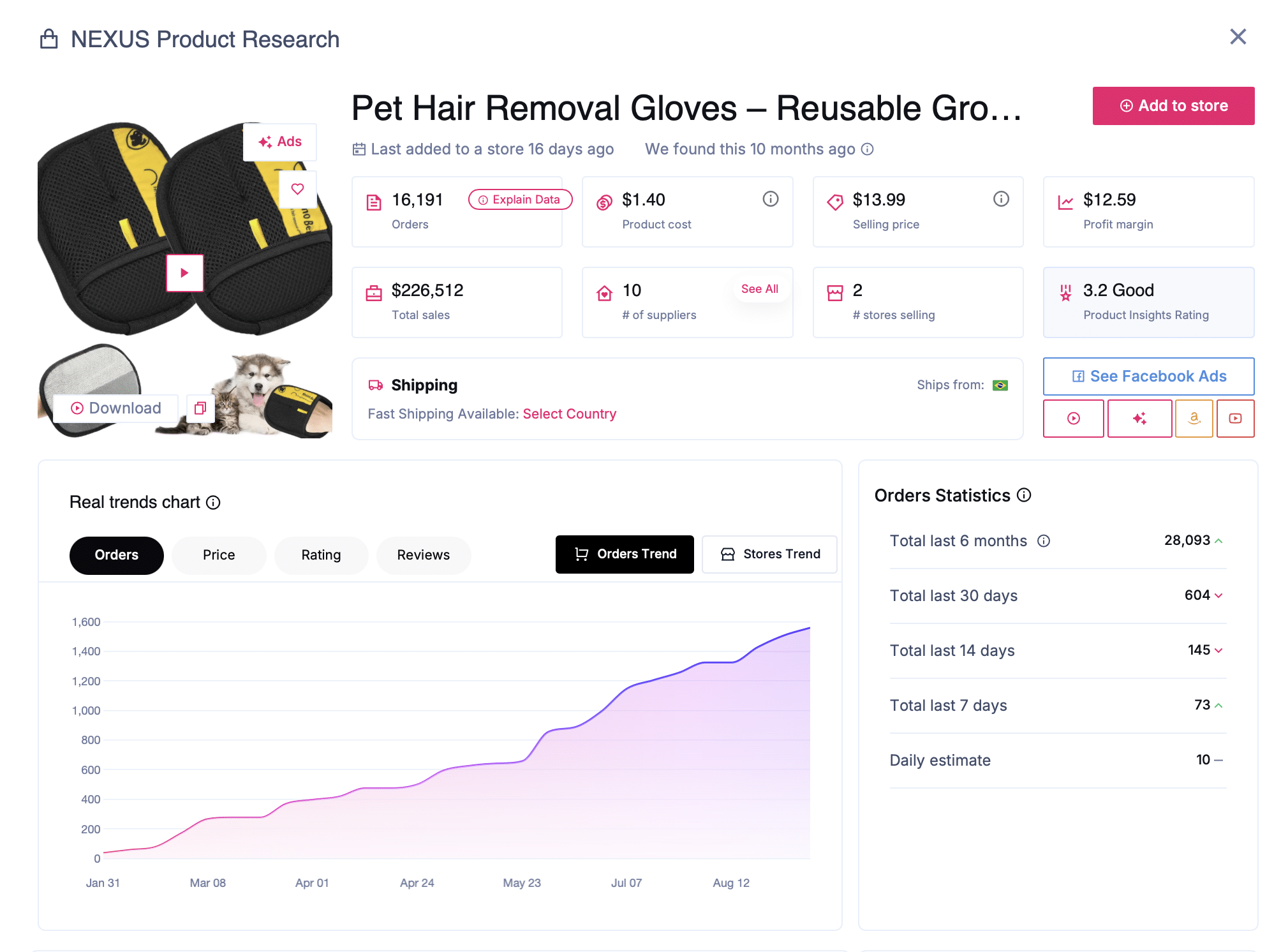
Here’s an example:
In this NEXUS example, pet-hair removal gloves show 604 orders over the last 30 days and 10 supplier options. These figures give you a starting point for investigating recent buying activity and comparing sourcing options before adding the item to your shortlist.
Read the figures together rather than relying on the rising chart alone. The 30-day order figure carries a downward indicator, so the screenshot should not be presented as proof of accelerating demand. Investigate the recent pattern before deciding whether to test the item.
The dashboard also displays a $1.40 sourcing price, a $13.99 selling price, and a $12.59 “profit margin.” That $12.59 is the difference between the two displayed prices, not verified take-home profit. Account for delivery, payment fees, advertising, and refunds before deciding whether the offer is viable.
“Pre-validated” should mean screened against existing market signals, not guaranteed to generate profitable sales in your store.
Explore winning products and choose a candidate to evaluate before importing it.
2. How Can You Check Whether Demand Is Still Active?
Use Google Trends to investigate the timing of interest in your shortlisted item. Compare the past 90 days, 12 months, and five years while keeping the destination country consistent. This approach helps you investigate whether attention is recent, recurring, or concentrated around a brief spike.
The chart measures relative search interest on a 0–100 scale, not sales or absolute search volume. A score of 100 marks peak relative popularity within the selected comparison, not 100 purchases or searches.
For the pet-hair example, investigate both the item’s name and the problem it addresses, such as “remove pet hair from sofa.” Look for supporting evidence of consistent demand elsewhere rather than approving a candidate because its chart briefly rises.
3. What Can Advertising Activity Tell You About a Product?
Review the advertisements associated with your shortlisted item to understand how sellers demonstrate it and position their offers. Sell The Trend’s Facebook Ads Explorer provides access to creatives, engagement information, and ad-duration signals, while its TikTok Viral Ads Explorer helps investigate demonstrations and promotional angles on that platform.
Cross-check active campaigns in Meta Ads Library, which makes active advertisements from advertisers available for inspection.
During your review, record independent sellers, fresh creative variations, and recent social media activity. Ask whether each demonstration explains a useful benefit or merely attracts attention.
Do not equate a large ad count with proven demand or profitable scaling. Treat advertising activity as a reason to investigate further, not a substitute for purchase evidence.
No title
Pro Tip: Count independent advertisers, not duplicate creatives. Ten advertisements from one store still represent one seller’s activity.
4. What Should You Learn From Reviews and Customer Conversations?
Read competitor reviews and speak with people who match your target audience to understand their needs and objections. Use customer surveys to gather current reactions from potential customers, including people outside your friends and family. Shopify recommends including respondents beyond your personal circle to reduce the risk of biased feedback.
Ask specific questions rather than “Do you like this product idea?” For the cleaning example, try: “What do you currently use?”, “What frustrates you about it?”, and “What would stop you ordering this at $40?”
Organize customer feedback around recurring pain points, such as ineffective cleaning, difficult maintenance, or uncertainty about suitable surfaces.
Your target customer might care more about protecting delicate upholstery than cleaning quickly. That distinction gives you a concrete claim to investigate through testing instead of assuming every buyer wants the same benefit.
5. How Can You Find an Offer That Competes?
Conduct competitor analysis by comparing three stores selling the same product or a close alternative. Examine their pricing strategies, demonstrations, bundles, delivery information, and support promises. Your goal is to identify a meaningful reason to choose your offer, not simply copy the lowest price or most polished website.
Sell The Trend’s Store Intelligence helps investigate best-selling items and store performance. Treat modeled revenue and sales data as estimates rather than access to a competitor’s verified accounts.
For search-focused competitor research, Ahrefs can reveal ranking keywords and estimated organic traffic data. Those estimates describe search visibility, not confirmed orders.
Look for market gaps you can genuinely address. For example, competing pages might omit fabric-compatibility information. Testing the item on relevant surfaces and publishing an accurate demonstration would provide a more useful advantage than changing the logo.
6. How Do You Calculate Whether the Margins Work?
Calculate how much each sale leaves before advertising. Include product cost, shipping cost, transaction charges, discounts, and a realistic allowance for refunds or replacements. This creates an acquisition ceiling based on your own offer, rather than a blanket markup rule that ignores the expenses involved in completing each order.
Per-order break-even acquisition cost = net order revenue − non-advertising variable expenses.
Consider this hypothetical pet-hair removal bundle:
Item
Illustrative amount
Revenue after discounts, excluding collected taxes
$40
Supplier charge
$10
Delivery expense
$5
Payment processing
$2
Refund and replacement allowance
$3
Amount remaining before advertising and fixed overhead
$20
In this example, spending $20 to acquire an order leaves nothing toward fixed overhead or profit. An acquisition target of $14 would leave a $6 contribution.
Compare plausible price points before committing to the test. When the numbers leave insufficient room, revise the bundle, sourcing arrangement, or positioning.
No title
Pro Tip: Recalculate using the destination and delivery service you intend to advertise, not the cheapest shipping option displayed on a supplier’s listing.
7. How Do You Verify the Item and Supplier Before Listing?
Order a sample and evaluate the entire product under the conditions your buyers will encounter. Check product quality, packaging, instructions, processing time, and delivery to your intended market. Use Sell The Trend’s supplier ratings, which consider item quality, shipping speed, and communication, to help narrow the supplier comparison.
For the reusable remover, test the surfaces you intend to mention in your description. Record whether it performs as expected, how easily it can be cleaned, and whether the packaging protects it adequately.
For a new design, a minimum viable product is a basic version that lets early adopters evaluate essential product features and provide feedback before further development. With an existing dropshipping item, apply that test-first approach through supplier samples rather than assuming you need to manufacture a prototype.
Reject or pause a candidate when the sample fails to support the claims you planned to make, then start your Sell The Trend free trial to quickly source and validate high-quality alternatives.
8. How Can You Test Interest Before Publishing a Listing?
Create a transparent pre-launch landing page that explains the product concept, shows the proposed price, and invites visitors to join a waitlist. This lets you gauge interest without presenting the item as available for immediate purchase. Shopify includes email-collection landing pages among its recommended approaches for investigating demand before launch.
For example, show an accurate demonstration, describe the intended use, and use a clear call to action such as “Join the launch waitlist.” Keep the displayed offer specific enough that visitors know what they are expressing interest in.
Run tightly limited paid ads or recruit relevant visitors through an existing audience. For an acquisition test, prioritize people who do not already know you, then evaluate existing followers separately so the two groups do not blur together.
Choose a spending limit and success criteria before the campaign begins. Small tests can gather behavioral evidence before a larger investment, but the result may still be inconclusive. Shopify’s testing guidance recommends small experiments and predefined measures rather than committing fully before evaluating the response.
Track these key metrics:
Measure
What it tells you
Ad click through rate
The proportion of impressions that produce clicks
Cost per click
Advertising spend divided by clicks
Visitor-to-email signup rate
The proportion of visitors who join the waitlist
For a hypothetical planning target, you might choose a 5–10% signup rate, equivalent to 20–40 signups from 400 visitors. This is an example target, not a universal benchmark or proof of future purchases.
Once you proceed to a limited release, Shopify Analytics can help you examine add to cart rate, checkout progression, and completed purchases. Keep those transactional results separate from waitlist signups.
A landing page helps test market demand for the proposed offer, but only actual transactions show whether visitors will pay.
What Are the Benefits of Product Validation Before Listing?
Product validation helps you avoid wasting money on weak candidates, improve your offer, and identify problems before committing to a larger launch. These key benefits give store owners a clearer basis for deciding what to test, revise, or reject instead of relying on enthusiasm alone.
How Does Validation Reduce Launch Risk?
Validation lets you address weak demand signals or an unsuitable offer before spending money on a full product launch. Testing first gives you an opportunity to change direction while your commitment is still limited, rather than discovering fundamental problems after investing in promotion.
For context, a 2021 study examined 83,719 US consumer packaged goods introduced between 2002 and 2009. It found that 25% were no longer purchased after one year, rising to approximately 40% after two years. These are historical retail findings, not Shopify failure rates or proof that skipping validation caused those failures.
How Does Validation Help Protect Profit Margins?
Validation makes your proposed price and expenses part of the selection decision, rather than an afterthought. It helps you distinguish an item that attracts buyers from an offer that can leave enough money after each sale to contribute toward overhead and profit.
For example, a hypothetical $35 order with $18 in non-advertising expenses leaves $17 for acquisition before fixed overhead. Paying $20 to acquire that order would create a $3 loss before overhead, giving you a clear reason to revise the offer before expanding promotion.
How Does Validation Improve Inventory and Supplier Decisions?
Dropshippers typically do not hold inventory, but they still need to monitor supplier availability and delivery reliability. The priority is selecting a manageable catalog and dependable fulfillment partners, rather than assuming that avoiding warehouse stock eliminates the business risks associated with unavailable items or delayed shipments.
Sell The Trend’s supplier ratings help you compare delivery speed, item quality, and communication, while automated inventory synchronization helps monitor availability after listing. For the pet-hair remover example, approve only the surfaces your sample performs well on and set delivery expectations your supplier can realistically meet.
No title
Pro Tip: Set your rejection rules before testing, such as an unacceptable sample defect or insufficient room for acquisition expenses, so excitement does not override the evidence.
How Does Sell The Trend Facilitate Effective Product Validation?
Sell The Trend combines AI-assisted discovery, expert selections, competitor insights, and supplier information in an all-in-one platform. This gives you a structured starting point for validating product ideas: choose a screened candidate, inspect its supporting evidence, and decide whether it deserves a sample and a limited test.
How Does NEXUS AI Bring Research Signals Together?
NEXUS AI supports predictive product research using 26+ data signals and filters for margin potential, competition, and supplier location. Combine those insights with Store Intelligence to examine competitor products, prices, and estimated revenue, then review advertising creatives to uncover opportunities for a more useful offer.
Use these signals to prioritize candidates, not to assume your store will match another seller’s results. For a broader introduction, explore our AI Dropshipping guide.
How Do Hand-Picked Winners Simplify Selection?
Hand-Picked Winners provides an expert-curated starting point with cost breakdowns, saturation information, supplier options, and prepared marketing copy. Instead of assembling a candidate’s details from scratch, you can review its supporting information and concentrate on whether the proposed offer suits your store and intended buyers.
For the pet-hair remover example, compare the supplied figures with your destination-specific supplier quote and sample results before approving it.
What Does Sell The Trend’s Research Show?
Sell The Trend’s State of AI Dropshipping 2026 report describes research-time reductions of up to 85% versus manual methods and up to 45% fewer failed product tests with structured validation. The figures come from company testing, anonymized user information, and comparisons of AI-assisted and manual workflows.
The report does not disclose a sample size or detailed testing protocol. Treat these as company-reported findings, not guaranteed improvements for your store.
You do not need to construct an online store before beginning research. Once a candidate passes your checks, Sell The Trend’s Shopify integration supports 1-Click Push to Store and order processing, connecting the research stage to a controlled launch.
Shopify Product Validation Checklist: Should You Test, Revise, or Reject?
Use this five-check framework to decide whether to test, revise, or reject a shortlisted item. The market validation methods above provide evidence, but your decision also depends on margins and fulfillment. Treat the checklist as a practical review, not a scoring system that predicts future sales.
Validation check
Question to answer before proceeding
Current demand
Do recent signals show market interest in this specific item, rather than attention to its broader category?
Buyer intent
Have people shown genuine interest after seeing the proposed price and delivery terms?
Competitive advantage
Can you offer a meaningful improvement instead of simply copying successful products?
Unit economics
Does each order leave room for acquisition expenses, returns, and a contribution toward overhead?
Fulfillment readiness
Have you tested a sample and checked whether the supplier can deliver the promised customer experience?
Use industry reports for category context, then examine evidence specific to the item and buyer group you intend to serve.
Test: Proceed to a limited launch when the evidence is promising, the sample is satisfactory, and the proposed economics support a controlled experiment.
Revise: Address a fixable weakness, such as unclear positioning, an unsuitable bundle, or an expensive delivery option, before testing again.
Reject or pause: Stop when serious quality, safety, fulfillment, or margin problems remain unresolved, regardless of encouraging engagement.
Hypothetical example: A pet-hair remover generates early interest, but your sample damages the upholstery it is supposed to clean. Pause that version rather than letting waitlist signups override the sample result, and test any replacement before offering it to buyers.
Frequently Asked Questions About Shopify Product Validation
Can I Validate a Product Without Publishing It on Shopify?
Yes. In the early stages, you can research existing offers, inspect samples, and collect reactions through a coming-soon page without making the item available to purchase. Shopify’s password page supports email collection while the rest of the store remains restricted, giving you a way to build a launch list.
What Are the Best Free Ways to Evaluate a Shortlisted Item?
After shortlisting with Sell The Trend, use free public ad libraries, marketplace reviews, search-trend checks, and conversations with likely buyers to challenge your assumptions. You do not need all the tools available; choose a few that answer different questions instead of collecting several versions of the same signal.
How Much Should I Spend on Product Validation?
Set a limit you can afford to lose and separate sample expenses from advertising tests. Work backward from the margin available on each order rather than copying another seller’s budget. For example, a hypothetical $60 campaign at $0.60 per visit buys 100 visits to examine product interest, not a guaranteed number of orders.
How Do I Know Whether a Product Is Too Saturated?
Do not reject an item simply because competitors exist. Compare delivered prices, advertising angles, and your ability to offer something meaningfully different. Separate attention to a particular brand from demand for an unbranded alternative, and pause when your only advantage would be an unsustainable discount.
Can Advance Orders or Crowdfunding Help Validate Demand?
Yes. Paid pre orders let customers commit before shipment, potentially bringing cash in before fulfillment while testing willingness to pay. Clearly state expected shipping dates, payment timing, and cancellation arrangements. This is a sales test, not a no-purchase landing-page test, and upfront receipts still need to cover delivery and possible refunds.
An actual purchase at the intended price is stronger evidence than a hypothetical survey response. Shopify suggests a 10% to 20% advance-order conversion range in its validation guidance, but treat that as an advisory target rather than a universal pass mark.
Crowdfunding can also provide backing before production when a campaign meets its funding conditions. Consider it for an original design, and check platform eligibility before assuming that an existing supplier item qualifies.
How Much Evidence Is Enough to Make a Decision?
Define the action you need to observe, then evaluate its frequency and cost. Shopify suggests 100 conversion events, such as orders or signups, as a testing target. Analyze conversion data separately for each action and traffic source; that event count alone does not guarantee a reliable conclusion.
For context, Baymard reports an average documented cart-abandonment rate of 70.22% across 50 studies. Basket activity should therefore not be treated as completed sales or used alone to confirm demand.
No title
Pro Tip: Record the visitor count, result count, spend, and offer for every test so that “20 signups” never appears without the information needed to interpret it.
Are Screened Dropshipping Products Guaranteed to Sell?
No. A screened candidate still needs to suit your buyers, price, and delivery promise. Evidence of product market fit develops through sales and customer satisfaction, not one popularity score; where relevant, repeat purchases provide further support, while a durable item may be better evaluated through continued use and recommendations.
What Should You Do Before Listing Your Next Shopify Product?
Start with Sell The Trend’s NEXUS AI or Hand-Picked Winners, then use the checklist to decide which candidate deserves a controlled launch. Understanding what is a winning product means treating candidates as opportunities to investigate rather than guarantees of profit—letting your own order results determine when to scale.
Make the next step a measured test with a defined budget, not an all-in bet. Start your Sell The Trend free trial and evaluate one candidate before adding it to your Shopify catalog.
Maria is a marketing specialist with hands-on experience in digital growth strategies and eCommerce.
As part of the Sell The Trend team, she has developed deep expertise in dropshipping through close work with product research, trend analysis, and go-to-market strategies used by successful online sellers.
Her content focuses on practical marketing insights, audience behavior, and data-driven decision-making to help merchants launch and scale with confidence.