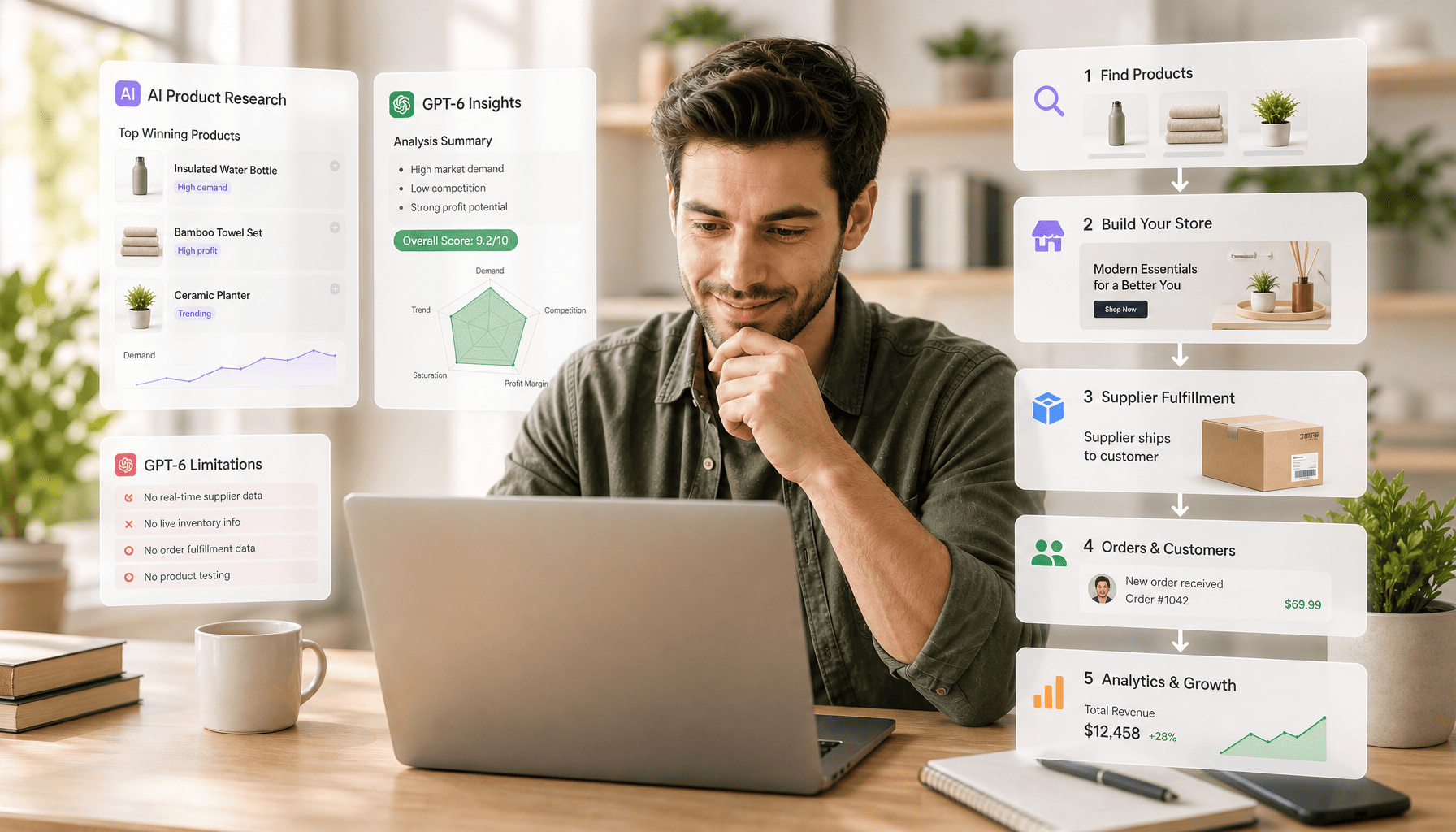
For high-performing AI dropshipping, GPT-6 can help you brainstorm, compare, and position products, but it cannot independently confirm live market movement. Integrating a specialized product research platform like Sell The Trend and its NEXUS AI adds structured demand, competition, and supplier signals. The strongest workflow uses both: one to interpret opportunities and the other to investigate them.
Key Takeaways
GPT-6 is useful for brainstorming, not verifying sales. It can generate product ideas, analyze customer needs, compare pricing strategies, and develop ad creative, but it cannot independently confirm live sales velocity or product demand.
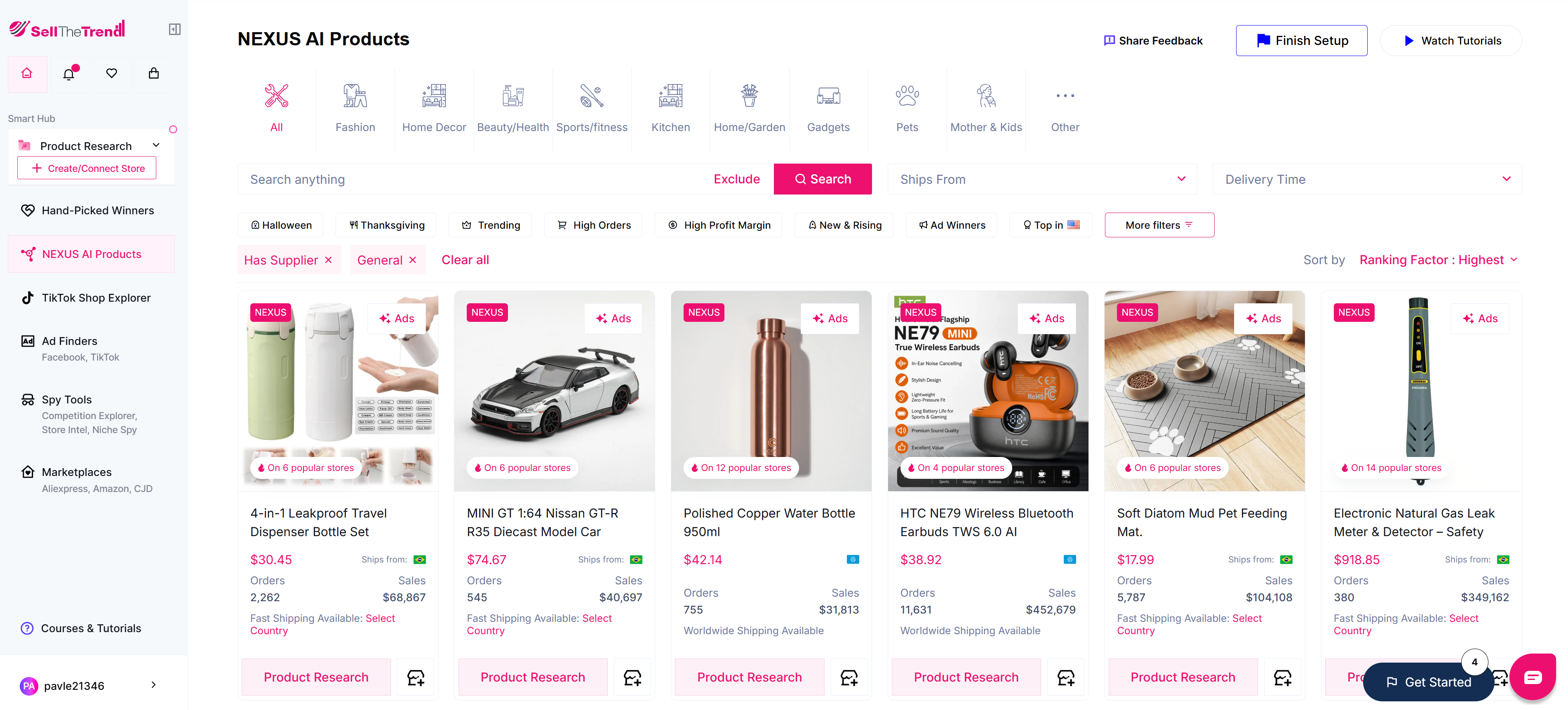
Sell The Trend’s NEXUS AI provides specialized product research data. It helps identify winning dropshipping products by examining demand signals, competition, product trends, and performance indicators.
Finding winning products requires multiple data sources. Product validation should consider consistent demand, market saturation, competitor activity, reliable suppliers, and realistic profit margins—not AI-generated predictions alone.
GPT-6 and dedicated product research tools work best together. Use NEXUS AI as your primary research tool for product discovery and quantitative insights, then use GPT-6 to evaluate positioning, customer objections, and marketing opportunities.
No AI tool can guarantee profitable products. Validate demand, calculate costs, and test products before committing significant ad spend. Strong research reduces uncertainty but cannot eliminate business risk.
Can GPT-6 Find Winning Dropshipping Products in 2026?
GPT-6 can help you identify promising product ideas and evaluate their appeal, but it cannot guarantee winning products. To validate demand, you still need current product research data: evidence of orders, sales velocity, market saturation, supplier availability, and realistic profit margins.
If you’re a beginner choosing your first niche, or an established seller deciding what to test next, this distinction matters. Confusing a convincing AI answer with proof of demand can mean spending money on the wrong niche.
This guide compares GPT-6 with Sell The Trend’s NEXUS AI, explains what each does best, and shows how to combine qualitative analysis with measurable signals. It’s a practical look at GPT-6 + NEXUS AI in dropshipping. For the broader business model, see our AI dropshipping startup guide.
How Is GPT-6 Different From a Dedicated Research Tool?
GPT-6 is a general-purpose assistant for reasoning, writing, and interpreting information. NEXUS AI is a dedicated product discovery engine built to examine ecommerce signals. ChatGPT can search the web or use connected tools when available, but those options do not turn its underlying model into a continuously updated database of verified orders.
Research task
GPT-6
Sell The Trend’s NEXUS AI
Generate product ideas
Strong at brainstorming and audience fit
Surfaces candidates from product and trend data
Assess market demand
Interprets information you supply or retrieve
Presents structured demand and trend signals
Compare competition
Explains patterns in supplied evidence
Supports product-level competition and saturation research
Review suppliers
Evaluates supplier criteria and trade-offs
Connects research to supplier options and shipping information
Draft ad creative
Generates hooks, scripts, and product descriptions
Offers complementary tools for discovering ad examples
Sell The Trend currently reports a catalog of 11 million products across 83 ecommerce niches, with NEXUS AI examining 26+ signals per product.
No title
💡Pro Tip: The comparison isn’t “smart AI versus old software.” Both are AI tools, but their roles differ: GPT-6 helps you make sense of information, while Sell The Trend’s tools are designed to gather specialized product research signals.
👉 Ready to go beyond AI-generated product ideas? Discover products backed by demand signals, competition insights, and predictive analytics. Start your 14-day free trial with Sell The Trend and explore NEXUS AI for yourself.
What Can GPT-6 Do Well for Product Research?
GPT-6 is useful for customer reasoning, market research planning, and turning scattered observations into testable hypotheses. It can compare product categories, organize research questions, and explain why different audiences might respond to the same product. Think of it as an analyst for the evidence you collect, not the source of all the evidence.
GPT models rely on pre-trained knowledge rather than high-frequency e-commerce transactional feeds. That describes their built-in knowledge, not every possible workflow: web browsing, uploaded files, and authorized connections can give ChatGPT additional, more current context.
AI-generated product ideas may not reflect current market demand. An interesting product suggestion becomes a business opportunity only after you check observable demand, competition, costs, and the people likely to buy it.
How Can GPT-6 Stress-Test Product Ideas and Audiences?
GPT-6 can compare customer needs, objections, and positioning angles before you run paid ads. Give it one product, a target audience, a plausible selling price, and competing alternatives; then ask it to challenge your assumptions rather than praise the concept.
For example, imagine testing a portable pet water bottle. Ask: “Which buyer problems does this solve, what alternatives already exist, and what would make a shopper choose a higher-priced version?” The answer may reveal useful angles, but it does not establish current sales velocity.
For product research specifically, the division of labor is clear: use NEXUS AI to find and screen candidates, then use GPT-6 for qualitative product analysis. For more ideas about where AI fits, see our guide to AI tools for dropshipping.
No title
💡Pro Tip: Ask GPT-6 for three reasons not to launch the product. A useful research tool should uncover weak assumptions, not simply agree that every concept is a winner.
Can GPT-6 Improve Ad Creative and Pricing?
GPT-6 can evaluate pricing strategies and marketing strategies. Give it product cost, shipping, expected fees, target profit margins, and the audience you want to reach; it can show how different price points affect your business model, provided the inputs are accurate.
GPT-6 serves as a creative co-pilot for building marketing funnels and email sequences. It can write ad creative variations, landing-page headlines, and product descriptions, or propose tests for different buyer motivations.
But strong copy cannot rescue a product with weak demand. Before scaling ad spend, compare those ideas with real advertisements, customer reactions, and supplier economics instead of assuming a polished campaign will make the product profitable.
What Can’t GPT-6 Verify on Its Own?
GPT-6 cannot independently establish whether a particular listing has genuine customer purchases, whether a supplier will ship on schedule, or whether today’s interest will persist. It can analyze reliable evidence you give it, but that analysis should not be mistaken for direct access to private transactions or fulfillment records.
The key limitation is evidence, not intelligence. Even detailed AI analysis becomes speculative when the underlying order counts, ad activity, supplier quotes, or trends are missing or outdated.
Can ChatGPT See Live Sales, Ad Spend, and Inventory?
ChatGPT lacks access to live sales data. More precisely, an ordinary unconnected chat does not have direct access to private merchant order databases; authorized integrations or uploaded reports can change which specific information it can analyze.
GPT-6 lacks a native continuously updated database of live supplier inventory. That does not prevent it from interpreting a supplier feed you provide, but it cannot certify stock levels, shipping speed, or inventory freshness merely by generating an answer.
No title
💡Pro Tip: Dedicated tools can supply structured data that GPT-6 cannot independently possess. Treat their estimates and analytics as decision signals, however, not guaranteed profit or audited access to every competitor’s sales. The next step is to examine how NEXUS AI gathers and presents those signals.
How Does Sell The Trend’s NEXUS AI Discover Winning Products?
Sell The Trend’s NEXUS AI is an AI-powered product discovery engine that analyzes 26+ data points per product, helping sellers identify emerging opportunities across 11 million products and 83 ecommerce niches. Unlike GPT-6, which primarily interprets information, NEXUS AI is designed to identify products using structured ecommerce data, predictive analytics, and competition signals.
AI-powered platforms can analyze millions of products simultaneously. More precisely, these platforms process large product databases through automated analysis rather than manually inspecting each listing. This allows sellers to narrow down thousands of potential opportunities to a manageable shortlist.
Specialized research tools are designed to surface products and analyze store trends. NEXUS AI combines product performance indicators, supplier information, and competitive signals to identify promising dropshipping products across multiple marketplaces.
For example, someone researching home improvement products can filter by product categories, competition levels, supplier location, and potential profit margins. Rather than relying on AI-generated suggestions, they can examine products already showing signs of market demand.
This matters because finding winning products isn’t simply about identifying something interesting. It’s about determining whether enough customers want it, whether competition is manageable, and whether selling it makes financial sense.
No title
💡Pro Tip: According to Sell The Trend’s State of AI Dropshipping 2026 report, AI product research can reduce research time by up to 85%. This figure comes from the company’s internal benchmarking of AI-assisted versus manual research workflows, not an independently established industry-wide average.
👉 Want to explore emerging opportunities? Start with Sell The Trend’s dropshipping product finder guide to understand how AI-driven product discovery helps sellers identify candidates worth testing.
Which NEXUS AI Signals Reveal Product Demand and Sales Velocity?
NEXUS AI evaluates multiple performance indicators to help sellers distinguish emerging products from established or oversaturated listings. Important signals include order momentum, sales velocity, competition levels, engagement patterns, and supplier availability. Together, these metrics provide a more useful picture of potential demand than an isolated popularity score.
Sales velocity refers to how quickly products sell over a particular period. A product with accelerating orders may deserve investigation, while one with declining momentum could indicate fading demand.
Dedicated tools gather real-time sales metrics and shipping time data. However, the available information depends on each tool’s data sources: some figures are marketplace observations or modeled estimates rather than independently verified merchant transactions.
Dedicated tools provide direct feedback on product saturation and engagement metrics. Sellers can use these indicators to compare product ideas before committing to advertising or inventory-related expenses.
Consider two hypothetical products. Product A has experienced a brief burst of social media engagement but limited evidence of repeat orders. Product B shows steadier order momentum across several weeks, with multiple stores continuing to promote it.
Product B may represent a more sustainable opportunity, although neither pattern guarantees sales. The objective of product research is to identify stronger evidence, not eliminate uncertainty completely.
How Can You Evaluate Market Saturation Before a Product Peaks?
Market saturation describes how crowded a product’s competitive landscape has become. Sell The Trend’s NEXUS AI uses saturation indicators alongside demand and performance trends to help sellers identify opportunities that may have room to grow. Lower saturation is attractive only when sufficient buyer interest also exists.
For instance, finding a product sold by relatively few competitor stores can be encouraging. But limited competition could indicate weak demand rather than an overlooked opportunity.
A stronger candidate combines growing order momentum, manageable competition, and pricing that supports healthy profit margins. It also helps to compare different suppliers and determine whether the same product is widely available elsewhere.
You may encounter claims such as “Sell The Trend’s NEXUS tool identifies products with 200%+ engagement growth.” However, this specific threshold isn’t established in the published feature documentation. Sellers should evaluate available engagement and sales trends rather than treating one percentage as proof of demand.
Instead, compare actual engagement changes with sales indicators and competitor activity. A product attracting attention without meaningful buying signals may be less promising than one showing moderate engagement alongside consistent demand.
No title
💡Pro Tip: Use Sell The Trend’s Low Saturation Products report to shortlist products with lighter competition, then investigate their order momentum and supplier options before testing.
👉 Find promising products before the market gets crowded. Stop relying on guesswork. Use NEXUS AI to investigate emerging trends, track product performance, and explore low-competition opportunities. Try Sell The Trend free for 14 days.
How Can You Validate Demand Before Listing a Product?
Product validation means checking whether customers are likely to buy a product at a price that supports a viable business. Effective validation combines observable demand, competitor activity, supplier feasibility, and profitability. Rather than trusting one AI recommendation, sellers should compare independent signals before spending money on advertising.
Validating products requires checking at least three demand signals. This is a practical research guideline rather than a universal industry requirement; examining more relevant evidence can improve your confidence.
A useful starting framework includes three signals: sustained product interest, observable selling activity, and competing offers that appear commercially viable. Neither advertising activity nor social engagement alone proves profitable sales.
Successful products show consistent demand rather than short-lived spikes. This is generally a desirable pattern for evergreen products, although seasonal products and short-lived viral products can also succeed when timing and execution are appropriate.
Imagine evaluating a compact kitchen organizer. NEXUS AI surfaces the product based on its performance indicators, and you examine competing listings, recent customer reviews, and pricing. GPT-6 can then help assess buyer objections and suggest positioning angles.
The final decision should reflect the evidence rather than the AI-generated description. Our Shopify product validation guide explains how to assess demand, supplier reliability, and profitability before launching.
Can Google Trends Confirm Consistent Product Demand?
Google Trends helps identify sustainable product interest over time. It shows changes in relative search interest, allowing sellers to investigate whether a product category is growing, stable, or seasonal. However, search interest is not equivalent to completed purchases, so Google Trends should complement, not replace, specialized product research data.
Start by checking the product’s search history over the past 12 months. Then compare a longer period, such as five years, to identify recurring seasonal patterns or lasting increases in interest.
Google Trends normalizes its results on a scale from 0 to 100 for the selected search terms, geography, and timeframe. A score of 100 represents peak relative interest within that comparison, not 100 searches or a confirmed sales volume.
For example, a portable fan might show repeated summer peaks, while an ergonomic desk accessory could demonstrate relatively consistent interest throughout the year.
The stronger workflow begins with NEXUS AI to identify products showing ecommerce demand signals, then uses Google Trends to investigate broader search behavior. For additional techniques, see our guide to finding trending products using AI.
What Should You Check Before Approving a Product for Testing?
A useful product validation checklist should combine demand, competition, pricing, and fulfillment evidence before a seller invests in promotion. The purpose is to decide whether a product deserves a small, controlled market test—not to declare it a guaranteed winner.
Use these five checks:
Demand: Does the product show sustained interest, meaningful order activity, or improving sales velocity?
Competition: Are competing offers growing, and is there room to differentiate through price, quality, or positioning?
Profitability: After product cost, shipping, transaction fees, returns, and estimated ad spend, can the product support reasonable profit margins?
Suppliers: Are reliable suppliers available with acceptable shipping speed, fulfillment terms, and stock levels?
Customer fit: Can you identify a specific business opportunity, target audience, and persuasive reason to purchase?
A practical approach combines both GPT-6 and specialized tools for product research workflows. Use Sell The Trend’s NEXUS AI to discover and investigate candidates, then let GPT-6 challenge your positioning, marketing assumptions, and launch strategy.
No title
💡Pro Tip: For a more detailed process, explore our AI-assisted product research system playbook. The next step is examining competitor stores, advertising activity, and supplier information to determine whether your shortlist holds up under closer scrutiny.
How Does Competitor Analysis Help Validate Winning Products?
Competitor analysis helps dropshippers understand which products other businesses promote, how they position their offers, and whether demand may justify further testing. Combining Sell The Trend’s Store Intelligence with advertising research provides a clearer picture of competition, pricing, and marketing activity than relying on GPT-6-generated recommendations alone.
Competitor analysis reveals validated demand through active advertising. More precisely, active ads confirm that businesses are investing in promotion, not that customers are necessarily buying. Repeated campaigns, sustained activity, and supporting sales estimates provide stronger evidence than a single advertisement.
Competitor analysis can reduce testing costs by leveraging existing market data. Studying what multiple brands are promoting helps narrow your shortlist before spending money, although copying a competitor’s strategy doesn’t guarantee similar results.
What Does Facebook Ad Library Reveal About Competitor Products?
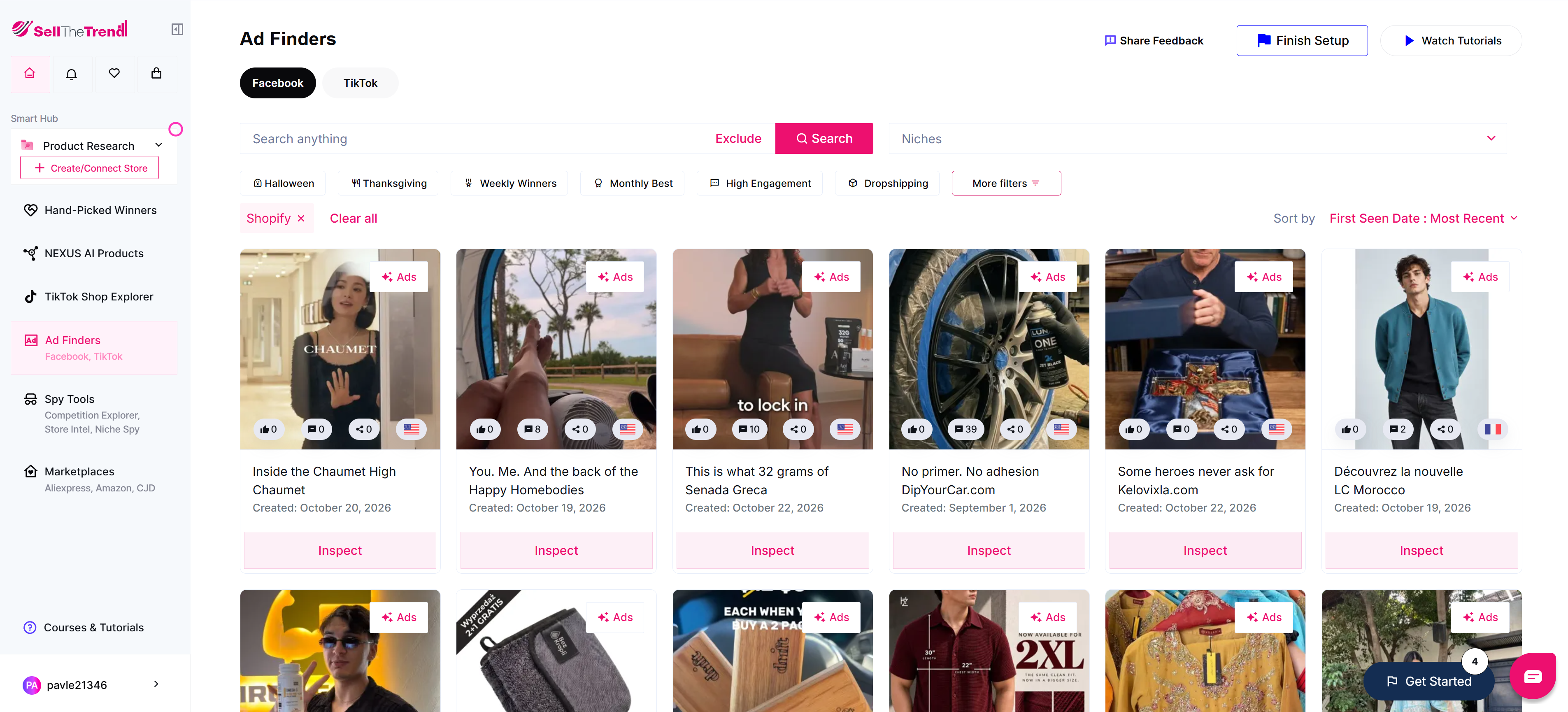
Facebook Ad Library shows active ads from competitors for market validation. You can examine advertising creatives, messaging, launch dates, and the businesses running campaigns. However, ordinary commercial ads generally don’t disclose actual conversions, profitability, or advertising budgets, so visible activity should be treated as evidence of promotion rather than confirmed sales.
Start by searching the Facebook Ad Library for a product category, relevant keywords, or a competing brand.
Examine active ads for recurring selling points, repeated product demonstrations, and different ad creative variations. If several brands are promoting the same product, you have evidence of competitive interest worth investigating.
Pay particular attention to how long successful-looking ads have remained active. Long-running campaigns can suggest continued advertiser interest, but the ad library cannot independently establish whether those campaigns are profitable.
Sell The Trend’s Facebook Ads Explorer complements this manual research by organizing advertising signals alongside other product discovery features. You can compare active ads, examine engagement patterns, and investigate products through NEXUS AI rather than treating each advertisement as an isolated opportunity.
No title
💡Pro Tip: Save three advertisements promoting comparable products. Ask GPT-6 to compare their opening hooks, emotional appeals, and customer objections. Then verify whether the promoted products show meaningful demand in NEXUS AI.
How Can TikTok Creative Center Reveal Emerging Product Trends?
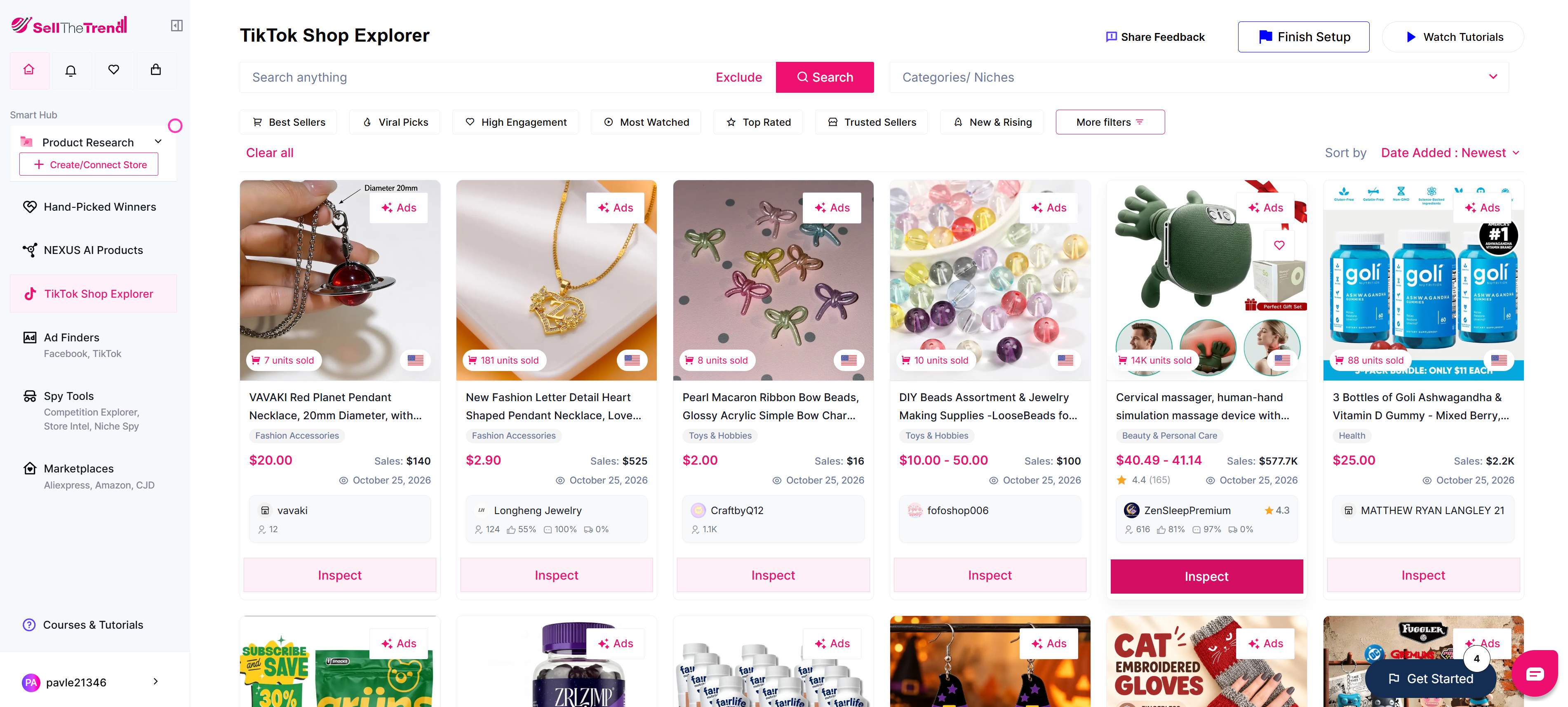
TikTok Creative Center helps sellers investigate viral products, advertising formats, and changing consumer interests. Its Top Ads dashboard features high-performing creatives, while trend exploration highlights popular content and audience behavior. Combined with Sell The Trend’s TikTok Ads Explorer, these resources can support product validation without confusing social media engagement with confirmed purchases.
The TikTok Creative Center allows advertisers to explore examples using filters such as region, industry, and campaign objectives. Its Top Ads dashboard also provides selected advertising performance indicators.
A practical approach begins with NEXUS AI identifying promising products. You can then examine relevant TikTok campaigns to understand which demonstrations, storytelling formats, and customer benefits attract attention.
For example, a cleaning accessory may generate strong engagement because its demonstration is visually satisfying. That doesn’t automatically mean buyers will pay enough to support healthy profit margins.
Compare the product’s engagement with order momentum, competition, and pricing before testing. Our guide to spying on dropshipping stores using AI explains how advertising research fits into a broader competitive investigation.
What Can Store Intelligence and Other Competitor Tools Actually Measure?
Sell The Trend’s Store Intelligence analyzes competitor stores to reveal product catalogs, estimated revenue, product rankings, pricing patterns, and advertising activity. These insights help sellers identify products worth investigating, but revenue and sales estimates are modeled indicators, not verified access to a competitor’s private transaction records.
Tools like Commerce Inspector show competitors’ best sellers and traffic sources. Commerce Inspector was rebranded as Shine Commerce, and its store analytics use available observations and estimates rather than unrestricted access to merchant accounts.
Similarly, Dropship.io tracks competitor ad spend and sales data for product validation. Its documented advertising tools include spend estimates and EU advertising insights, but these figures should not be interpreted as complete, independently verified global advertising expenditure or actual private sales records.
Dedicated dropshipping tools pull backend store orders and sales volume histories. This is accurate for authorized store management integrations; competitor intelligence tools generally rely on public signals and modeling instead.
Dropshipping tools track live store orders and monitor daily order volumes when connected to a seller’s own store. Dedicated research tools can track live store orders and ad spend where authorized connections or accessible advertising information permit it. These are distinct from estimated competitor metrics.
For dropshippers comparing product categories across multiple marketplaces, Sell The Trend’s Store Intelligence provides a practical starting point.
No title
💡Pro Tip: Select three competitor stores selling similar products. Compare estimated sales activity, pricing, active ads, and product selection before choosing which opportunity deserves further testing.
👉 See what your competitors are selling. Explore competitor stores, investigate trending products, and uncover opportunities with Sell The Trend’s research tools. Start your 14-day free trial and turn competitor insights into smarter product decisions.
How Can You Find Reliable Suppliers for Winning Products?
Reliable suppliers are essential because shipping delays, poor product quality, and unexpected stock shortages can undermine even promising products. Sell The Trend’s AI Supplier Finder supports supplier research through product matching and supplier information, helping sellers compare fulfillment options after identifying potential winners through NEXUS AI.
84% of dropshippers cite finding reliable suppliers as a challenge. This statistic appears in published industry compilations, including ZIK Analytics, but the underlying survey methodology is not sufficiently documented to establish it as a representative industry-wide finding.
Supplier reliability impacts inventory shortages and delivery performance. A vendor with inconsistent stock levels can cause canceled orders, while slow shipping can increase complaints, refund requests, and customer acquisition costs.
AI tools cannot verify supplier reliability or shipping timelines. More precisely, they can analyze available supplier ratings, shipping estimates, and connected records, but cannot guarantee that a particular order will arrive on time.
No title
💡Pro Tip: Before choosing between different suppliers, investigate product quality, warehouse location, shipping speed, return policies, and fulfillment history. Ordering samples provides evidence that neither GPT-6 nor a research dashboard can fully replace.
How Should You Calculate Profit Margins Before Spending on Ads?
Products should have a minimum 30% profit margin after all costs. Treat this as a suggested target rather than a universal requirement: viable margins vary by niche, acquisition strategy, overhead, and customer lifetime value. What matters is whether revenue consistently exceeds the full cost of acquiring and fulfilling orders.
Consider this hypothetical sale:
Cost component
Amount
Selling price
$50
Product cost
$15
Shipping
$5
Payment processing
$2
Expected refunds allowance
$3
Advertising cost per order
$10
Contribution after these costs
$15 (30%)
This example leaves $15 per order, but fixed overhead, taxes, and other unlisted expenses may reduce the final net profit.
GPT-6 can calculate scenarios and compare price points, while NEXUS AI helps investigate product costs and supplier options. Together, they can support better profitability decisions before paid ads begin.
The important question isn’t simply whether a product is trending. It’s whether sufficient demand exists at a selling price that leaves room for advertising, fulfillment, and sustainable profit.
Which Products Deserve Further Testing After Competitor Research?
The strongest candidates combine credible demand signals, manageable competition, reliable fulfillment, and realistic margins. Before launching, compare several products against the same criteria rather than selecting whichever has the most attractive ad creative or highest social media engagement.
For example, two kitchen accessories might show similar advertising activity. But one may have multiple dependable suppliers, steadier sales velocity, and a better contribution margin, making it the more attractive test candidate.
Use Sell The Trend’s NEXUS AI as your primary research tool to identify products, then investigate competitors, suppliers, and customer interest. GPT-6 can help challenge your assumptions and organize the evidence, but the decision should remain grounded in measurable results.
Once you’ve narrowed the shortlist, the final step is creating a repeatable workflow that combines GPT-6 with dedicated research tools while controlling research costs and testing risk.
How Do You Combine GPT-6 and NEXUS AI Into One Product Research Workflow?
The most effective approach uses Sell The Trend’s NEXUS AI for product discovery, then GPT-6 for qualitative analysis and marketing decisions. NEXUS AI helps identify products using demand signals, competition indicators, and supplier information, while GPT-6 evaluates customer motivations, pricing strategies, and potential weaknesses before you invest in testing.
Here’s a practical five-step workflow for finding winning dropshipping products:
Discover products with NEXUS AI. Choose relevant product categories and filter opportunities by trend data, sales velocity, competition, and supplier availability. Prioritize products with evidence of consistent demand rather than relying exclusively on viral products.
Investigate competitor activity. Use Sell The Trend’s Store Intelligence, Facebook Ad Library, and TikTok Creative Center to examine competitor stores, active ads, and ad creative. Compare multiple brands promoting similar products to understand market positioning.
Validate demand using multiple data sources. Examine product research data, Google Trends, and available marketplace indicators. Check whether demand extends beyond a brief engagement spike and whether the same product sells across different marketplaces.
Analyze profitability and supplier reliability. Compare product cost, shipping expenses, expected ad spend, and competing price points. Verify stock levels and delivery expectations with different suppliers before deciding whether a product can support healthy profit margins.
Use GPT-6 to develop your marketing approach. Provide your research findings and ask GPT-6 to evaluate customer objections, identify product differentiators, and generate advertising concepts. Test those recommendations against real customer responses.
Dedicated dropshipping tools connect directly to live APIs and social media ad libraries. However, integrations vary: some tools use authorized APIs, while others analyze publicly available information or licensed datasets. Access to an advertising library does not automatically include private conversion or spending data.
AI tools can reduce product research time by up to 85%. This figure comes from Sell The Trend’s internal 2026 research, comparing AI-assisted workflows with manual methods. Individual results will vary.
No title
💡Pro Tip: Create a simple evaluation sheet for every shortlisted product. Record demand signals, competition, estimated profit margins, and supplier risks. Then ask GPT-6 to identify missing evidence before approving the product for testing.
👉 Put your product research workflow into action. From discovering winning products to researching suppliers and automating fulfillment, Sell The Trend brings everything together. Start your 14-day free trial today and take your next product idea from research to launch.
Can You Do Dropshipping Product Research With Free AI Tools?
Using GPT-6 with free resources aids in investigating demand before paying for a tool subscription. ChatGPT’s free plan, Google Trends, Facebook Ad Library, and TikTok Creative Center can support early market research. However, these resources do not provide all the tools needed for comprehensive product discovery, supplier verification, and store automation.
A completely free research workflow can help beginners explore product ideas, compare broad trends, and study successful ads. But it usually requires more manual research and offers limited access to structured sales estimates or integrated supplier information.
A free plan may also restrict AI usage or access to advanced research features. Similarly, a basic plan from a specialized research platform may impose limits on searches, product listings, or connected stores.
AI cannot track real-time ad spend or market velocity without access to suitable external information. A standalone GPT-6 conversation cannot independently verify these metrics, while specialized platforms may supply current observations or estimated advertising activity.
For sellers managing an active business, Sell The Trend’s all-in-one platform connects predictive product research with a built-in store builder, supplier automation, inventory synchronization, and order fulfillment.
The advantage isn’t simply having more features. It’s reducing the need to move between disconnected tools while researching, listing, and managing dropshipping products.
Which Research Option Is Best for Your Dropshipping Business?
The right research option depends on your experience, budget, and business requirements. GPT-6 is useful for developing ideas and marketing strategies, while NEXUS AI focuses on structured product intelligence. Ecommerce businesses combining both can investigate opportunities more thoroughly without expecting either tool to guarantee profitable results.
Your situation
Recommended approach
Exploring dropshipping with no research budget
ChatGPT and free public research resources
Looking for products with measurable demand signals
Sell The Trend’s NEXUS AI
Studying competitor advertising and store performance
NEXUS AI, Store Intelligence, and ad research tools
Developing product descriptions and marketing funnels
GPT-6
Managing discovery, suppliers, and fulfillment together
Sell The Trend’s integrated platform
Scaling an established store
NEXUS AI for research, GPT-6 for analysis, followed by controlled testing
Successful dropshippers should also consider their product mix. High-ticket products may require stronger trust signals and more detailed buyer education, while inexpensive seasonal products may depend more heavily on timing and acquisition costs.
Research should also extend into secondary markets when relevant. Demand, shipping availability, and competitive pricing may differ significantly between countries.
The dropshipping market was valued at $401 billion in 2026. More precisely, The Business Research Company estimated the global market would reach $401.41 billion in 2026; this is a market-size estimate, not a finalized measure of actual 2026 sales.
As the market evolves, successful dropshippers need evidence-based decisions rather than relying on generic AI-generated recommendations.
FAQ
Can GPT-6 find winning dropshipping products?
GPT-6 can generate product ideas and analyze market opportunities, but it cannot independently verify live sales or demand. Dedicated product research tools provide the additional data needed for product validation.
Is NEXUS AI better than ChatGPT for product research?
NEXUS AI specializes in product discovery, demand signals, and competition analysis. GPT-6 excels at evaluating product ideas, understanding customers, and creating marketing strategies. Using both provides a more complete research workflow.
How do you validate a winning dropshipping product?
Check sales velocity, market demand, competitor activity, supplier reliability, and profit margins. Using multiple data sources helps identify promising products before investing in advertising.
Can you research dropshipping products for free?
Yes. ChatGPT’s free plan, Google Trends, Facebook Ad Library, and TikTok Creative Center can help you investigate product ideas, although specialized tools provide additional ecommerce data.
Can AI product research tools guarantee profitable products?
No. AI tools can identify trends and potential opportunities, but success depends on actual customer demand, competition, pricing, supplier performance, and effective marketing.
Conclusion: What’s the Best Way to Find Winning Products in 2026?
The best approach combines specialized ecommerce data with thoughtful AI analysis. Use Sell The Trend’s NEXUS AI to discover products and examine performance signals, then use GPT-6 to evaluate positioning, customer needs, and marketing ideas. Validate suppliers, demand, and profitability before committing significant advertising spend.
Neither GPT-6 nor any other AI product research tool can guarantee success. However, combining product intelligence with careful analysis helps replace assumptions with evidence and creates a more repeatable research process.
Sell The Trend’s predictive product research, competitor intelligence, supplier automation, and built-in store builder also make it useful beyond the initial discovery stage.
👉 Ready to find winning dropshipping products using real research signals instead of guesswork? Start your Sell The Trend 14-day free trial to explore NEXUS AI, investigate trending products, compare suppliers, and discover opportunities for your next product test.
Lisa is an eCommerce and digital marketing specialist with over 6 years of experience helping online businesses grow through data-driven strategy and hands-on execution.
She has worked across dropshipping and direct-to-consumer channels, focusing on product research and performance marketing. At Sell The Trend, she creates practical, research-backed content to help merchants make confident decisions.