Created: 9 September 2026 Updated: 11 September 2026
Contents
AI store builders, including Sell The Trend’s AI dropshipping platform, are ecommerce tools that use artificial intelligence to automate parts of creating and configuring an online store. Depending on the platform, they can generate store layouts, product pages, product descriptions, product imports, and other storefront elements, reducing the manual work required to launch an ai dropshipping store.
For dropshippers, the biggest advantage is speed. Instead of spending days or weeks designing a storefront and adding products manually, sellers can use AI assisted tools to create a starting point much faster. However, an AI store builder does not guarantee sales or profitability. Product demand, supplier reliability, pricing, marketing, and customer experience still require human decisions.
If you are learning how to start dropshipping, an ai tool can reduce the technical work involved in getting your first store online. This gives you more time to focus on product research, validation, marketing, and testing.
An AI store builder is software that uses artificial intelligence to automate parts of ecommerce store creation. It can help with tasks such as website design, product imports, product descriptions, page creation, and storefront customization.
For dropshipping, some platforms go beyond website creation by connecting store building with product research, supplier sourcing, inventory management, and order automation. To ensure you have profitable items to sell, AI agents scan trending market data in real time for product sourcing.
Who should use an AI store builder?
AI store builders are particularly useful for beginners, dropshippers testing multiple product ideas, and sellers who want to reduce the tech skills needed to create an ecommerce storefront.
They can be less suitable for businesses that require highly customized functionality, complex integrations, or complete control over every aspect of the development process. If you want to bypass the learning curve and start selling quickly, automation is key. AI tools can analyze market signals to identify winning products, giving new sellers a massive advantage.
What can an AI store builder automate?
Depending on the platform, an AI store builder may automate:
Store design and layout
Product page creation
Product descriptions and titles
Product imports
Image and content placement
Mobile friendly formatting
Store customization
inventory synchronization
Pricing workflows
Some order and fulfillment tasks
The exact capabilities vary between platforms, so sellers should evaluate the features rather than assuming every AI store builder provides the same level of automation. As an added benefit, automation helps maintain healthy margins and reduces pricing chores.
What Is an AI Store Builder?
An AI store builder is an ecommerce platform or tool that uses artificial intelligence to simplify the process of creating an online store. Instead of manually designing every page, writing product descriptions, and entering product information, sellers can use AI to automate or assist with these tasks in just a few clicks.
Traditional store creation often requires several separate activities. A seller may need to choose a shopify theme, customize the layout, create product pages, write descriptions, import products, configure navigation, and optimize the site for mobile devices.
AI store builders reduce much of this manual work by generating or assisting with these elements automatically. This means you do not need formal design skills to launch.
For dropshipping, the concept can go further. Some platforms connect store creation with product discovery, supplier tools, pricing, inventory, and order management.
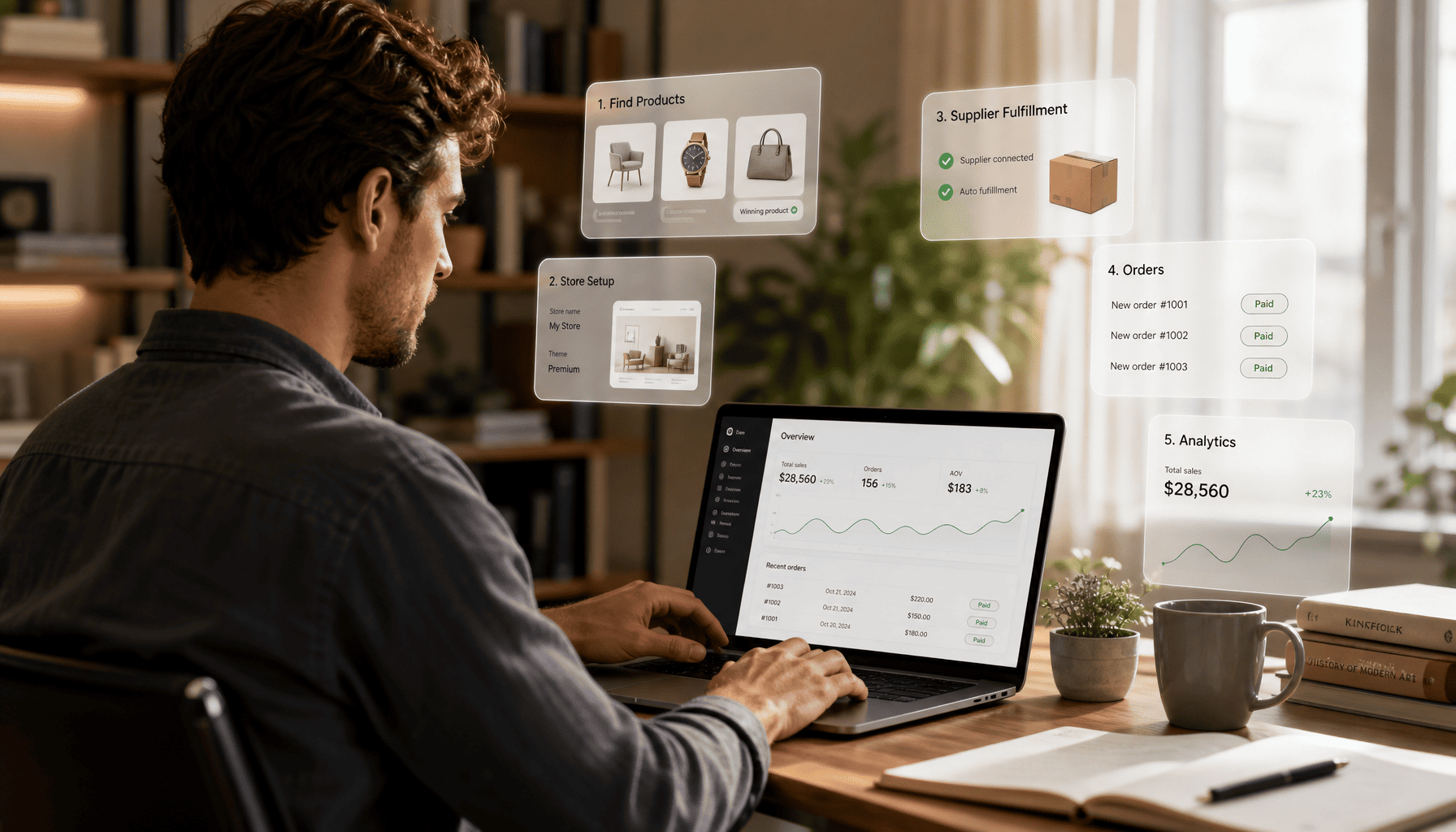
That creates a broader workflow: Discover > Validate > Build > Launch > Automate.
This is important because building a free store is only one part of starting a dropshipping business.
How Does an AI Store Builder Work?
The exact process varies between platforms, but most AI store builders follow a similar workflow.
1. Choose a product, niche, or store concept
The seller starts with a product, product category, niche, or business idea. Some platforms can also help identify products before the store is created. This is particularly useful for dropshippers who want to connect product research with store creation. For instance, ForgeBuilder generates stores from text prompts instead of product URLs.
2. Generate the store structure
The AI creates or recommends elements such as homepage layouts, product pages, navigation, sections, banners, calls to action, and basic branding elements. The goal is to provide a functional starting point without requiring the seller to build every component manually. This helps establish a strong brand identity right away.
3. Import products
On supported platforms, product information can be imported instead of being entered manually. To speed up the process, DropMagic generates complete, multi-page Shopify stores from a single product link. Depending on the integration, this may include product names, images, descriptions, variants, supplier information, pricing, and inventory information.
4. Generate product copy
AI can create product titles, descriptions, benefits, and other ecommerce copy based on the available product information. However, sellers should review AI generated content before publishing it. Product claims, specifications, shipping information, and pricing should always be checked against reliable source information to ensure you have optimized product pages.
5. Customize the storefront
AI creates the starting point, but the seller remains responsible for the final store. You can change colors, fonts, images, product information, pricing, page sections, branding, and navigation. This allows sellers to use automation without giving up control. Your entire store is fully customizable, letting you customize specific design elements easily.
6. Connect ecommerce and fulfillment tools
Depending on the platform, the store can be connected with ecommerce, supplier, inventory, payment, and fulfillment systems. This seamless setup process ensures there are no hidden fees when connecting integrations.
7. Review and launch
Before launching, sellers should test the complete customer journey. That includes checking the product page, mobile experience, checkout, pricing, shipping information, payment configuration, and fulfillment process to prepare for your first sale.
What Features Should an AI Store Builder Have?
The core features of an AI store builder generally include automated design, product setup, copy generation, product importing, mobile optimization, and customization.
Feature
What it does
AI store design
Creates or assists with storefront layouts
Product page generation
Helps create product pages and sections
AI copywriting
Generates product titles and descriptions
Product importing
Transfers supported product information into the store
Mobile optimization
Helps format storefronts for mobile devices
Customization
Allows sellers to modify AI generated content and layouts
Product research
Helps identify potentially promising products on some platforms
Supplier tools
Connects sellers with sourcing or supplier workflows
Inventory automation
Can synchronize supported inventory information
Order automation
Can reduce manual order processing work on supported integrations
Not every platform offers all of these features. A basic AI website generator may focus primarily on design to turn visitors into buyers. Meanwhile, a dropshipping focused platform can combine store creation with product research and operational automation.
To improve backend operations, automation synchronizes inventory levels and updates tracking information. Furthermore, connected systems track supplier price fluctuations in real time. Many builders also integrate with other tools to enhance customer support.
No title
Pro Tip: Always review AI generated product descriptions before publishing them. Adding accurate, niche specific information can make the content more useful and more relevant to your customers.
What Are the Benefits of AI Store Builders for Dropshipping?
The main benefits of AI store builders are faster store creation, less manual work, lower technical requirements, and easier product testing. For dropshippers, these advantages can allow more time to be spent on product validation, marketing, and customer acquisition to build a profitable online business.
Faster store creation
A traditional store can require significant time for design, product uploads, page creation, and customization. AI assisted tools can reduce the amount of manual work involved and, on supported platforms, create an initial storefront within minutes.
Lower technical requirements
AI store builders can help beginners create an ecommerce storefront without needing advanced coding or web development tech skills. This makes store creation more accessible to people who want to test a business idea without immediately hiring a developer to create complex landing pages.
Faster product testing
For dropshippers, speed matters because product opportunities can change quickly. A faster store building process allows sellers to move from product research to testing without spending most of their time on website development. This lets you start making sales sooner.
Less repetitive work
AI and automation can reduce repetitive tasks such as product imports, product copywriting, store formatting, inventory updates, pricing adjustments, and order processing. AI streamlines operational tasks like order routing and inventory syncing. Furthermore, AI tools monitor supplier prices and adjust retail prices automatically.
More time for business decisions
The real value of automation is not simply doing tasks faster. It is freeing the seller to spend more time on decisions that AI cannot make reliably on its own. This includes determining whether a product has enough demand, checking competition, verifying supplier shipping, calculating if the economics make sense, and deciding how to drive traffic to the store.
What Can’t an AI Store Builder Do?
An AI store builder can automate store creation, but it cannot guarantee that a product will sell or that a business will be profitable. This distinction is important for long term success.
AI can help create a professional looking storefront, but a good looking website does not automatically create demand. Established stores know that you still need to validate product demand, research competitors, check supplier reliability, calculate profit margins, and create a marketing strategy. If you pick bad products, you will face the same problem regardless of how nice the site looks. AI can automate execution, but sellers still need to make business decisions.
Can AI Build a Shopify Dropshipping Store?
Yes. AI can assist with building a shopify store by generating layouts, product pages, descriptions, and other storefront elements, depending on the tools and integrations being used. Shopify remains the ecommerce platform, while the shopify ai store builder provides automation or assistance with store creation.
This distinction is important because the platform and an ai shopify store builder are not necessarily competing products. A shopify ai system simply enhances the base software. If you use an ai shopify store, you get the reliability of a major network with the speed of artificial intelligence.
Shopify vs. AI Store Builder
Feature
Shopify
AI Store Builder
Primary purpose
Ecommerce platform
Automate or assist with store creation
Store operation
Yes
Depends on the platform
Store design
Themes, customization and apps
AI assisted or automated
Product copy
Manual or AI assisted
Often AI generated
Product research
May require separate tools
May be integrated
Supplier tools
Depends on integrations
May be integrated
Best for
Operating an ecommerce business
Faster store creation and setup
For sellers exploring Shopify Dropshipping, the ideal setup depends on whether they need only an ecommerce platform or want additional tools that connect product discovery, validation, store creation, and automation.
Several specialized tools exist in this ecosystem. For instance, Atlas AI includes a premium theme with built-in upsell features. To boost conversions natively, the system supports cart upsells. Additionally, CreateMyStore.ai installs over 40 marketing apps with each store for free, and currently, over 30,000 Shopify merchants trust CreateMyStore.ai. You can easily launch a free shopify store using these connected methods.
How Does Sell The Trend Automate Dropshipping Store Creation?
Sell The Trend combines dropshipping product research, store creation, supplier tools, and automation within a broader ecommerce workflow. Its store building ecosystem includes SellShop and makemystore.ai, which are designed to help sellers create dropshipping storefronts without building everything manually. This makes it the best ai store builderavailable today.
The workflow can connect product discovery with store creation. For example, a seller can identify a potentially promising product through product research, evaluate the opportunity, and then use store building tools to create a storefront around the product. You simply click to import products and the system builds the layout.
How does the Sell The Trend workflow work?
Discover products: Use product research capabilities to identify products and market opportunities.
Validate the opportunity: Review available product and market signals before investing money into the product.
Build the store: Use the store building tools to generate the initial ecommerce storefront.
Import and organize products: Supported products can be added to the store with less manual data entry.
Customize the store: Adjust branding, product information, images, pricing, and other elements.
Launch and test: Review the complete store and begin testing the product with appropriate traffic and marketing.
Sell The Trend’s broader value is therefore not simply that it can create a website. The workflow connects product discovery, validation, store creation, and dropshipping operations. According to internal data, users have reported up to 85% less time spent on product research compared with manual research methods.
No title
Pro Tip: Before launching any ai built store, check supplier shipping times yourself. Fast and reliable fulfillment can have a significant effect on the customer experience.
AI Store Builder vs. Traditional Store Creation: Which Is Better?
AI driven store creation is generally faster and requires less manual technical work than traditional store development, while traditional development provides greater control for highly customized websites. The right option depends on the seller’s needs.
Factor
Traditional Store Creation
AI-Driven Store Creation
Store design
Manual setup and customization
AI assisted or automated
Product importing
Often manual
Automated on supported platforms
Product copy
Written manually or with separate tools
AI generated or AI assisted
Product research
Often separate
May be integrated
Technical requirements
More hands-on knowledge
Less technical work required
Customization
Highly flexible
Depends on platform
Launch speed
Usually slower
Usually faster
Best suited for
Highly customized builds
Faster setup and product testing
For a dropshipper testing multiple product ideas, reducing store development time can be particularly useful. You can often launch an option that is completely free of hidden charges. These modern ai builds are changing the e commercelandscape. For a business that needs complex functionality or highly customized architecture, traditional development may still be the better approach.
How Do You Choose the Best AI Store Builder?
The best AI store builder depends on whether you need simple storefront generation or a broader system that also supports product research, suppliers, and dropshipping automation. Before choosing a platform, evaluate these factors:
Store creation: Does the platform generate a complete storefront or only individual pages?
Product research: Determine whether the platform provides meaningful product and market data.
Product importing: Check whether products, variants, images, and other information can be imported automatically.
Supplier access: Consider whether the platform provides supplier discovery or sourcing tools.
Automation: Look for inventory synchronization, pricing workflows, order fulfillment, and tracking updates. AI streamlines the routing of orders to suppliers with tracking updates.
Customization: AI should create a starting point, not prevent you from controlling your branding and customer experience.
Ecommerce integrations: Check compatibility with the ecommerce platforms and tools you already use.
Pricing: Consider the complete cost, including platform fees, domains, apps, products, advertising, and other business expenses.
Support: A beginner friendly platform should provide sufficient documentation and support to help users troubleshoot problems.
What Should You Check Before Launching an AI-Built Store?
AI can create the initial store design quickly, but the seller should complete a manual review before launching. Use this checklist:
Product demand has been researched
Competition has been evaluated
Supplier reliability has been checked
Shipping times have been verified
Product cost has been calculated
Retail price has been reviewed
Profit margin has been calculated
Product claims have been verified
Product images are accurate
Product descriptions have been reviewed
Mobile layout has been checked
Checkout has been tested
Payment settings are configured
Shipping policy is accurate
Refund policy is available
Contact information is correct
Inventory synchronization works
Tracking information is functioning
A test order has been completed
No title
Pro Tip: Order a sample product whenever practical. Testing the actual product, packaging, shipping speed, and customer experience can reveal problems that an AI generated storefront cannot identify.
What Is the Future of AI Store Builders?
AI store builders are likely to expand beyond basic website generation into personalization, marketing assistance, customer support, analytics, product research, and ecommerce workflow automation.
However, the future is more likely to involve increasing levels of assistance and automation rather than completely removing human decision making. You will always maintain full control of your business. Potential developments include:
Automated marketing: AI assists in generating scalable customer acquisition assets such as ad concepts, product copy, and social content.
More personalized storefronts: Future systems may use customer behavior and other signals to personalize layouts, recommendations, and offers.
AI powered customer support: Built-in conversational AI chatbots can handle routine customer inquiries about products, orders, and shipping.
Faster product page creation: AI tools can increasingly create individual pages for an existing shopify store. For example, PagePilot creates individual product pages from supplier links for existing stores. This allows sellers to test new products without rebuilding an existing store.
Prompt based store creation: Instead of starting with a product URL or template, sellers may increasingly describe their desired store in natural language and have AI generate the initial structure.
Deeper operational automation: Inventory, order routing, supplier communication, pricing workflows, and tracking updates can become increasingly connected.
Frequently Asked Questions
How quickly can I launch a business with an AI store builder?
Some platforms can create an initial storefront within minutes, but launching a complete dropshipping business requires more than creating a website. You still need to select and validate products, verify suppliers, configure payments, and develop a customer acquisition strategy to run a complete online store.
How does an AI store builder work?
When you let an ai store builder create your setup, it typically automates parts of store design, product setup, copywriting, and storefront customization. Depending on the platform, it may also import products, generate product descriptions, connect supplier information, and support inventory or order automation.
Can AI build a complete dropshipping store?
AI can automate many parts of creating a dropshipping store, but it does not automatically create a profitable business. Sellers still need to validate products, check suppliers, calculate margins, configure payments, test the customer experience, and develop a marketing strategy.
Can AI find winning dropshipping products?
AI can help identify promising products by analyzing available market, sales, trend, competition, and product signals, but it cannot guarantee that a product will become a winner. Product discovery should be followed by validation of demand, competition, supplier reliability, pricing, and customer fit.
Can I use an AI store builder with Shopify?
Yes, depending on the tool and available integrations, AI can be used to assist with creating and customizing a Shopify store. Shopify provides the ecommerce platform, while AI tools can automate or assist with tasks such as design, product page creation, product copy, and product imports.
Are AI generated product descriptions good for SEO?
AI generated product descriptions can provide a useful starting point for ecommerce SEO, but they should be reviewed and customized before publication. Sellers should verify product information, avoid unsupported claims, write for the actual customer, and ensure that each product page provides useful information rather than generic text.
Do AI store builders guarantee sales?
No. AI store builders cannot guarantee sales. They can reduce the time required to create a storefront and automate repetitive tasks, but sales depend on factors such as product demand, pricing, competition, customer acquisition, the offer, website experience, and fulfillment.
Can I launch an online store without upfront costs?
Some AI store builders offer free trials or entry level options, but operating a complete ecommerce business can still involve costs. These may include ecommerce platform fees, domains, applications, products, shipping, advertising, and transaction related expenses.
Do I keep control over an AI generated store?
Yes, on platforms that provide customization, the seller can continue editing the AI generated storefront. You can typically change branding, images, product information, pricing, page sections, and other elements. The exact level of control depends on the platform.
Are AI store builders good for beginners?
AI store builders can be useful for beginners because they reduce the amount of coding and manual store setup required. However, beginners still need to understand product research, supplier selection, pricing, marketing, customer service, and ecommerce fundamentals.
What are the disadvantages of AI store builders?
The main disadvantages are limited customization on some platforms, potential inaccuracies in AI generated content, dependence on platform integrations, and the risk of assuming that automation replaces business judgment. Sellers should review everything generated by AI and verify important product, supplier, pricing, and shipping information.
Is an AI store builder better than hiring a web designer?
An AI store builder can be more practical when speed and cost are priorities, while a web designer may be better for highly customized or complex ecommerce projects. The right choice depends on how much customization the business requires and how quickly the seller needs to launch.
What should I check before launching an AI generated store?
Before launching, verify your product information, supplier, shipping times, pricing, profit margins, payment system, checkout, policies, mobile layout, product claims, and customer support process. A test order is also useful for confirming that the customer journey and fulfillment workflow work as expected.
Conclusion: Are AI Store Builders Worth It for Dropshipping?
AI store builders can make dropshipping store creation faster and easier by automating tasks such as design, product imports, product page creation, and copywriting. Their greatest value comes when store creation is connected to product research, supplier tools, and ecommerce automation.
However, AI does not replace the fundamentals of running an ecommerce business. A professionally designed store cannot compensate for weak product demand, unreliable suppliers, poor pricing, or ineffective marketing.
The strongest approach is to use AI for what it does well: Discover > Validate > Build > Automate > Test > Improve. For sellers who want these activities connected within one dropshipping workflow, Sell The Trend combines product research, store creation, supplier tools, and automation in one ecosystem.
Maria is a marketing specialist with hands-on experience in digital growth strategies and eCommerce.
As part of the Sell The Trend team, she has developed deep expertise in dropshipping through close work with product research, trend analysis, and go-to-market strategies used by successful online sellers.
Her content focuses on practical marketing insights, audience behavior, and data-driven decision-making to help merchants launch and scale with confidence.






![Discover Dropshipping TikTok Niches: Tap Into Emerging Markets [Analysis]](https://www.sellthetrend.com/wp-content/uploads/2026/10/editorial-hero-img-1791824763061-h7ghs-1.png)