How to Start Dropshipping in 2026: The Direct Answer
To start dropshipping in 2026, you select a data-backed niche, use an AI-powered platform (like Sell The Trend) to build a mobile-first online store and source high-margin products instantly, prioritize suppliers with transparent delivery estimates, strong communication scores, and faster local or regional shipping options, establish your legal entity and business banking, and launch high-visibility traffic campaigns using modern TikTok organic video strategies or AI-targeted paid ads.
The 2026 Shift: Why Old Playbooks Fail
The e-commerce landscape has experienced a massive structural shift. To build a resilient online brand today, you must abandon the legacy manual processes of the past:
❌ The Old Way: Tedious manual product hunting, generic product descriptions, and burning massive ad budgets on cold, unoptimized audiences.
The 2026 Way (AI Dropshipping): Leveraging predictive data engines (like NEXUS), utilizing automated store builders, and launching rapid, zero-dollar organic social posts.
Whether you are completely new to online selling or an experienced marketer looking to consolidate your assets into a highly profitable business model, this comprehensive guide provides a modern roadmap. From zero-dollar organic traffic plays to advanced scaling frameworks, here is exactly how to start dropshipping and build a resilient brand from scratch.
Key Takeaways
What Are the Key Takeaways?
Based on the strategic structure and client details we’ve mapped out, here are the absolute core pillars of this master guide:
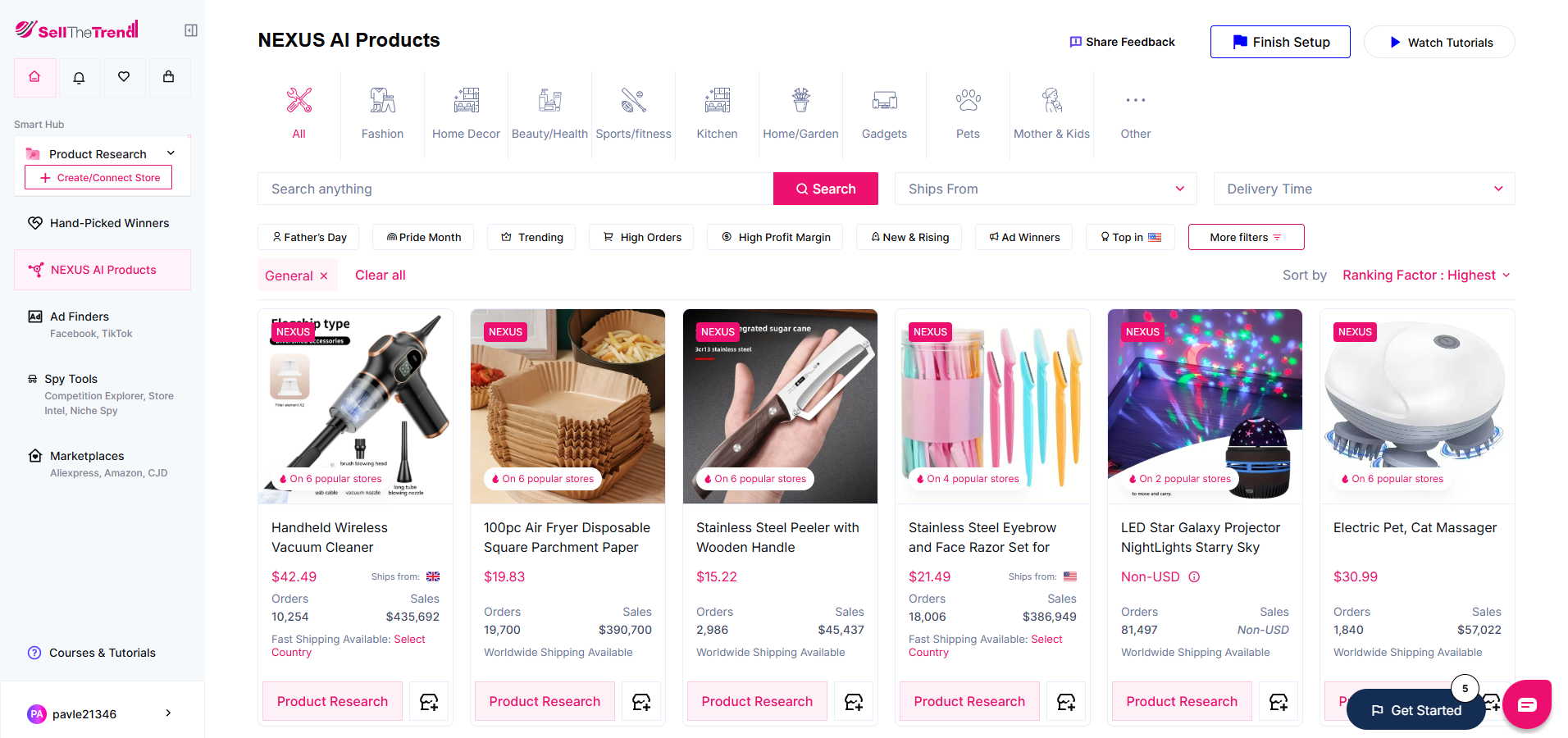
The AI Redefinition: Dropshipping in 2026 is no longer about generic manual sourcing or tedious store setups. Success depends on utilizing advanced AI store builders, predictive product analytics (NEXUS AI), and automated data translation to dramatically minimize launch time and optimize conversions.
Speed & Quality Over Cheap Inventory: The “old way” of 3-week slow shipping is dead. Longevity requires selecting high-quality suppliers who are actively vetted on real communication and accelerated delivery metrics to prevent customer churn.
Strict Operational and Legal Discipline: Scaling past initial sales requires structural maturity. Creating a proper business entity (LLC), separating personal and business finances via dedicated checking accounts, and mapping out sales tax obligations are non-negotiable for 2026 business owners.
The Power of Zero-Dollar Capital: Bypassing heavy upfront ad budgets is completely viable by maximizing organic algorithms. Using a dedicated short-form vertical video engine (like TikTok Organic) allows beginners to generate viral product awareness and brand equity for free.
Data-Driven Execution: The primary bottleneck for failing stores isn’t a lack of interest but rather the failure to use sales data and neglect customer service. Longevity belongs to store owners who systematically use consumer insights to iterate their pricing and marketing efforts.
Start by validating your niche and first products with Sell The Trend’s NEXUS AI, then use SellShop AI and supplier automation to move from product idea to launch-ready store faster.
What is Dropshipping? (The 2026 Definition)
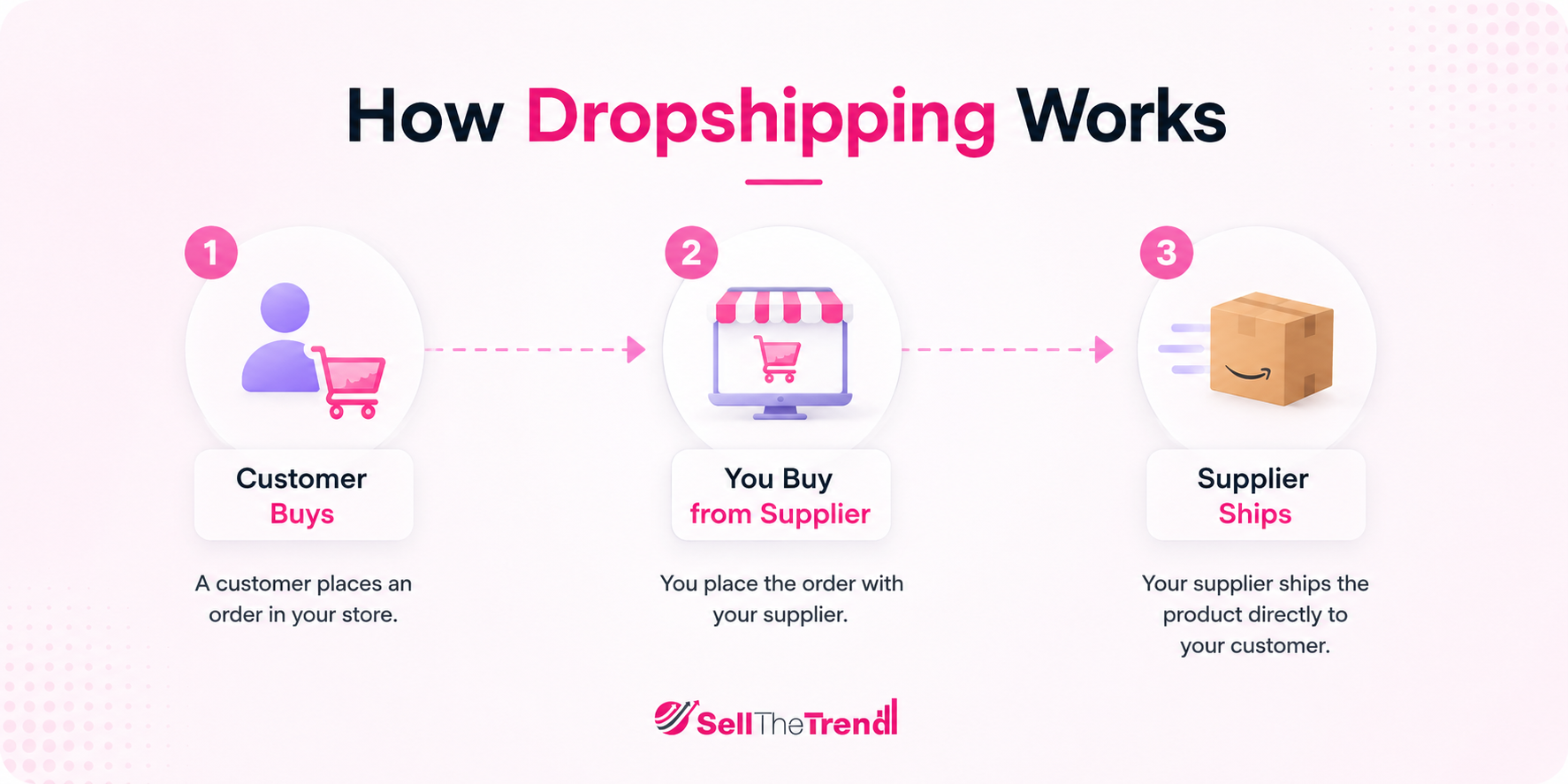
At its core, dropshipping is an order fulfillment model that allows an online store to sell products without holding any physical inventory. Instead of purchasing hundreds of items upfront and storing them in a warehouse, you partner with a third-party distributor or manufacturer. When a customer places an order on your ecommerce website, the supplier ships the products directly to the customer’s doorstep. You purchase the item from the supplier at a wholesale price only after you’ve been paid by the consumer, keeping the difference as profit.
In the modern ecommerce ecosystem, this definition has expanded. Dropshipping is no longer just a simple middleman transaction; it is a sophisticated data-and-design infrastructure. With the integration of next-generation automation tools, managing a dropshipping store means acting as an agile brand curator.
No title
Pro Tip: Advanced software handles real-time stock synchronization, automatic fulfillment, and instant product data translation, transforming the model from a basic logistics workaround into an efficient, low-overhead digital asset. Review our evaluation of the leading dropshipping automation software solutions to choose the right tech stack for your backend order flow.
How Does a Dropshipping Business Work?
The actual operational loop of a modern dropshipping business relies on a seamless chain of communication between three distinct entities: the consumer, your digital storefront, and your logistics partner.
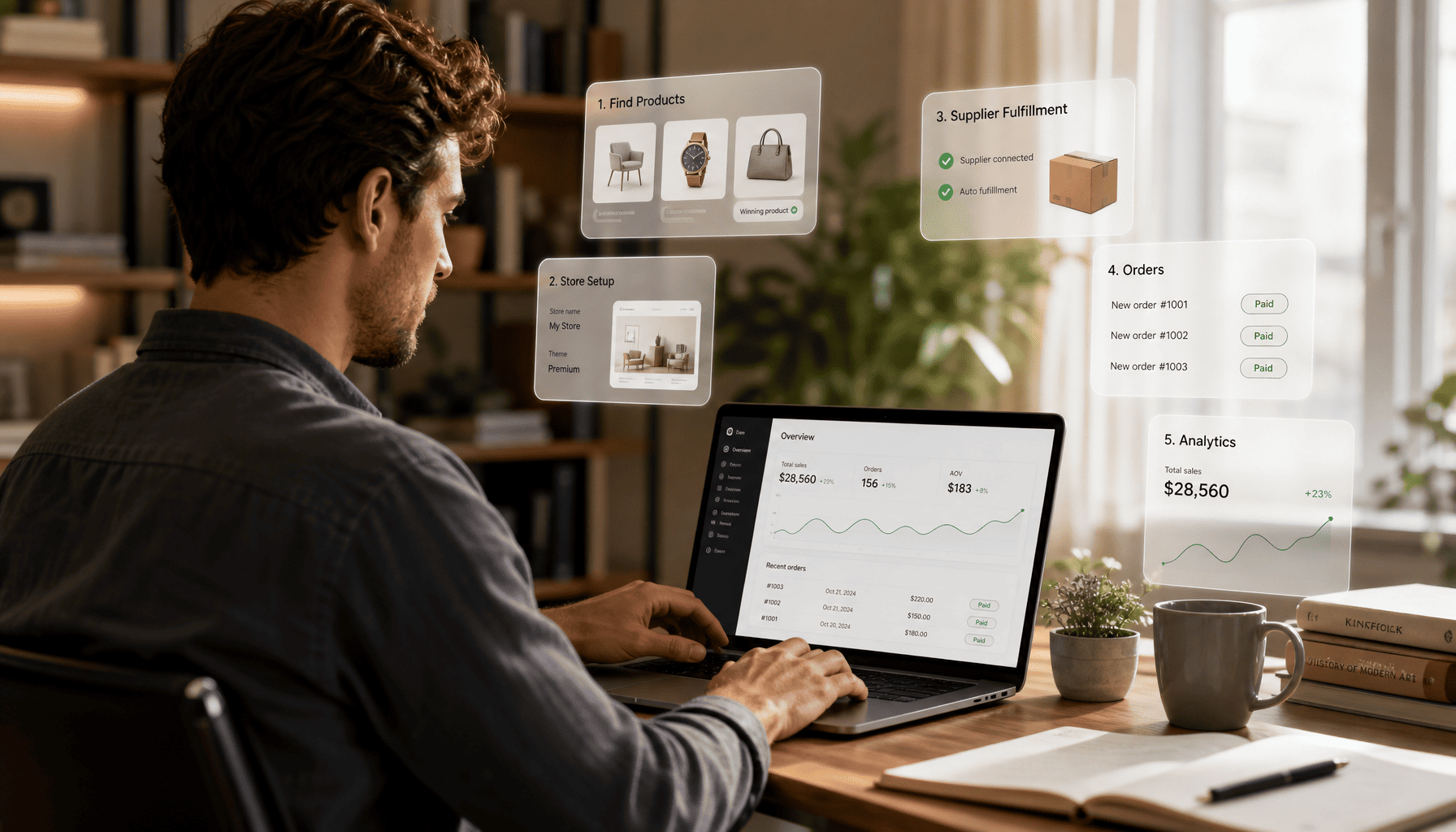
To clarify how this mechanism flows in real-world environments, let’s break down the supply chain step-by-step:
The Discovery: A shopper lands on your custom online store, browses your curated collection of unique items, and completes a purchase for a retail price of $100.
The Transmission: The order appears in your backend dashboard. In an automated setup, you can send it to the supplier with 1-click fulfillment, while tracking information is generated and shared with the customer.
The Fulfillment: Without you ever touching a cardboard box, the supplier picks, packs, and labels the package using your brand’s technical specifications.
The Completion: The product is delivered directly to the end consumer. Your store keeps the remaining $60 margin, which covers your software overhead, marketing efforts, and baseline operational profit.
This entire sequence highlights why starting a dropshipping business remains one of the most accessible entry points into entrepreneurship. Because your platform communicates directly with your fulfillment network, your primary focus stays entirely on customer acquisition, conversion optimization, and brand presentation.
Once you understand the fulfillment loop, use the Sell The Trend trial to connect product research, supplier selection, product importing, fulfillment, and tracking in one workflow.
Is Dropshipping Still Worth It in 2026? Pros and Cons
As global digital sales reach record heights, many aspiring entrepreneurs wonder if entering this space is still a viable move. The answer is an emphatic yes, but only if you understand the psychological and structural shifts occurring in the marketplace. The global dropshipping market is projected to grow from $128.6 billion in 2020 to a massive $476.1 billion by 2026. This explosive trajectory proves that consumer demand for distinct, direct-to-consumer products is stronger than ever.
However, achieving success requires weighing the distinct advantages against the clear competitive hurdles of this operational strategy.
What Are the Advantages: Low Friction and Ultimate Agility
Low Startup Costs: Traditional retail business models require thousands of dollars to fund initial product runs and warehouse space. Dropshipping removes this barrier entirely. You do not need to invest in inventory upfront, dramatically minimizing your initial capital risk and eliminating legacy inventory costs.
Operational Flexibility: Because you don’t manage physical inventory, you can run a business from absolutely anywhere in the world. As long as you have a laptop and a stable internet connection, you can monitor sales, launch campaigns, and communicate with your network.
Infinite Scalability: In a standard brick-and-mortar or traditional warehouse setup, doubling your order volume means doubling your physical workload, staff, and space. With digital fulfillment, your supplier absorbs the scaling stress, allowing you to scale your daily order volume with minimal friction.
What Are the Challenges: Competition and Margins
High Market Competition: Because the barrier to entry is low, many casual retailers end up selling the same products sourced from the same public databases. Without a clear strategy for brand differentiation and custom positioning, stores can easily get caught in a race to the bottom on pricing.
Smaller Profit Margins: Operating on a single-item fulfillment basis means you pay a premium per unit compared to buying in massive bulk containers. This inherently yields smaller initial profit margins, requiring business owners to execute careful, data-backed retail pricing strategies to cover software, payment gateways, and ad expenses comfortably.
Operational Factor
Traditional Retail Model
Modern Dropshipping Model
Upfront Capital
High (Bulk inventory & storage costs)
Extremely Low (Only platform & marketing)
Inventory Risk
High (Unsold items equal direct losses)
Zero (Items purchased only after a sale)
Location Liberty
Restricted (Tethered to stock/warehouse)
Full (100% remote laptop operation)
Fulfillment Burden
High (Manual picking, packing, shipping)
Automated (Handled instantly by partners)
When you have a full grasp of the pros and cons, you can make an informed decision, but the best place to start your dropshipping journey is with a 14-day Sell The Trend trial.
How to Start a Dropshipping Business in 5 Steps?
Transitioning from theoretical knowledge to building an actual, revenue-generating ecommerce framework requires an actionable execution blueprint. You cannot build a sustainable online business by relying on guessing games or disorganized strategies. Instead, establishing a highly profitable business model requires you to progress through a series of concrete structural milestones systematically.
By breaking down the initialization phase into an organized sequence, you can establish your digital presence with minimal capital friction, maximize initial sales momentum, and bypass the legacy inventory hurdles that plague traditional brick-and-mortar setups. Here is the definitive roadmap to taking your enterprise from a basic concept to an active, fully operational digital brand.
Step 1: What’s Important About Niche & Product Research?
The initial phase of any highly successful business begins long before you write a single line of text or choose a color scheme for your website storefront. The ultimate determining factor in your store’s survival is the precision of your initial market research.
No title
Pro Tip: Many amateur store owners make the critical mistake of selecting products based entirely on personal preferences rather than relying on verifiable consumer demand data. In a highly competitive digital economy, execution must be completely cold, analytic, and driven by explicit market signals.
Why is it Important to Identify Your Ideal Target Audience?
Choosing a dropshipping niche helps you identify your target audience, making it easier to find products to dropship. When you narrow down your operational focus, you stop marketing to a generic, uninspired crowd and begin speaking directly to motivated consumer groups with unique needs.
Why Should You Use Predictive Tools for Market Research?
To find a niche with high customer interest but low competition, dropshippers should assess market demand through keyword and product research. You can track macro-level consumer search interest over multi-year cycles, helping you distinguish short-lived viral fads from stable, evergreen macro-trends.
No title
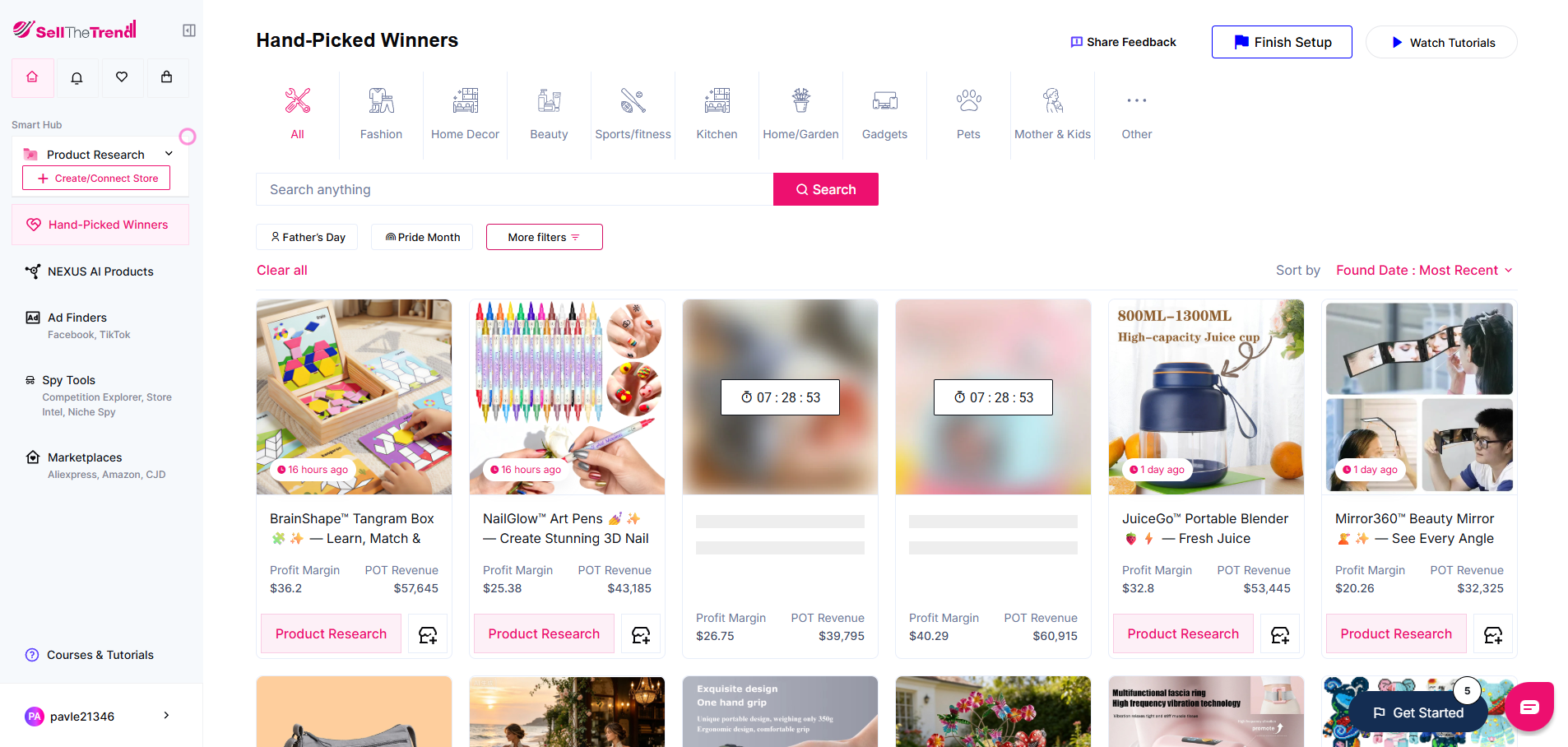
Pro Tip:Use Sell The Trend’s NEXUS AI as your product discovery engine: it evaluates product momentum, competition, social signals, supplier availability, and sales patterns so you are not choosing products based on guesswork. To understand the deeper data science behind uncovering these items before they saturate the market, read our full framework on how to find winning products using predictive real-time trends.
Why Should You Conduct Comprehensive Competitor Research?
Conducting thorough competitor research is essential when selecting a niche, as it helps identify potential products and marketing strategies. You must analyze established store footprints within your chosen vertical to map out exactly what is already generating conversions.
No title
Pro Tip: Study their structural weaknesses: Are their product configurations outdated? Are their descriptions generic or poorly written? By auditing their social media footprints, visual ads, and landing page funnels, you can identify open gaps in their execution, discover hidden product variations, and map out a highly disruptive angle for your own dropshipping brand.
Why Is It Important to Choose a Sustainable Dropshipping Niche?
Ultimately, settling on the right business niche means balancing commercial viability with long-term scaling potential. You want to prioritize a specialized dropshipping niche populated by passionate hobbyists, urgent problem-solving items, or high-ticket luxury goods that carry a perceived lifestyle value.
Use Sell The Trend’s NEXUS AI product research tool to compare demand, competition, supplier options, and product momentum before choosing what to sell.
Step 2: How to Choose Your Platform (Shopify vs. AI Store Builders)?
Once your initial database of viable products is locked in, your next priority is deploying an accessible, conversion-optimized storefront to display your digital inventory. Your platform serves as the structural command center of your enterprise, dictating how seamlessly you can capture traffic, handle customer data, and process incoming payments.
How to Start Dropshipping for Beginners: Traditional Ecommerce Platforms
When building an online store, choosing a reliable eCommerce platform is crucial, as it enables customization, sales management, and payment processing, all of which are essential for a successful business. Utilizing an established ecommerce platform like Shopify or WooCommerce provides a reliable sandbox with secure payment gateways, expansive plugin ecosystems, and structural stability that scales with your increasing order volume.
For beginners starting Shopify dropshipping with no experience, the safest path is to connect product research, product importing, fulfillment, and tracking before launching ads. However, as your business grows, you can also consider alternatives to Shopify that align with your changing business requirements
How to Streamline Store Creation with an AI Website Builder?
An advanced AI website builder eliminates the technical learning curve. With SellShop, beginners can launch a customizable dropshipping storefront without coding, choose a niche, use pre-loaded winning products, and manage store setup, suppliers, and fulfillment from an integrated workflow.
How to Design the Architecture of a Professional Online Store?
A well-designed online store should include product pages, user guides, buying guides, and relevant blog posts to enhance the customer experience and improve visibility in search engine results. Modern consumers demand cohesive, high-authority digital environments before they feel safe entering their credit card details.
How to Maximize Conversions with AI-Enhanced Product Listings?
The primary point of failure for an unoptimized ecommerce store lies within the product presentation itself. Importing low-resolution, generic product descriptions directly from wholesale databases instantly destroys user trust.
No title
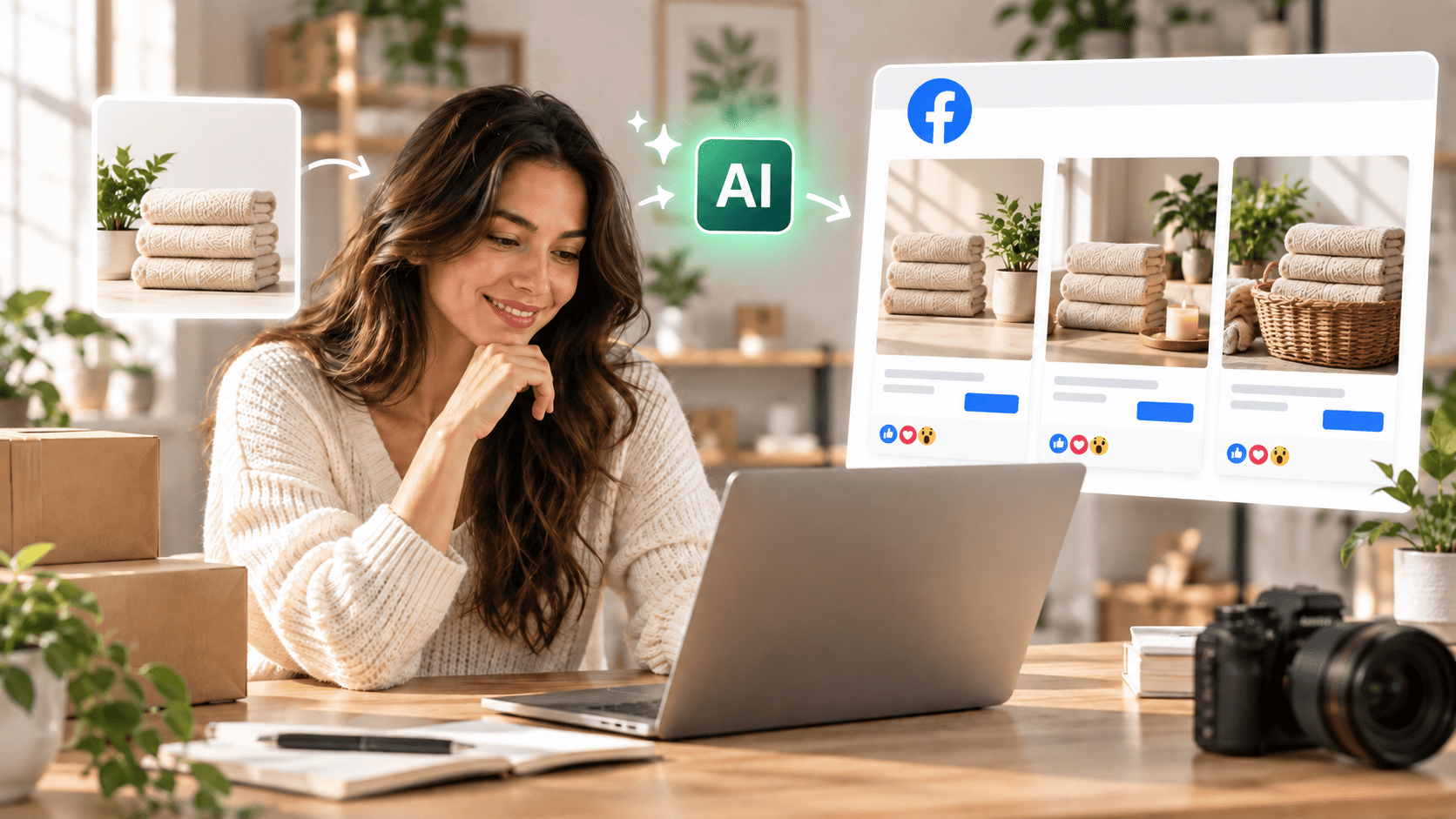
Pro Tip: Using AI tools can enhance product listings by generating SEO-friendly descriptions and transforming supplier images into branded visuals, helping to differentiate product pages from competitors. These intelligent asset tools allow you to seamlessly rewrite copy into high-intent sales language, remove distracting background graphics from supplier images, and construct unified, premium product listings that justify a higher retail price point.
Step 3: How to Find Reliable, Fast-Shipping Suppliers?
You can deploy an immaculate website and construct flawless marketing campaigns. Still, if your backend logistics network fails to deliver, your online business will crumble under the weight of payment chargebacks and critical consumer reviews. In a world accustomed to rapid fulfillment infrastructure, managing your logistical chain with absolute precision is a non-negotiable prerequisite for scaling.
Why Sourcing Dictates the Success of Your Dropshipping Store?
The choice of suppliers significantly impacts the success of a dropshipping business, as they handle inventory, logistics, and customer deliveries. Your chosen partner acts as an anonymous extension of your internal team. If they use poor packaging, forward defective products, or mismanage tracking data, your brand takes a direct hit to its reputation. Therefore, selecting an aligned logistics partner requires great diligence.
How to Evaluate a Vetted Dropshipping Supplier vs. Public Databases?
Instead of browsing unverified public open-source forums, focus on finding a professional dropshipping supplier or an established direct-source supplier that offers transparent stock levels, clear English communication channels, and strict factory-level quality control. If you are targeting domestic buyers, check our vetted directory of the best dropshipping suppliers in the usa to lock down 48-hour delivery windows.
No title
Pro Tip: Instead, focus on finding a professional dropshipping supplier or an established direct-source supplier that offers transparent stock levels, clear English communication channels, and strict factory-level quality control.
How to Leverage a Supplier Directory App for Rapid Integration?
Using supplier directory apps and websites can simplify the process of finding reliable dropshipping suppliers, connecting your store with a wide range of options. Incorporating a dedicated dropshipping app (such as Sell The Trend’s internal automation ecosystem) connects your digital storefront directly to a curated database of top-tier, pre-vetted supply partners.
These integrated platforms remove the burden of manual cross-referencing across databases by allowing you to filter options based on explicit past performance ratings, regional warehouse locations, and factory capacity. This enables you to seamlessly integrate your store infrastructure with multiple suppliers, maintaining operational redundancy.
How to Mitigate Customer Churn with Expedited Shipping Options?
The era of forcing consumers to endure agonizing three-week shipping timelines from overseas facilities is completely over. Long or unpredictable shipping times can lead to customer churn in dropshipping businesses, generating a wave of negative support tickets that can cause payment processors to freeze your business bank account.
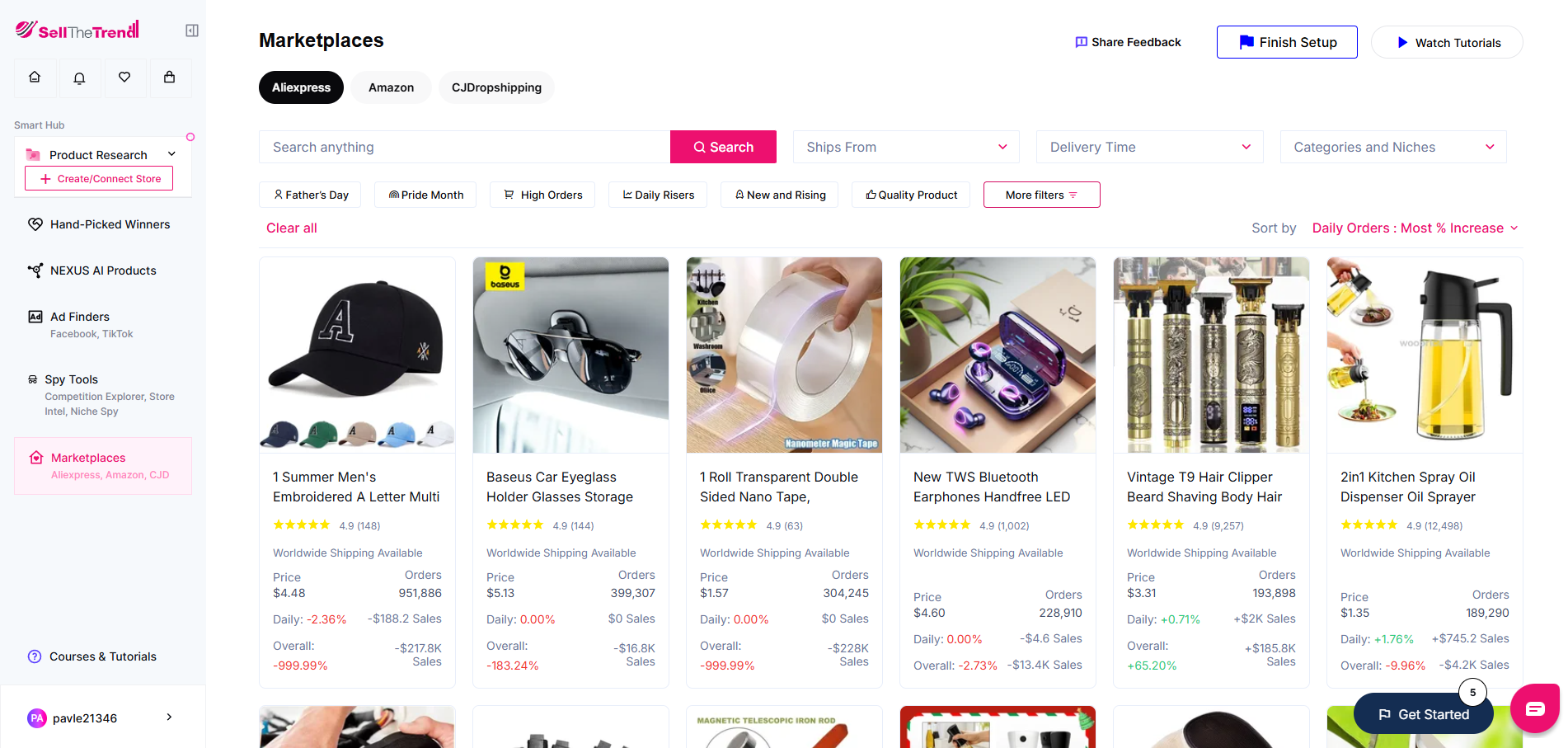
Use Sell The Trend’s supplier tools as well as the SellShop AI store builder to compare product rating, pricing, communication, and shipping speed before importing products.
Step 4: How to Set Up Payment Gateways & Legality?
When you decide to start a dropshipping business, it is incredibly easy to get swept up in the creative aspects of design and product sourcing. However, transforming a simple dropshipping business idea into a legitimate corporate asset requires a firm commitment to regulatory and operational compliance. Skipping the foundational legal steps can leave your enterprise vulnerable to sudden merchant freezes, fines, or unnecessary personal risk. Building a stable framework from day one ensures that as your order volume scales, your business remains structurally sound.
Why Establishing a Clear Business Structure Matters?
Choosing the right legal business structure is your very first line of defense as a business owner. While a basic sole proprietorship requires minimal paperwork, it leaves your personal assets completely exposed to any business liabilities. If a logistics partner fails or a customer pursues legal action over a product issue, your personal bank account, vehicle, and property could be at risk.
No title
Pro Tip: To avoid this exposure, most entrepreneurs who choose to start a dropshipping business opt to form a limited liability company (LLC). Registering a limited liability company establishes a clear legal wall separating your personal assets from your corporate liabilities, granting you vital personal liability protection. This ensures that any debt, dispute, or merchant-related complication remains strictly confined to the entity itself, safeguarding your family’s financial security.
How to Obtain Your Employer Identification Number and Business License?
Once your regional authority approves your limited liability company, you need to secure the necessary documentation to operationalize your digital footprint. Your next immediate step is to apply for an employer identification number (EIN) through your relevant tax authority. This acts as a social security number for your ecommerce business, allowing you to execute official corporate actions legally.
No title
Pro Tip: In tandem with your tax identifier, check your municipal and state guidelines to see if you need a specific license or reseller permit to sell products online. A reseller permit or business license is often mandatory when opening wholesale accounts with premium domestic distributors. This documentation proves you are a legitimate retailer, allowing you to source items without paying localized sales tax at the initial point of purchase.
How to Optimize Your Corporate Finances and Bank Account Setups?
To ensure financial transparency and simplify accounting, it is recommended to open a separate business checking account for your dropshipping business. Co-mingling your personal and business finances is a critical mistake that can dissolve your personal liability protection in a legal dispute, a complication often referred to as “piercing the corporate veil.”
By directing all incoming customer funds and outward software fees through a dedicated checking account, you keep your accounting records perfectly clean. Link this primary bank account to a business credit card to fund your daily inventory fulfillment costs and software applications. This separation streamlines your tracking, ensures clean tax preparation, and builds a verified corporate credit profile that makes it easier to track corporate transactions over time.
How to Navigate Sales Tax Compliance and Collection Loops?
Managing sales tax is one of the most complex elements of running a modern ecommerce business. You do not just pay sales tax; you are legally required to collect sales tax from consumers residing in tax jurisdictions where your business maintains an economic or physical footprint, commonly known as tax nexus.
Modern platforms make it simple to monitor where you have crossed transaction or revenue thresholds. Ensure your backend system is configured to automatically calculate and collect sales tax at checkout based on the buyer’s precise location. Work with an ecommerce accountant early on to establish clean registration processes, ensuring you remit the tax you collect to the appropriate state authorities on time and avoid severe compliance penalties. Compliance also extends to data privacy. If you sell to shoppers in the EU, UK, or California, a consent-management app like Consentmo helps Shopify merchants display compliant cookie banners and meet GDPR and CCPA requirements as their store scales.
How to Choose and Vet High-Conversion Payment Gateways?
Your payment gateway is the bridge that converts incoming consumer traffic into verified capital within your business checking account. To accommodate a diverse global audience, your store should offer multiple trusted merchant solutions, including Stripe, PayPal, and digital wallets like Apple Pay.
When configuring your gateways, read their terms of service carefully regarding digital fulfillment strategies. Provide your processors with instant tracking updates and maintain an initial capital reserve inside your bank account. This proactive approach prevents sudden payment holds or account freezes, ensuring your daily business transactions continue to flow smoothly.
Step 5: How to Launch Your First Marketing Campaign?
With your digital storefront legally compliant and structurally optimized, you are ready to shift your focus to the lifeblood of ecommerce: customer acquisition. You can build an immaculate platform, but without a predictable mechanism to drive highly targeted traffic, you cannot build a successful dropshipping business.
The goal of your initial marketing is to put your dropshipping products directly in front of buyers with high immediate purchase intent. Here is how to build a highly optimized marketing engine to attract customers and generate consistent conversions.
How to Drive Scalable Traffic with Paid Advertising Funnels?
Paid advertising on platforms like Facebook, Instagram, and search engines can effectively increase brand visibility and attract customers to your dropshipping store. For items that rely on high visual appeal or emotional impulses, such as fashion, unique lifestyle gadgets, or home decor, running video ads on Meta and Instagram allows you to hyper-target precise demographics based on explicit user interests.
If you are selling utility-driven items or problem-solving dropshipping products that consumers actively search for, focusing your ad budget is a highly effective strategy. Deploying highly targeted search campaigns and optimized shopping ads ensures your store appears at the absolute top of search engine results right when a shopper is looking to buy. This search-intent traffic routinely yields higher conversion rates, maximizing the return on your initial marketing costs.
How to Amplify Brand Credibility via Influencer Marketing Campaigns?
Influencer marketing can help extend your reach and credibility, potentially increasing sales by leveraging the trust influencers have with their audiences. Modern consumers are inherently cynical of traditional corporate ads; instead, they seek authentic recommendations from creators they actively follow.
Instead of spending your entire budget on high-cost macro-celebrities, focus your influencer marketing campaigns on micro-creators within your specific business niche. Send them free product samples and offer a percentage-based affiliate commission on the sales they generate. This approach minimizes your upfront marketing costs while generating high-authority user-generated video content that you can reuse to optimize your paid advertising campaigns.
How to Build Long-Term Asset Value with Strategic Content Marketing?
Content marketing, such as blogging or creating instructional videos, can enhance your brand’s visibility and keep customers engaged after their purchase. While paid channels offer rapid sales feedback, they require continuous funding to remain active. Combining paid strategies with an organic content framework ensures your ecommerce store builds long-term, compounding asset value.
No title
Pro Tip: Develop deep-dive buying guides, product comparison articles, and high-value video tutorials optimized for search engine optimization. This comprehensive content architecture addresses pre-purchase consumer questions, reduces friction at checkout, and keeps buyers deeply connected to your dropshipping brand. Over time, this organic visibility decreases your reliance on paid platforms, significantly lowering your overall acquisition expenses. Before calculating your ad spend, you can leverage our suite of free dropshipping tools & calculators to map out your expected margin caps and operational costs instantly.
How to Set Your Retail Pricing Strategy for Maximum Viability?
Before launching any external traffic campaigns, you must finalize a precise retail pricing model. Establishing a pricing strategy involves calculating costs, including supplier prices and operating expenses, to set competitive retail prices that ensure profitability.
If you price your items too low to copy generic competitors, your remaining profit margin will not cover your daily marketing and platform overhead. Aim for a healthy markup that covers your acquisition costs while leaving room for promotional discounts, ensuring your ecommerce store generates sustainable cash flow from its very first day online.
What’s the Difference Between AI vs. Traditional Dropshipping: The Modern Operational Shift?
The e-commerce landscape has experienced a massive evolution, separating classic retail strategies from next-generation frameworks. To truly understand how to build a successful business in the modern market, entrepreneurs must recognize the shift from manual labor to automated systems. The legacy style of e-commerce required hours of manual copy-pasting, whereas modern AI-driven dropshipping relies on automated data workflows.
How to Redefine the Classical Business Model?
In a standard store configuration, owners used to spend days manually analyzing competitor stores and trying to guess demand. Under the automated model, a dropshipping store operates as a highly integrated data system. Utilizing an advanced website builder powered by predictive artificial intelligence allows a business owner to deploy automated systems that synchronize inventory levels, track changes in wholesale price points, and adjust retail pricing rules automatically. This shifts the entire focus of running a dropshipping business from tedious administrative chores to high-level customer acquisition and brand optimization.
How to Streamline the Modern Ecommerce Industry?
Within the global ecommerce industry, speed and efficiency determine who captures the market. Steep upfront capital investments and heavy inventory costs weigh down traditional retail frameworks. In contrast, the modern dropshipping business model offers maximum agility. By removing physical fulfillment hurdles, entrepreneurs can test new product variations in real time without being tethered to a fixed physical location or suffering from capital stagnation.
Here’s a quick comparison table.
Workflow
Traditional dropshipping
AI dropshipping
Product research
Manual marketplace browsing
NEXUS AI + trend signals
Store setup
Theme, apps, manual copy
AI-assisted store/page creation
Suppliers
Manual vetting
Supplier filters and rankings
Fulfillment
Manual order handling
1-click fulfillment and tracking
Marketing
Guessing creatives
TikTok/Facebook ad intelligence
Once you understand the difference, use the 14-day trial on Sell The Trend to move from manual product guessing to AI-assisted product research, supplier filtering, and store automation.
How to Start a Dropshipping Business with No Money
One of the greatest advantages of starting a dropshipping business is its remarkably low barrier to entry. Dropshipping businesses typically have lower startup costs than traditional retail models because they do not require inventory investment, allowing entrepreneurs to start with minimal capital. If you are operating on a zero-dollar budget, you can trade upfront capital for strategic sweat equity, utilizing a variety of free platforms and organic traffic loops to launch a successful business without financial friction.
How to Start Dropshipping for Free: Choosing Initial Storefront Channels
When looking at dropshipping with zero capital, you can initially bypass subscription platform fees by setting up your storefront on free marketplaces. Using social commerce channels like Facebook Marketplace or building product galleries on an Instagram business profile lets you showcase dropshipping products to active shoppers. Once your initial organic sales begin to generate consistent cash flow, you can reinvest those early profits into a dedicated online store powered by a premium website builder.
How to Assess Market Demand Through Free Research Tools?
To find a niche with high customer interest but low competition, dropshippers should assess market demand through keyword and product research. Bypassing expensive analytical software is entirely possible by maximizing the use of free discovery tools.
No title
Pro Tip: Conduct in-depth market research to visualize real-time consumer search behavior and shifts in geographic demand. By entering target phrases, a business owner can easily identify emerging product categories, identify evergreen consumer needs, and ensure their dropshipping business idea is grounded in verifiable public interest.
How to Create a TikTok Organic Strategy: Building Brand Equity Without Ads?
The absolute centerpiece of a free e-commerce launch is a robust vertical video strategy. Instead of allocating massive budgets toward paid advertising funnels, you can leverage short-form short-video algorithms to generate free viral traffic. Order a single sample of your product or utilize high-quality supplier media to film engaging, lifestyle-driven videos. Post consistently on TikTok, Instagram Reels, and YouTube Shorts, optimizing each post with trending audio tracks and niche hashtags to place your dropshipping store in front of millions of potential buyers completely for free.
How to Get Free Visibility with Search Engine Optimization?
To build sustainable, long-term traffic without relying on ongoing marketing expenses, implementing an organic SEO framework is essential. When you build an online store, choosing a reliable platform is crucial, as it enables customization, sales management, and payment processing, which are essential for successful dropshipping.
The goal is not just free traffic; it is brand equity. Use repeated product demos, founder-style videos, problem/solution hooks, and customer-style UGC to make the store feel like a real brand before you spend on ads.
No title
Pro Tip: Integrate high-intent informational keywords directly into your online store design, author high-value blog posts, and craft extensive buying resources. This structured approach helps your ecommerce business earn top search positions, allowing you to attract people passively for years to come.
What Are the Common Pitfalls for New Dropshippers (And How to Avoid Them)?
While starting a dropshipping business offers an incredibly accessible path to digital entrepreneurship, many beginners fail because they treat it as a passive hobby rather than a serious corporate operation. Navigating the competitive e-commerce landscape requires avoiding common operational mistakes that can easily stall your growth and damage your brand equity.
What About Ignoring Sales Data and Performance Metrics?
Ignoring sales data is a common mistake among new dropshippers, as it can prevent them from optimizing their store for profit. Many amateur store owners continue to fund underperforming marketing or keep dead inventory listings active simply because they fail to conduct thorough financial audits. To build a successful dropshipping business, you must continuously analyze your customer acquisition costs, conversion rates, and gross profit metrics. Letting cold data guide your optimization efforts allows you to scale winning products ruthlessly while cutting unprofitable campaigns before they drain your corporate reserves.
What About Failing to Plan for Growth and Scale?
Many dropshippers fail to plan for growth, which can bottleneck their business and limit their ability to handle increased order volumes. When an organic video or a paid ad campaign suddenly goes viral, a store can easily jump from three orders a day to three hundred orders overnight. If your backend infrastructure relies on a single slow supplier or lacks automated fulfillment software, your delivery times will skyrocket, leading to chargebacks and payment holds.
No title
Pro Tip: To protect your dropshipping business, ensure your store is linked to a scalable dropshipping app that can instantly process large volumes of orders without errors.
What About Neglecting Customer Complaints and Support Quality?
In dropshipping, the retailer is responsible for handling returns, tracking orders, and providing customer service, even though they do not manage shipping directly. Neglecting customer complaints can lead to negative reviews and high return rates, which is a significant mistake for dropshippers, who are the primary point of contact for customer support.
If a package arrives broken or faces customs delays, the consumer will blame your dropshipping brand, not the supplier. Failing to provide a clear response can quickly destroy your brand’s reputation online. To protect your enterprise, you must commit to providing exceptional customer service. Deploy automated tracking emails, resolve disputes transparently, and maintain excellent customer service loops to turn one-time shoppers into highly profitable, loyal repeat buyers.
Start Your Hustle: Easy Dropshipping Tips for Accelerated Success?
To move past basic survival and establish a highly dominant market presence, you need to implement advanced tactics that elevate your store above the sea of amateur competitors. Here are three proven, high-leverage strategies designed to maximize your operational efficiency and generate higher margins.
Tip 1: Why Should You Partner Only with Vetted, Reliable Suppliers?
Your backend supply chain is the true backbone of your entire ecommerce business. Instead of sourcing unthinkingly from public marketplaces, you should focus on establishing secure relationships with a reliable supplier or a verified direct-source supplier.
No title
Pro Tip: Partnering with suppliers who offer expedited shipping options can help reduce customer churn. Make it a strict policy to filter your partners using an integrated dropshipping app to verify their real-world communication scores, factory output capacity, and shipping speed before you import products into your store. Securing a reliable supplier ensures consistent product quality, stable inventory levels, and fast shipping times, which are paramount to maintaining top customer satisfaction ratings.
Tip 2: Why Should You Secure Premium Wholesale Dropshipping Accounts?
As your daily sales volume grows, your next logical step is to transition from basic retail arbitrage sourcing to securing dedicated wholesale accounts with high-tier domestic distributors. Establishing official wholesale accounts unlocks true wholesale pricing, giving you access to lower per-unit baseline costs.
This structural shift directly enhances your baseline profit margin, giving you the necessary capital flexibility to scale your paid campaigns, absorb sudden delivery fluctuations, and generate higher profit margins across your entire product catalog.
Tip 3: Why Should You Use Continuous Product and Niche Auditing?
The e-commerce market moves at a rapid pace, and a winning item today can easily lose its market momentum next month. To build a highly resilient online business, you must never allow your product portfolio to become stagnant.
Continuously use a modern website builder tool alongside advanced predictive discovery platforms to find dropshipping suppliers, evaluate fresh consumer trends, and test new product listings weekly. Systematically auditing your store’s performance allows you to prune underperforming items early while continuously integrating fresh, high-demand goods that align with the evolving interests of your target audience.
Navigating the logistical, legal, and operational moving parts of the e-commerce industry can feel overwhelming to beginners. To help streamline your path to launch, here are clear, data-backed answers to the most common pre-purchase questions about starting a dropshipping business.
How much money do you need to start a dropshipping business?
One of the most attractive elements of this business model is its remarkably low barrier to entry. Because you do not have to manage physical inventory or cover upfront costs, you can theoretically start a dropshipping business with $0 capital by leveraging free marketplace channels and executing a raw TikTok organic video strategy.
However, to launch a scalable, fully independent online store that builds long-term asset value, a realistic initial budget ranges from $100 to $500. This structural runway comfortably covers your essential software applications, an optimized website builder plan, custom domain registration, and initial testing budgets for your paid advertising funnels.
Is a digital dropshipping store legal, and do I need a license?
Yes, dropshipping is a completely legitimate and legal product fulfillment method recognized by global banking institutions and major e-commerce platforms. However, to operate legally and maintain a successful dropshipping business, you must treat your storefront as a real corporate entity.
While you can technically process your very first few sales as a basic sole proprietor, you should quickly establish a formal business structure, such as a limited liability company (LLC), to protect your personal assets. Furthermore, depending on your local municipal and state regulations, securing an official license or a resale certificate is highly recommended. This documentation allows you to establish premium wholesale dropshipping accounts and ensures you remain fully compliant when you collect sales tax from consumers.
How do I find dropshipping suppliers for my online store?
Locating an aligned logistical partner is paramount to safeguarding your brand’s consumer experience. The most efficient way to find suppliers is to utilize a dedicated supplier directory app that integrates directly with your platform.
Avoid browsing unverified public open-source forums, which often leave store owners vulnerable to shipping delays and communication breakdowns. Instead, leverage a professional product research platform like Sell The Trend. Their comprehensive backend database gives you instant access to thousands of pre-vetted supply partners, allowing you to source items instantly, evaluate past factory fulfillment ratings, and compare suppliers by product rating, pricing, communication, warehouse location, and shipping speed, then prioritize the fastest, most reliable option before importing the product.
Can a single owner run an online business by themselves?
Absolutely. The evolution of modern e-commerce automation tools means that a single independent owner can easily manage a high-volume online business from a laptop without hiring an initial team.
By leveraging an integrated dropshipping app, tedious operational tasks, such as updating daily stock tracking, syncing product data descriptions, and routing order tracking codes directly to the end consumer, are handled automatically in the background. This extreme operational efficiency frees up your time, allowing you to focus your daily energy on creating high-converting marketing strategies and optimizing your digital layout.
How does AI help beginners choose dropshipping products?
The most profitable products are items that possess a strong immediate emotional appeal, solve a distinct everyday problem for consumers, or cater to highly passionate hobbyist subcultures.
To ensure your dropshipping business idea is built on a stable financial foundation, avoid selling overly generic items that consumers can easily purchase from local brick-and-mortar retail chains. Instead, conduct in-depth market research using historical predictive data engines such as NEXUS AI. Focus on sourcing unique lifestyle apparel, high-utility tech gadgets, smart-home organizational accessories, or specialized pet-care goods that allow you to set a premium retail pricing structure and achieve much higher profit margins.
Conclusion: Launch Your Automated Storefront Today
Building a highly profitable online store in the modern e-commerce landscape requires a firm commitment to operational efficiency, data-driven optimization, and premium brand presentation. An agile era of automated intelligence has completely replaced the outdated methods of manual scraping and sluggish multi-week fulfillment lines. Success belongs exclusively to modern entrepreneurs who treat digital fulfillment as a real, disciplined corporate asset.
By systematically moving through the foundational milestones mapped out in this guide, from validating product demand with NEXUS AI and Store Intelligence to establishing a clear LLC and deploying a mobile-responsive storefront, you eliminate the critical points of friction that routinely cause amateur storefronts to stall.
There is absolutely no need to spend weeks bogged down in technical developmental loops or burning through critical capital reserves trying to guess what consumers want to buy. By combining your strategic sweat equity with an all-in-one automation ecosystem like Sell The Trend, you gain a clearer, faster workflow for finding products, building your store, and managing fulfillment. Their advanced predictive infrastructure grants you instant access to the revolutionary NEXUS AI product explorer, an automated store builder that deploys optimized landing pages in seconds, and an integrated network of fast-shipping domestic suppliers.
The tools have been completely democratized, the logistical barriers have been removed, and the consumer demand path is clearer than ever before. Take decisive action, claim your 14-day trial on Sell The Trend, and begin building your automated e-commerce empire today.
Lisa is an eCommerce and digital marketing specialist with over 6 years of experience helping online businesses grow through data-driven strategy and hands-on execution.
She has worked across dropshipping and direct-to-consumer channels, focusing on product research and performance marketing. At Sell The Trend, she creates practical, research-backed content to help merchants make confident decisions.