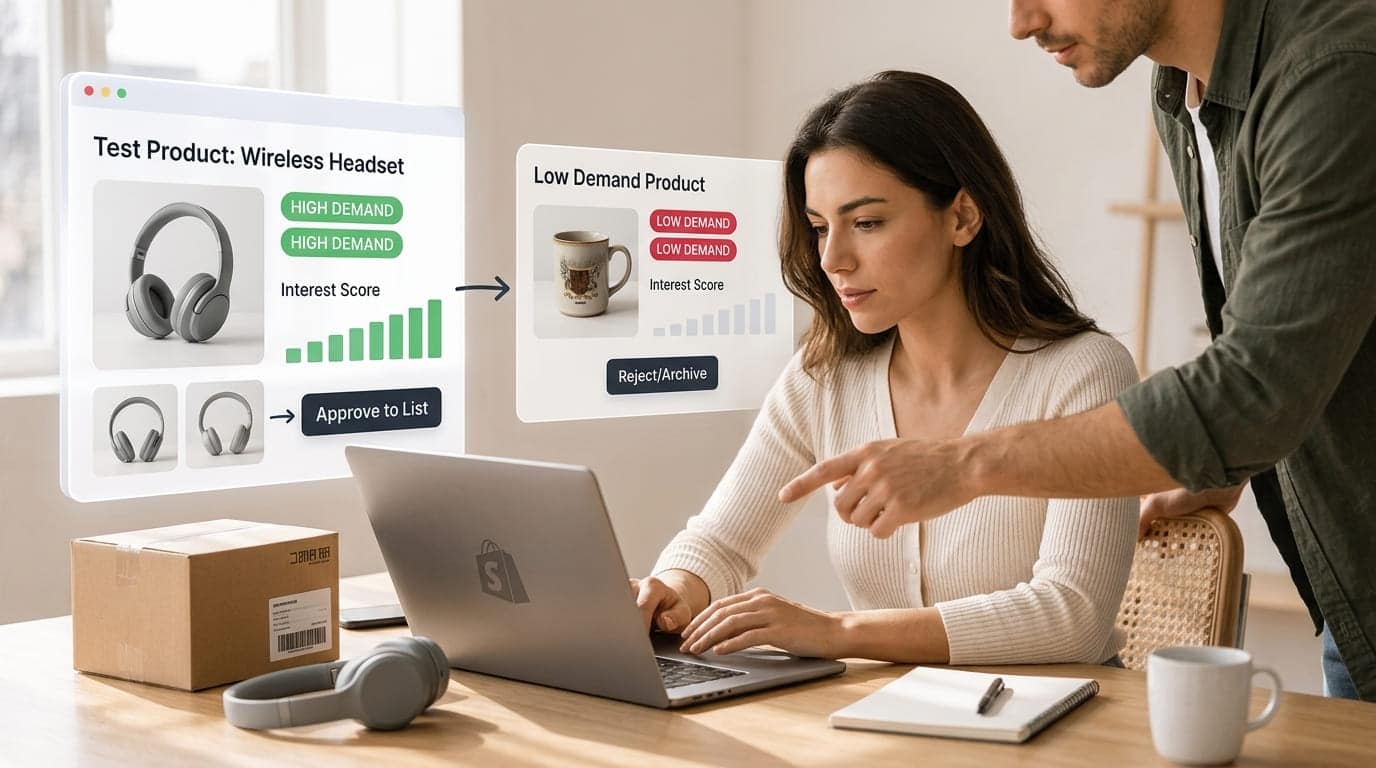
To create Facebook ads for dropshipping products with AI, choose a researched product, select an advertising blueprint, generate visuals and copy, then edit, resize, and test. Sell The Trend’s AI Ads Creator combines your product with a chosen advertising approach, giving you creative concepts rather than just isolated images.
While AI-enabled dropshipping software drastically accelerates your production, treat every generated creative as a prime candidate—testing allows you to validate and scale your true winners.
For new dropshippers and growing e-commerce businesses, this guide shows how to build static ads, prepare video ads, and review results. You’ll follow an AI dropshipping workflow connecting product research with creative production.
Key Takeaways
Start with product research, then choose one customer problem, need, or interest for each ad.
Use ad blueprints as inspiration, not permission to copy another advertiser.
Compare static ads and video ads through meaningful tests, not assumptions.
Judge Meta ads using performance data rather than appearance alone.
Why Does Facebook Advertising Matter for Dropshipping?
Facebook ads let you introduce products to potential customers and direct them toward your store. For your ad strategy, treat that opportunity as a testable question: which product benefit gives someone a reason to click, explore the offer, and eventually purchase?
Meta’s creative testing guidance recommends using experiments and metrics to develop your approach. Your goal is useful evidence, not simply more ad campaigns.
How Do You Find a Product Worth Advertising?
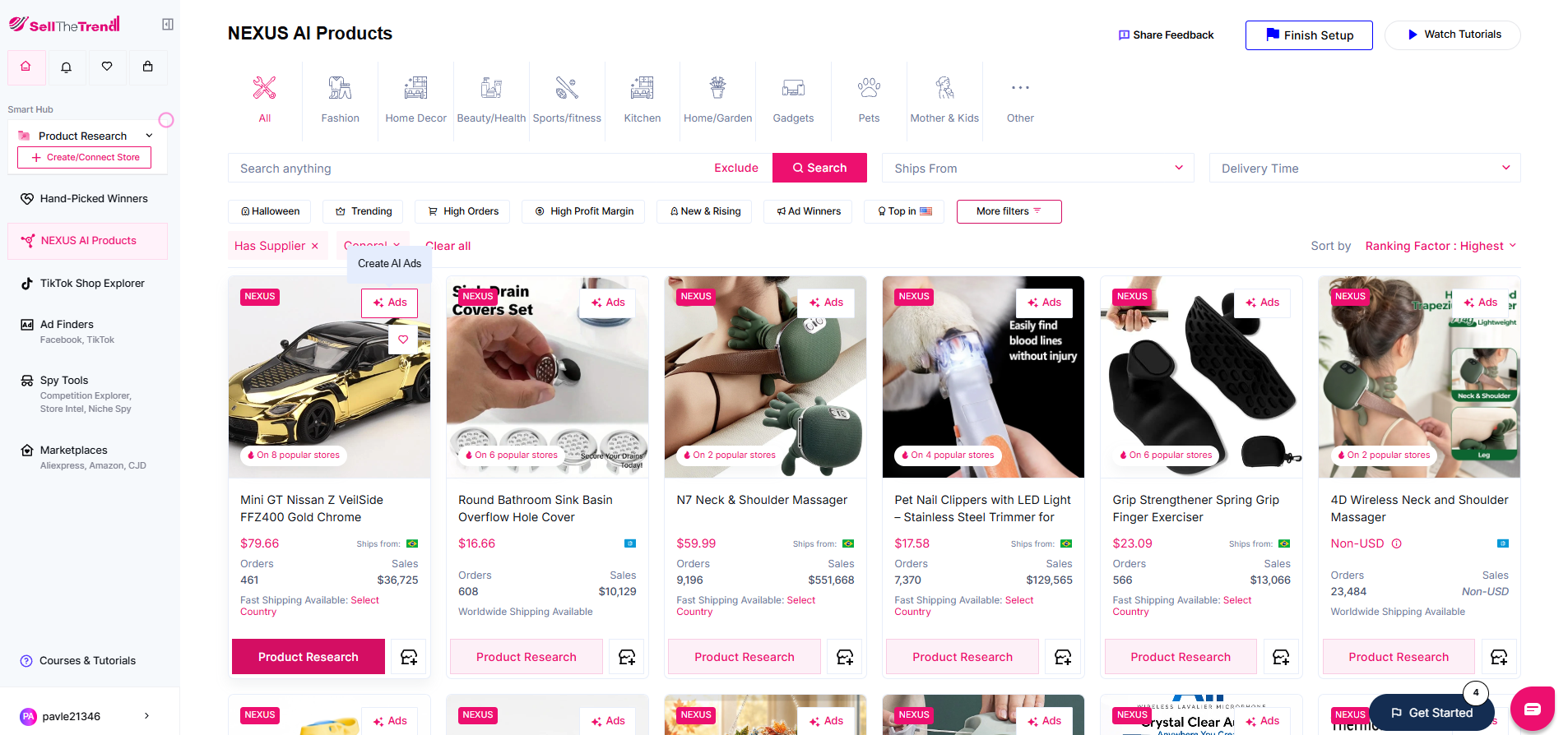
Start with Sell The Trend’s Nexus AI to research product demand and competition before creating ads. Its predictive product research provides information for shortlisting candidates; use those findings alongside supplier costs, shipping details, and your proposed selling price when deciding what deserves a test.
Store Intelligence adds competitor product and pricing context. Treat that information as research, not a promise that your store will achieve similar results.
For example, the gold-colored model car shown later in this walkthrough gives you several buying motivations to investigate: adding to a display, expressing an interest in cars, or choosing a gift. List likely questions about its dimensions, finish, and packaging so your next creative can address them with verified details.
Who Should Your Facebook Ads Speak To?
Choose a target audience by describing the need, interest, or occasion that makes your product relevant. For the model car, consider car enthusiasts, model collectors, or people choosing a gift for an adult hobbyist. Then write around a specific motivation, such as adding a car-themed display piece to a desk or shelf.
Sell The Trend’s Facebook Audience Builder supplies audience insights from a product or niche. Use it to inform your starting assumptions, then test the response.
Keep the message specific: “Bring your love of cars to your desk” gives the ad creative a clearer direction than “Upgrade your lifestyle.”
No title
💡Pro Tip: Before generating creatives, write one sentence naming the buyer, their motivation, and the desired outcome. Use it to check whether each version communicates the same useful promise.
What Makes a Strong Facebook Ad Creative?
Build your ad creative around an accurate product visual, a specific benefit, credible supporting details, and a clear next step. Make the image and words reinforce each other. Shopify’s conversion-copywriting guidance emphasizes audience relevance, coordinated design, and calls to action that connect the message to its goal.
Treat Facebook ad design for ecommerce as communication, not decoration. For standout Facebook ads, ask: “What should someone understand before clicking?” Remove creative elements that distract from that answer.
Should You Start With Static Ads or Video Ads?
Start with static ads when one image can communicate the offer; test video ads when showing the product in use adds information. These are starting hypotheses, not format rankings. Meta recommends diversifying creative by concept and format, giving you a reason to explore both.
Format
Suggested starting concept
Review question
Static image ads
Product photo and one benefit
Is the purpose immediately understandable?
Video ads
Short product demonstration
Does the footage answer a buyer’s question?
👉 Sell The Trend’s separate Video Ads Creator turns product images or clips into video ads with editable captions and music. Use it when your concept needs a video version.
How Do You Write a Hook That Shows the Benefit?
Lead with the change the customer wants, then use product details to explain how it happens. Shopify’s copywriting guidance recommends pairing features with benefits. For static ads, put that idea in the headline; for video ads, demonstrate it immediately rather than opening with a long introduction.
Evidence note: The claim that video ads capture attention in the first 2–3 seconds is not established as a universal benchmark in this guide. Use that window as an editing prompt, not a guarantee: show the actual product immediately, introduce a clear reason to keep watching, and test viewer response.
For example, move beyond “Gold-colored model car” to “Bring your love of cars to your desk.” Use the headline to express the display benefit, then support it with accurate photos and verified product details.
For a video version, open with a close-up of the actual model car, then show its front, side, and rear. Use real product footage, and do not demonstrate moving parts or included accessories unless the actual item has them.
What Should Your Ad Copy and Call to Action Say?
Write Facebook ad copy that establishes relevance, explains a useful outcome, and gives the reader a clear action. For cold traffic—people unfamiliar with your store—provide enough context to understand the offer. Support benefits with accurate details, and use urgency only when the deadline or limitation is genuine.
For our model-car example, try: “Bring a car-themed display piece to your desk or shelf. Explore the model from different angles, check its dimensions, and decide where it fits in your collection—or whose gift list it belongs on.”
Match the call to action to the destination. “Shop Now” should lead to the relevant product page, where customers can verify the same product and offer shown in your static ads.
No title
💡Pro Tip: Preview static ads on your phone and watch video ads muted. Can you identify the product, benefit, and next step without extra explanation?
How Do AI Tools Speed Up Ad Creation?
AI tools can improve production speed by drafting visuals and ad copy together. Sell The Trend’s AI Ads Creator combines product details with an advertising blueprint to generate ads, including the creative, headline, primary text, and description. You review the outputs before choosing which concepts to edit and test.
How Does AI-Powered Creative Generation Use Ad Blueprints?
AI-powered creative generation uses a selected advertising approach to guide the output. Sell The Trend calls this workflow AI Ads Blueprint: pair your product with a blueprint, and the AI applies that approach to new creative and copy rather than simply recreating the reference ad.
Think of it as a reusable selling angle, not a finished design. “Give a car enthusiast something to display” is the angle; your product photo, wording, and offer should make that idea specific to your store.
For our model car, give the creative generation process a specific task: keep the product prominent, emphasize its display appeal, and preserve its actual appearance. Start with that direction, not a blank page.
What Still Needs Human Review?
Review every image, claim, and offer before publishing. Compare AI-generated ads with your actual product: check dimensions, visible parts, included accessories, and readable text. For static ads, ask whether the picture communicates the benefit without exaggerating what arrives in the customer’s package.
Use a brand consistency checklist for colors, fonts, and tone when reviewing static creatives. Specify these requirements before asking AI tools to produce ads.
How Do You Create Facebook Ads With Sell The Trend’s AI Ads Creator?
Follow six steps: choose your product, select a blueprint, generate, edit, resize, and download. This ad creation process combines product information with advertising inspiration to produce creative assets and supporting copy. Use the walkthrough below to prepare your first concepts for Facebook ads for dropshipping products.
The screenshots below use a gold-colored model car to demonstrate the workflow. The suggested briefs and alternative headlines show how to develop that example further; they are not reports of campaign results.
Step 1: How Do You Choose Your Product?
Choose a product researched inside Sell The Trend, or provide your own product information and images. Before generating creatives, assemble a short brief naming the buyer, their motivation, and a verified benefit. Keep your product URL nearby as a reference for checking details.
For our example, include a clear model-car photo and confirmed product dimensions. Use the actual product listing to verify details before mentioning scale, materials, moving parts, or included accessories.
A useful brief might read: “Keep the gold-colored model car prominent against a simple background. Emphasize its appeal as a desk or shelf display piece. Preserve the supplied product’s shape and appearance, and do not add unverified features or accessories.”
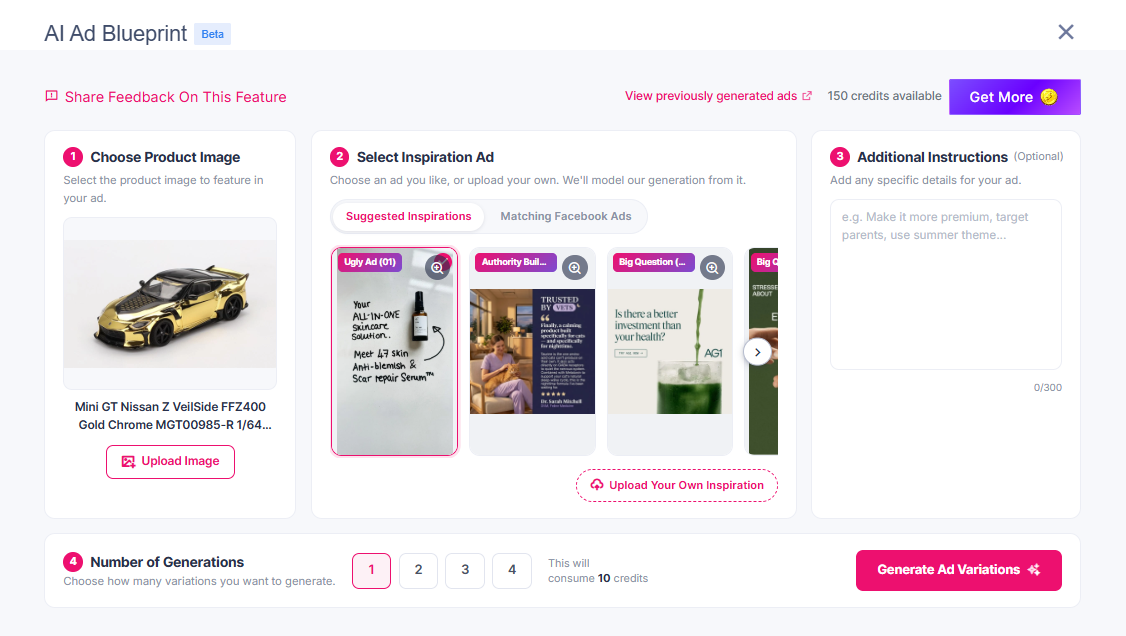
Choose a suggested format, use matching Facebook Ads Explorer examples, or supply your own inspiration. The creator recognizes approaches such as problem–solution or benefit-led messaging. For static ads, select a structure that makes sense for your product rather than choosing an image simply because it looks polished.
In the screenshots, the selected inspiration ad uses a handwritten-style layout. The generated result applies that visual approach to the model car, replacing the original product and message with a new product-focused creative.
Use our ad spy tools guide to research advertising angles. Adapt the idea to your product instead of copying another brand’s words or identity.
💡Pro Tip: Save a short note explaining why you selected each blueprint. Later, use it to compare the intended message with what the generated ad actually communicates.
Step 3: How Do You Generate Ads and Copy Together?
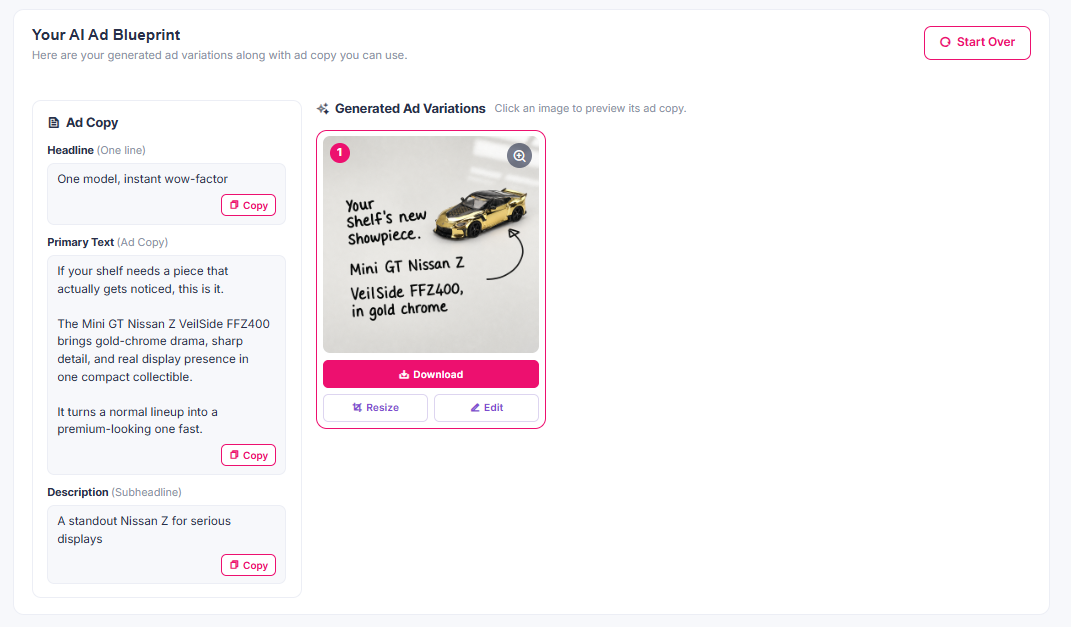
Generate multiple ad variations from your selected product and blueprint. Sell The Trend creates concepts that can include a visual, headline, primary text, and description. Review each complete ad creative as a unit, rather than selecting an image and leaving the accompanying message unchecked.
In the interface shown, Number of Generations offers options from one to four. One generation is selected, with an estimated cost of 10 credits. Choose the number of concepts you need, review the displayed estimate, and then select Generate Ad Variations.
The generated screenshot uses the message “Your Shelf’s new Showpiece.” For a separate gift-led version, try “A Model Car for the Car Fan in Your Life.” Treat these as creative directions to compare, not proven winning messages.
Compare the promise, not just the appearance: does the visual actually illustrate the headline? Keep concepts that communicate a distinct reason to consider the product.
Edit the generated message, layout, or creative direction without restarting the workflow. Choose one purposeful revision at a time: simplify a crowded image, sharpen the headline, or remove unnecessary text. For static ads, prioritize a clearly visible product and one benefit that your reader can understand.
For example, remove background props when they compete with the model car. Keep the product as the focal point, and check that its shape, wheels, and visible finish still match the original photo.
To preserve brand consistency, check fonts, colors, and product details across your static creatives. Save approved versions separately from drafts.
Label revisions by their main change, such as “benefit headline” or “closer product view,” so you can explain what distinguishes multiple variations.
Try to be as authentic as you can. Authenticity is essential in creating effective dropshipping ads using AI. Make authenticity part of your approval check: compare the generated model car with the supplied product image. Remove invented accessories, altered product details, or unsupported claims before publishing.
Step 5: How Do You Resize for Meta Placements?
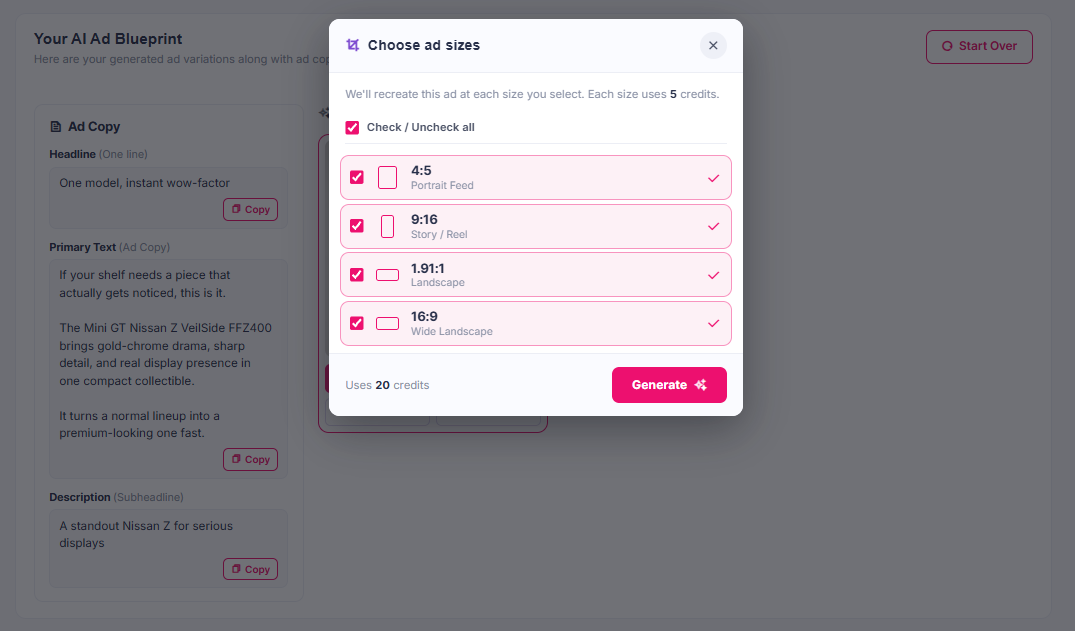
Resize your chosen creative using the creator’s supported ratios: 4:5 portrait, 9:16 Stories and Reels, 1.91:1 landscape, and 16:9 wide landscape. Review each composition, checking that the product, headline, and supporting details remain readable rather than approving every size automatically.
For our model car, keep the full vehicle visible rather than cropping away the front, rear, or wheels. Shorten the headline if the portrait version feels crowded, and check that the product remains recognizable.
Resizing static ads does not turn them into video ads; prepare a separate video asset when your concept requires motion.
The resize dialog shown here lists five credits per selected size. All four sizes are selected in this example, producing a displayed total of 20 credits. Select only the formats you need for the next test, and check the current estimate before choosing Generate.
Credit figures describe the interface captured for this walkthrough. Check your account for current requirements and available credits.
Download the finished creative and copy the generated text, then continue into campaign setup. Keep each image paired with its approved ad copy and destination product URL. Treat exported static creatives as ready for your final checks, not as ads that have automatically started running.
Before launching campaigns, confirm the budget, schedule, and placements in your Facebook ads account. These settings belong to Meta Ads Manager, not the creative-generation step.
Check that the destination opens the intended product page and that the offer matches your ad content. Correct any mismatch before your ads run.
No title
💡Pro Tip: Name files by product, concept, ratio, and version—for example, “model-car-display-4×5-v1.” Use matching names in your ad account so later results connect to the exact creative.
How Do You Turn AI-Generated Static Creatives Into Useful Tests?
Build tests around different reasons to buy, not just different colors. To generate static creatives worth comparing, give each concept a clear message and hypothesis. Meta’s creative diversification guidance covers differences in concepts, motivations, and formats, making this a useful framework for developing your next batch.
When generating creatives, label the intended message before reviewing the design. Keep that label alongside your performance data.
Which Three Concepts Could You Test First?
Try a display-led concept, a gift-led concept, and a detail-led concept. Three is a manageable example batch, not a required minimum or a promise of better results. For the model car, start with static ads and keep the photo consistent so the first comparison focuses on messaging rather than changing ad formats simultaneously.
Evidence note: This guide does not establish that testing at least three ad variations can increase CTR by 20%. The 20% figure is an unverified claim here, not an established benchmark. Treat three variations as a practical testing exercise, and measure the actual result rather than expecting a fixed improvement.
Concept
Suggested visual
Example headline
Display-led
Clear model-car photo
“Your Shelf’s New Showpiece”
Gift-led
The same model-car photo
“A Model Car for the Car Fan in Your Life”
Detail-led
The same model-car photo
“Take a Closer Look at This Model Car”
Keep the offer and destination consistent across these static ads. Test the chosen message in video ads separately to explore creative variations.
Ask AI tools for alternative hooks within each concept, but avoid testing every output at once. Select the versions that communicate genuinely different messages, and reserve minor layout changes for a later, more focused comparison.
How Do You Adapt Creatives for Multiple Platforms?
Adapt the presentation while keeping the product promise consistent across multiple platforms. Review cropping, text placement, pacing, and the call to action for each destination. When preparing Meta ads alongside social media posts, use consistent brand elements as a starting point for building brand recognition.
Sell The Trend’s AI-powered Video Ads Creator supports multiple ad formats, including 1:1, 9:16, and 16:9. Create a video version when a moving demonstration serves the concept.
For additional inspiration, use Sell The Trend’s TikTok Ads Explorer to filter examples by niche or keyword. Study how advertisers introduce the product, benefit, or buyer motivation before developing your own presentation.
For messaging beyond Meta ads, the separate AI Brand Builder generates copy for Facebook, TikTok, and Google ads. Keep that copywriting function separate from campaign setup and publishing.
How Should Campaign Management and Creative Testing Work Together?
Use campaign management to define the conditions under which you evaluate an ad creative: the objective, audience, budget, and schedule. Then use creative testing to answer a specific question about the message or format, rather than changing everything together and guessing what caused the result.
Meta provides A/B testing and lift-testing guidance for measuring creative impact. Use the appropriate test design rather than treating ordinary ad delivery as a controlled experiment.
For your first Meta ads comparison, record the concept and measurement goal before launching. Keep a simple test log so multiple variations remain traceable to the decisions behind them.
No title
💡Pro Tip: Write the test question first: “Does a gift-led message produce a lower cost per purchase than a display-led message?” Review the result against that question before generating another batch of static creatives.
Which Performance Data Should Guide Your Decisions?
Use link click-through rate (CTR) to assess response, store conversion rate to assess completed purchases, and cost per purchase and return on ad spend (ROAS) to evaluate spending. Review creative performance over comparable periods, keeping attribution settings consistent before choosing which Meta ads deserve further testing.
Your store’s conversion rate measures the percentage of sessions resulting in purchases. Investigate the product page and checkout when clicks rise without orders.
Cost per purchase divides advertising costs by attributed purchases. In a hypothetical test, spending $60 for three purchases gives a $20 cost per purchase.
Suppose another model-car ad earns more clicks but costs $30 per purchase. With equal order values and product costs, the $20 version looks more promising.
Check the number of purchases behind both. Treat the difference as a reason to investigate further, not proof of a winner from three purchases.
ROAS compares attributed revenue with advertising cost, not profit. Check product costs, shipping, fees, and returns before deciding that your best-performing ads are commercially worthwhile.
Before acting on fresh results, allow for conversions still arriving within your attribution window. Meta distinguishes mature reporting data from incomplete conversion windows.
How Do You Recognize Creative Fatigue Without Arbitrary Cutoffs?
Creative fatigue is declining response after people repeatedly see the same creative. Meta’s analytics team warns that reported frequency is a poor standalone signal, so do not diagnose fatigue from a frequency of 3.0 or assume Meta ads expire after 7–21 days. Review sustained performance changes instead.
For example, investigate falling CTR alongside rising purchase costs, but also check whether tracking, pricing, availability, or the landing page changed.
To combat creative fatigue, develop a different demonstration or angle. Recoloring static ads should not be your entire refresh strategy.
When Should You Refresh, Pause, or Keep an Ad?
Keep ads that continue meeting your campaign goal, refresh concepts when evidence suggests creative fatigue, and pause tests that reach your predetermined spending limit without acceptable results. Before replacing static ads, check the wider buying experience; a broken checkout needs fixing, not a different headline.
Use performance data to identify promising creative elements, then test them again. Avoid letting a few early clicks dictate your entire creative process.
On Meta’s platform, eligible flexible ads group images, videos, and text so Meta’s algorithm can select the format for delivery. These options help optimize delivery, but automated selection should not replace a controlled test when you need to compare specific concepts.
Return to Sell The Trend’s AI Ads Creator with your next creative brief. For example: “Show the gold-colored model car from a different angle and focus the headline on its display appeal. Include dimensions only when they have been verified, and keep the product’s appearance consistent with the supplied photo.”
To limit wasted ad spend, set a review date and spending limit for that version. Check whether creative performance improves before expanding the test.
No title
💡Pro Tip: Note what your top-performing creatives have in common without assuming those details caused the results. Use those observations to make data-driven creative decisions, then keep reviewing whether your ads remain effective.
Choose an AI-powered tool around the task you need help with: product research, static ads, creative analysis, or campaign management. Compare its inputs, outputs, and editing options before subscribing. Match documented capabilities to your workflow, rather than treating software claims as proof of better results.
Tool
Starting point
Documented output
Check before using
Sell The Trend
Product information + blueprint
Visual, headline, primary text, and description.
Review generation and resizing credit estimates; campaign setup follows export.
AdCreative.ai
Product assets or webpage
AI image generation, video, and copy.
Connect an ad account to use Creative Insights analysis.
AdStellar
Product URL
Image and video ads, with access to campaign setup.
Review the extracted product details and generated copy before moving into campaign setup.
Choose the tool that fills the missing step in your workflow, then review its outputs and account requirements before committing to a subscription.
Where Does Sell The Trend Fit Best?
Sell The Trend fits e-commerce businesses that want to connect product discovery with ad creation. Start with Nexus AI, explore advertising approaches in Facebook Ads Explorer, then use the creator to generate ads. The documented process ends with editing, resizing, and downloading assets for your campaign.
The wider all-in-one platform includes SellShop, a built-in store builder, alongside inventory synchronization and order fulfillment. These support store operations beyond creative generation.
Use that connected workflow to research a product before you create ads, then carry verified details into your brief. Use that connected workflow to research a product before you create ads, then carry verified details into your brief. For our model car, keep its dimensions, finish description, and included accessories consistent across every concept.
When Might AdCreative.ai or AdStellar Be Useful?
Consider AdCreative.ai for conversion-focused creative generation, including AI image generation, and AdStellar for producing Meta ads from a product URL and moving them into campaign setup. Choose based on the missing step in your process, rather than replacing tools because another platform promises faster output.
AdCreative.ai’s Creative Insights analyzes a connected ad account to identify your top-performing ads and text.
AdStellar also supports AI-generated UGC-style video ads with synthetic presenters. Use these as scripted advertising, not invented customer experiences.
What Should You Check Before Choosing AI Tools?
Check generation credits, export formats, editing skills required, and ad account permissions. Before adding third-party tools, try the same product brief in each candidate and count the usable static creatives. Evaluate an AI-powered workflow by the effort needed to approve an accurate ad creative, not the number of drafts.
Ask whether the subscription covers the features you will actually use. For example, distinguish generating an image from downloading it, making revisions, or accessing analytics.
No title
💡Pro Tip: Time a complete brief-to-export session, including corrections. Compare the cost per approved ad creative rather than the advertised generation time.
Frequently Asked Questions About AI Facebook Ads for Dropshipping
Before your first test, check what the tool accepts, what it exports, and which campaign decisions remain yours. Use these answers to set expectations for AI-assisted production. Keep the distinction clear: generating an asset, launching an ad, and proving its performance are separate tasks.
Can AI Create Facebook Ads From a Product URL?
Yes, with tools that support URL inputs. Sell The Trend’s separate Video Ads Creator accepts a product URL or uploaded media; its blueprint creator documents product information and images as inputs. Check the selected tool’s requirements before assuming the same URL-based process works across both features.
How Long Does It Take to Generate Static Creatives?
Sell The Trend’s product page does not specify a fixed generation time. Measure your full ad creation session, including preparation, generation, review, and resizing, rather than assuming a finished ad takes 90 seconds. The documented workflow includes editing after generation, so budget time for checking the output.
Prepare accurate product photos and specifications before starting; record how long corrections take alongside the initial generation.
Are AI-Generated Static Creatives Better Than Video Ads?
Neither format should be treated as an automatic winner. Meta recommends diversifying concepts and ad formats; for your store, compare static ads with motion when a demonstration adds useful information. Choose according to the results of a relevant test, not whether the asset was generated by AI.
How Many Ad Variations Should You Test?
Start with a batch small enough to evaluate within your budget. Our three-concept example is a planning option, not a universal minimum; Meta’s testing guidance emphasizes experiments and metrics rather than a guaranteed result from any particular number of ads. Test meaningful differences before producing more versions.
For example, compare a display-led message with a gift-led message while keeping the product photo, offer, and format consistent.
How Often Should You Replace Meta Ads?
Review Meta ads regularly, but replace them when evidence supports a change—not because a fixed number of days has passed. Meta’s analysis links creative fatigue to repeated exposure and cautions against using frequency alone. Assess sustained changes in performance data before deciding that the creative needs replacing.
Check tracking, stock, pricing, and checkout functionality before attributing a decline to the ad.
Can AI Replace Campaign Management?
AI can support campaign management, but creative generation alone does not run your entire marketing ecosystem. For example, Meta’s algorithm can select formats from supplied assets in eligible flexible ads. Keep responsibility for product accuracy, budgets, tracking, and commercial decisions instead of assuming automation will handle them.
Treat creative production and campaign operation as connected tasks with separate checks.
How Can You Start Building Winning Creatives Today?
Start with one product researched through Nexus AI, choose a blueprint, and develop a few concepts through Sell The Trend’s AI Ads Creator. Its workflow brings the visual and copy together, then lets you edit, resize, and download assets. Make testing the next step, not an optional extra.
Use the model-car example to guide your dropshipping ad strategies: identify a buyer motivation, show the real product accurately, and make the next step clear. Keep the product promise consistent from the first impression to checkout.
For Facebook ads for dropshipping products, judge the next batch by what it teaches you, not simply by how many files you export.
No title
💡Pro Tip: Keep a reusable folder with verified product photos, specifications, approved claims, and previous test notes. Update it before each new brief.
👉 Start your 14-day Sell The Trend free trial and build your first blueprint-based creative. Choose one product, prepare your first test, and let the results guide what you create next.
Lisa is an eCommerce and digital marketing specialist with over 6 years of experience helping online businesses grow through data-driven strategy and hands-on execution.
She has worked across dropshipping and direct-to-consumer channels, focusing on product research and performance marketing. At Sell The Trend, she creates practical, research-backed content to help merchants make confident decisions.