To build an AI product research system, use ChatGPT to uncover customer problems and generate product ideas, then use Sell The Trend, AI powered dropshipping software built to validate those ideas with real sales trends, competitor data, supplier information, and market demand signals. This creates a repeatable workflow that replaces guesswork with evidence.
For sellers exploring AI Dropshipping, the challenge is not finding more ideas. It is knowing which ideas are worth pursuing, which is exactly the problem an AI product research platform is designed to solve. In this guide, you will learn how to move from AI brainstorming to product discovery, demand validation, competitor research, supplier checks, and a final launch decision using the Five-Layer AI Product Research System.
Key Takeaways
An AI product research system combines AI brainstorming with real market validation.
ChatGPT can uncover customer problems and generate ideas, but it cannot confirm live demand, competition, or supplier quality.
Sell The Trend acts as the verification layer by showing sales trends, competitors, suppliers, and market momentum.
A strong AI product research workflow moves through five stages: customer problems, product discovery, demand validation, competitive intelligence, and supplier validation.
The goal is not to find more ideas. It is to identify which ideas are worth launching.
Yes, but only if AI is used as part of a larger research system. AI can generate ideas, identify customer pain points, and uncover niche opportunities. However, winning product research still requires real-world sales trends, competitor data, supplier information, and market demand signals.
A tool like ChatGPT can help you decide what to investigate. Sell The Trend can then help you check whether demand is growing, how crowded the market is, and whether suitable suppliers are available. This keeps AI in the brainstorming role while market data guides the final decision.
Ready to validate your product ideas? Start your free Sell The Trend trial and turn AI-generated possibilities into evidence-backed opportunities.
Why Does Most AI Product Research Fail?
Most AI product research fails because AI generates plausible ideas without proving that people are buying them. It cannot reliably see live transactions, measure current saturation, verify supplier performance, or confirm whether demand is rising. Without a separate validation step, product selection remains educated guesswork.
Ask ChatGPT for products to sell, and it may suggest portable blenders, posture correctors, pet grooming gloves, or compact storage products. These ideas may solve real problems, but the recommendation alone does not reveal:
Whether sales are increasing or declining
How many stores already sell the product
What competitors charge
Whether margins can support advertising costs
Whether reliable suppliers can fulfil orders consistently
AI recommendations are also shaped by patterns in their training data. That makes them useful for brainstorming, but not a replacement for current market research or a structured dropshipping product research process.
For example, a product may appear popular across blog posts and social content while its sales momentum is already slowing. Another product may have strong demand but operate in a competitive landscape where dozens of established stores use the same pricing and advertising angles.
What Does an AI-Assisted Product Research System Actually Look Like?
An AI-assisted product research system is a repeatable workflow that moves from customer problems to a clear launch decision. Instead of relying on one prompt or platform, sellers combine idea generation, demand validation, competitor analysis, supplier research, and trend monitoring to turn scattered information into actionable insights.
This is the Five-Layer AI Product Research System:
AI Idea Generation
        ↓
Trend Validation
        ↓
Competitor Research
        ↓
Supplier Research
        ↓
Launch or Reject
ChatGPT supports the first layer by helping sellers explore customer needs, frustrations, and buying motivations. Sell The Trend supports the validation layers by bringing sales signals, competitor activity, product trends, and sourcing options into the same research process.
This structure also reduces manual research. Instead of switching between dozens of unrelated data sources, sellers can move through the same checks for every idea and store their research findings in a searchable system. The same principle applies when teams want one place to work across different models during research and evaluation. Using multiple llms in one place can make it easier to compare outputs without scattering prompts and notes across separate tools.
The goal is not to remove human judgment. It is to give sellers enough evidence to compare opportunities consistently and reject weak ideas before spending money on a store, ads, or inventory.
Use AI to brainstorm. Use Sell The Trend to validate. Start your free Sell The Trend trial and turn your next product idea into an evidence-backed launch decision.
Which Sell The Trend Tool Is Used at Each Stage?
Each stage of product research requires a different type of evidence. The table below shows where Sell The Trend’s tools fit into the workflow.
Research stage
Research task
Sell The Trend tool
Product discovery
Find products connected to a customer problem
NEXUS Product Research
Demand validation
Review sales activity, momentum, pricing, and competition
NEXUS Product Research
Competitor research
Analyze competing products, stores, pricing, and ads
Competition Explorer and Store Intelligence
Social trend research
Review products and ads gaining attention on TikTok
TikTok Viral Ads Explorer
Supplier validation
Compare suppliers, prices, ratings, and shipping options
AI Supplier Finder
Store launch and management
Import products, synchronize inventory, and process orders
SellShop and Store Automation
Step 1: Use AI to Understand Customer Problems
Use AI to identify recurring frustrations, desired outcomes, and buying triggers before searching for products. ChatGPT can organize product reviews, survey insights, and social media conversations into clear problem themes. This gives you a stronger starting point than asking it to generate a random list of products.
Start with clear research objectives. Decide whether you want to uncover common complaints, unmet expectations, purchase motivations, or problems that current products fail to solve.
Try prompts such as:
“What are the biggest frustrations new puppy owners experience?”
“What products help people organize small apartments?”
“Analyze these product reviews and group the complaints by frequency, urgency, and desired outcome.”
“What workarounds are customers currently using to solve this problem?”
“Which complaints suggest customers would pay for a better solution?”
Natural language processing helps AI sort unstructured data from reviews, forums, surveys, and comments. Sentiment analysis can then highlight repeated frustration, disappointment, or enthusiasm around specific problems.
This approach can also reveal market gaps. For example, if buyers repeatedly complain that existing pet paw cleaners are difficult to wash, the opportunity may not be a completely new product. It may be a cleaner version with removable parts or easier maintenance.
AI can also generate draft customer personas and likely objections to help you test early concepts. Treat these as hypotheses, not proof. Using the same evidence and scoring criteria for every niche can reduce human bias during the first stage, but real buyer behavior must still guide the final decision.
No title
Pro Tip: Ask ChatGPT to rank each problem by frequency, urgency, and willingness to pay. A common complaint is not automatically a strong opportunity unless customers care enough to purchase a solution.
By the end of this step, you should have three to five clear customer problems. The next step is to find products that solve them and determine which opportunities deserve deeper validation.
Step 2: Turn Those Problems Into Product Opportunities
Turn each customer problem into clear product criteria, then use Sell The Trend’s NEXUS AI to find products that match the audience, frustration, and desired outcome. This narrows broad AI-generated ideas into a shortlist of relevant products that can be tested against real demand in the next stage.
For example, suppose ChatGPT identifies this problem:
Dog owners struggle to clean muddy paws before their pets enter the house.
Instead of searching for one obvious item, list several ways to solve it:
Portable paw cleaners
Absorbent pet mats
Paw-cleaning brushes
Washable pet wipes
Waterproof dog boots
Use NEXUS AI as an AI-powered product discovery engine to find products connected to the customer problem. It analyzes 26 product data points and combines ecommerce activity, competition, pricing, supplier options, and predictive trend signals to help remove guesswork from product selection. For businesses developing physical products, an ai techpack can help organize design specifications, materials, measurements, and other product details before moving into manufacturing.
Evaluate each product using five questions:
Does it solve the original problem clearly?
Can buyers understand the benefit quickly?
Is the product easy to demonstrate?
Is there room for pricing, shipping, and advertising costs?
Does the available data justify deeper research?
Do not choose a product yet. The purpose of this step is to reduce a long list of possibilities to two or three candidates.
The next step is to verify whether customers are actually buying them.
Step 3: Verify That People Are Actually Buying
A product should move forward only when current market evidence shows real demand. Use NEXUS Product Research to compare order activity, sales momentum, pricing, competitor activity, and saturation signals. For social-commerce validation, use the TikTok Viral Ads Explorer to review trending products, advertiser activity, and the ads currently attracting attention.
Focus on 4 signals:
Signal
What to Check
Sales momentum
Are orders increasing, stable, or falling?
Trend velocity
Is demand building gradually or spiking briefly?
Market saturation
How many stores and ads already promote the product?
Profit potential
Can the selling price cover sourcing, shipping, fees, and advertising?
Start with historical sales data to see whether demand has lasted beyond a short viral moment. Then compare it with recent activity. A strong 6-month total means less if most sales happened months ago and current orders have slowed.
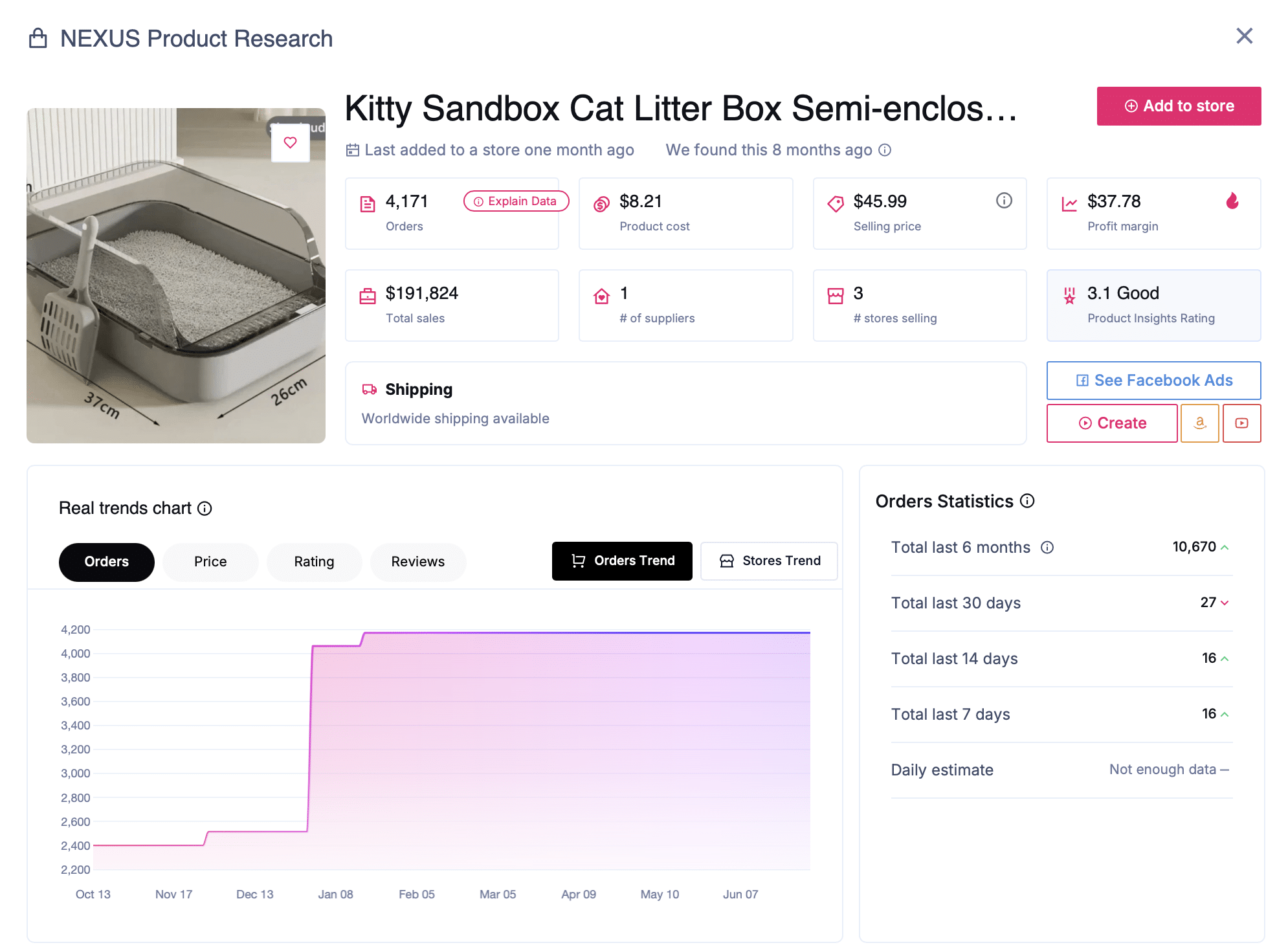
Here’s a great example of a historically popular product on Sell The Trend:
According to NEXUS data, it generated 4,171 orders and $191,824 in total sales, but only 27 orders in the last 30 days, showing why recent momentum matters as much as lifetime performance.
A useful market trends analysis looks at direction, speed, and consistency. NEXUS Product Research can show whether sales and order activity are gaining momentum, while the TikTok Viral Ads Explorer helps you review trending products, advertiser activity, and TikTok ad patterns.
Predictive analytics can forecast future behavior using past data, but it cannot guarantee what will happen next. Treat forecasts as supporting evidence and compare them with real time data, current ads, and recent order activity.
Winning product research should answer three questions:
Are buyers purchasing the product now?
Is demand growing fast enough to justify entering?
Is there still room to compete profitably?
No title
Pro Tip: Avoid products with one dramatic spike and no follow-through. Steady order growth over several weeks usually provides a stronger signal than a single viral surge.
At the end of this step, either move the product into competitive analysis or reject it. A weak demand signal is a reason to keep researching, not a reason to hope.
Step 4: Analyze Competitors Using AI
Once demand is confirmed, use Sell The Trend’s Competition Explorer to search for the product and identify competing sellers, pricing approaches, offers, and positioning.
You can then use Store Intelligence to examine competitor stores, including their best-selling products, recent additions, marketing channels, pricing strategies, and available advertising activity.
The workflow is simple:
Find a promising product in NEXUS Product Research.
Search for the product in Competition Explorer.
Identify stores selling the same or similar products.
Compare competitor prices, offers, and positioning.
Use Store Intelligence to review best sellers, recent additions, marketing channels, and ads.
Look for gaps that could help your offer stand apart.
For example, after finding a semi-enclosed litter box in NEXUS Product Research, search for that product in Competition Explorer.
You can then identify competing sellers and compare their pricing, offers, and positioning. Store Intelligence can provide a deeper view of individual stores, including their best-selling products, recent additions, marketing channels, and ads.
This makes competitive research faster than searching Google, marketplaces, and individual competitor websites one by one. It also gives you a clearer view of the competitive landscape before you invest in a store or marketing campaign.
Look for answers to these questions:
Are only a few stores selling the product, or is it already everywhere?
Do most sellers use the same images and product descriptions?
What benefits do competitors emphasize?
Are they competing on price, convenience, quality, or shipping?
Can you create a clearer offer for a specific audience?
The goal is not to copy another store. It is to understand what already exists, identify weak positioning, and decide whether you can offer a meaningful difference. When you need to examine the ads behind those offers more closely, ad spy tools can help you study creatives, hooks, and promotion patterns.
If the product appears heavily saturated and every seller uses the same angle, reject it or return to Step 2. If demand is healthy and competitors leave clear gaps, move on to supplier validation.
Step 5: Validate Suppliers Before You Launch
Validate suppliers before launching by comparing product quality, shipping times, order history, warehouse location, costs, and fulfillment capacity. Sell The Trend’s Supplier Database and AI Supplier Finder help you compare USA, European, and international suppliers based on product cost, shipping speed, ratings, quality, and service.
Beginners often skip this step because demand and competitor data feel more exciting. However, strong sales potential means little if customers receive damaged products, wait several weeks for delivery, or discover that the item looks different from the advertisement.
Use this supplier validation checklist:
Supplier Check
What to Review
Product quality
Ratings, reviews, materials, images, and customer complaints
Shipping reliability
Delivery estimates, tracking availability, and destination coverage
Fulfillment speed
Processing time before the order leaves the warehouse
Product cost
Item price, shipping fees, taxes, and possible discounts
Order history
Completed orders and recent buyer experiences
Communication
Response speed and willingness to answer detailed questions
Inventory
Current availability and ability to handle increased volume
Sell The Trend can help you compare sourcing options connected to the product you researched. The Supplier Database connects products with ranked USA and international suppliers, while the AI Supplier Finder helps compare options based on price, shipping speed, product quality, and supplier ratings.
Do not select a supplier based on price alone. A lower product cost can quickly become expensive when refunds, chargebacks, replacements, and poor reviews begin to increase.
Before committing, order a sample and check the product yourself. Review its packaging, instructions, build quality, delivery time, and whether its key features match the listing. You can also contact the supplier with a few questions to see how quickly and clearly they respond.
Pro Tip: Test the full customer experience, not just the item. Place a sample order using the same shipping method your buyers will receive.
A supplier should support the opportunity, not create a new risk. Once demand, competition, and sourcing all look viable, the final step is monitoring momentum so you can act before conditions change.
What Happens After a Product Passes Validation?
Once a product passes demand, competition, margin, and supplier checks, the next step is to connect it to your store and prepare the fulfillment process. This is where product research becomes an operational workflow rather than a one-time decision.
Sell The Trend’s store automation tools can help you:
Push validated products to your store
Synchronize product and inventory information with suppliers
Forward new orders to the correct supplier with one-click fulfillment
Send shipping and tracking information to customers
Reduce manual data entry and the risk of selling out-of-stock products
This means the research process does not end when you identify a promising product. The same platform can help move that product from discovery and supplier selection into store management and order processing.
Before launching ads, confirm that the product listing, supplier connection, inventory synchronization, shipping option, and order workflow are working correctly.
Ready to move from product validation to launch? Start your free Sell The Trend trialand manage product discovery, suppliers, and fulfillment in one connected workflow.
Putting the Entire Workflow Together
The complete AI product research workflow moves from a customer problem to a launch or reject decision. Each stage removes uncertainty by adding demand, competition, supplier, and trend evidence. Trend monitoring continues across all five layers rather than acting as a separate one-time check.
Here is how the process could work for a pet product:
Stage
Example
Customer problem
Dog owners struggle with muddy paws after walks
AI research
ChatGPT identifies cleanup time, dirty floors, and difficult washing as common frustrations
Product discovery
NEXUS surfaces paw cleaners, absorbent mats, wipes, and cleaning brushes
Demand validation
Recent orders and sales momentum show which solutions buyers currently prefer
Competitor research
Competition Explorer and Store Intelligence reveal competing stores, pricing, products, ads, and marketing angles
Supplier validation
The Supplier Database and AI Supplier Finder confirm supplier ratings, product costs, shipping options, and sourcing availability
Trend monitoring
Weekly checks show whether demand is growing or losing momentum
Final decision
Launch the strongest candidate or reject the opportunity
For example, a portable paw cleaner may solve the problem clearly, but it should only move forward if recent demand is healthy, the market leaves room for differentiation, and a dependable supplier can deliver it at a workable cost.
This is what makes the system repeatable. ChatGPT helps you understand the customer problem. Sell The Trend helps you test the opportunity against real ecommerce activity. The final choice is based on evidence gathered across the full workflow, not one AI-generated recommendation.
The Biggest AI Product Research Mistakes to Avoid
The biggest mistakes are treating AI as the only tool, confusing ideas with evidence, chasing products after a viral spike, ignoring supplier risk, and copying competitors without understanding their strategy. Strong decisions combine ai tools with current sales signals, customer feedback, competitive monitoring, and human judgment.
Avoid these common errors:
Trusting AI blindly: AI can suggest useful ideas, but its data analysis is only as reliable as the information provided.
Chasing viral products too late: A sudden spike may already be fading. Watch for sustained demand and wider market shifts.
Skipping validation: Collect evidence on sales, pricing, competition, and suppliers before making a launch decision.
Ignoring supplier quality: Low costs mean little if shipping is slow or the product creates refunds and poor reviews.
Copying competitors: Use competitors as competitive benchmarks, not templates. Look for gaps in their offers, messaging, or audience targeting.
Using too many disconnected platforms: Adding more tools does not improve the process unless each one answers a specific research question.
No title
Pro Tip: Create a simple pass-or-fail checklist for every product. If an idea fails demand, competition, or supplier validation, reject it instead of adjusting the criteria to justify the launch.
A repeatable workflow protects you from emotional decisions. The goal is not to prove that every idea can work. It is to eliminate weak products before they cost you time and money.
Frequently Asked Questions
Can ChatGPT Find Winning Products?
ChatGPT can suggest product ideas, summarize customer interviews, and organize research data, but it cannot confirm live demand on its own. Use it to form hypotheses, then validate those ideas in real-world contexts with sales activity, competitor evidence, supplier information, and tools such as Sell The Trend.
Can AI Replace Product Research?
No. AI can speed up data collection, data extraction, and early analysis, but it should not replace market researchers, focus groups, product testing, or other traditional methods. Human judgment is still needed to interpret consumer behavior, test assumptions, and decide whether an opportunity fits the business.
What Is the Best AI Product Research Tool?
ChatGPT is useful for uncovering customer problems and generating product hypotheses. Sell The Trend is the stronger choice for product discovery and commercial validation because NEXUS AI connects product trends with sales activity, competitors, pricing, and supplier options. The most reliable workflow uses ChatGPT for brainstorming and Sell The Trend for evidence-backed decisions.
How Do Ecommerce Brands Use AI for Product Research?
Ecommerce brands use AI-powered tools to study user feedback, organize user interactions, spot changes in user behavior, and summarize large amounts of information. Marketing teams can use these findings to refine product concepts, messaging, and offers before investing in larger campaigns.
Can AI Predict Product Trends?
AI can estimate future trends by applying machine learning and advanced algorithms to historical information. These systems help with identifying patterns humans may miss, but forecasts are not guarantees. Unexpected competition, social shifts, pricing changes, and supply issues can quickly affect the result.
How Does AI Make the Research Process Faster?
AI speeds up market research processes by automating repetitive tasks such as sorting reviews, grouping complaints, summarizing surveys, and comparing products. Instead of spending weeks turning raw data into reports, a team can surface key insights and valuable insights in hours, then spend more time evaluating the strongest opportunities. Pairing this speed with employee monitoring software gives managers visibility into how that saved time is being reinvested across the team.
Should Product Research Be Shared Across the Team?
Yes. Research findings should be stored in a searchable system that the entire team can access. This helps preserve proprietary research, prevents repeated work, and keeps product, sourcing, and marketing decisions connected to the same evidence.
Takeaway: Use AI to Brainstorm and Sell The Trend to Validate
An AI product research system works best when each tool has a clear role. ChatGPT can uncover customer problems and generate ideas, while Sell The Trend helps validate those ideas using sales momentum, competitor intelligence, supplier options, and market demand signals.
The Five-Layer AI Product Research System gives you a repeatable way to move from customer problems to product discovery, demand validation, competitive intelligence, and supplier checks. Instead of launching based on a promising suggestion, you make decisions using evidence.
AI can show you what to investigate. Sell The Trend helps you decide what is worth pursuing.
Ready to turn AI-generated ideas into validated product opportunities? Start your free Sell The Trend trial and use real sales, competitor, supplier, and trend data to make your next launch decision.
Maria is a marketing specialist with hands-on experience in digital growth strategies and eCommerce.
As part of the Sell The Trend team, she has developed deep expertise in dropshipping through close work with product research, trend analysis, and go-to-market strategies used by successful online sellers.
Her content focuses on practical marketing insights, audience behavior, and data-driven decision-making to help merchants launch and scale with confidence.





![Discover Dropshipping TikTok Niches: Tap Into Emerging Markets [Analysis]](https://www.sellthetrend.com/wp-content/uploads/2026/10/editorial-hero-img-1791824763061-h7ghs-1.png)