The short answer is no. ChatGPT can generate product ideas and help with market research, but it cannot verify real-time demand, supplier performance, or advertising data, making product validation essential before you invest in ads.
While the broader world of AI dropshipping can help sellers automate research, content creation, and store-building tasks, product validation is a completely different challenge. A product that looks like a winner in an AI-generated response may already be saturated, unprofitable, or facing fulfillment issues.
To find out how reliable AI product recommendations really are, we ran a simple test. We asked ChatGPT to identify trending dropshipping products, then compared those recommendations against live ecommerce data inside Sell The Trend, an AI product research platform built specifically to validate that kind of demand.
The results revealed exactly where AI excels, where it falls short, and why validating product ideas before spending money on ads is more important than ever, especially as AI powered dropshipping software takes on more of that validation work automatically
Key Takeaways
ChatGPT can generate product ideas, but it cannot verify whether those products are actively selling right now.
Winning products are determined by real-time demand, profit margins, advertising costs, and supplier performance.
Many AI-recommended products are based on historical popularity rather than current market momentum.
Sell The Trend helps validate product ideas using live ecommerce data before you invest money into advertising.
Can ChatGPT Find Winning Products? Here’s the Short Answer
No, ChatGPT cannot natively find winning products because it lacks real-time access to actual merchant transaction volumes, live supplier logistics logs, and raw ad account velocities. However, it can act as a powerful conceptual brainstorming assistant when paired with a live ecommerce data intelligence engine like Sell The Trend.
ChatGPT is excellent for brainstorming product ideas, identifying niches, and organizing research. However, it cannot verify live sales velocity, supplier reliability, advertising performance, or real-time ecommerce demand. Those signals require dedicated product research tools.
What it cannot do is verify whether those products are actively selling today. It cannot see sales velocity, supplier activity, advertising performance, or other real-time signals that successful dropshippers use to make decisions.
In other words, ChatGPT can generate product ideas. Validating those ideas requires real data.
To see how reliable AI recommendations really are, we put ChatGPT to the test.
ChatGPT vs. Sell The Trend: Which Tool Can Actually Validate Products?
Capability
ChatGPT
Sell The Trend
Generate product ideas
✅
✅
Brainstorm niche opportunities
✅
✅
Analyze customer pain points
✅
✅
Access live sales trends
❌
✅
Validate product demand
❌
✅
Analyze supplier performance
❌
✅
Estimate profit margins
❌
✅
Track sales velocity
❌
✅
Evaluate shipping quality
❌
✅
Monitor market saturation
❌
✅
Analyze competitor activity
Limited
✅
Make data-backed product decisions
❌
✅
What Products Does ChatGPT Recommend for Dropshipping?
To test whether ChatGPT can identify winning products, we gave it a straightforward prompt and compared its recommendations against real ecommerce data.
Within seconds, ChatGPT returned a list of products that looked reasonable on the surface:
Sunset Lamp
Pink Spicule Serum
Ergonomic Baby Carrier
Automatic Pet Feeder
LED Motion Sensor Night Light
If you’ve spent any time researching ecommerce, these recommendations probably look familiar. In fact, that’s part of the problem.
Many of these products have appeared in blog posts, YouTube videos, product roundups, and dropshipping guides for years. They are common examples that frequently appear whenever someone asks AI tools to find products with high demand.
At first glance, that might seem like a good sign. But product discovery is not about finding products that were popular. It’s about finding products that are gaining traction right now.
ChatGPT generates answers by recognizing patterns from existing information. It does not monitor live merchant activity, track sales velocity, or analyze supplier shipping data. As a result, it often recommends products that have strong historical visibility but may no longer represent the best opportunities in today’s market.
What Makes a Winning Product in 2026?
A winning product is more than something that’s popular on social media. It needs to show consistent demand, healthy profit margins, reliable fulfillment, and enough room to compete profitably in today’s market.
Before evaluating ChatGPT’s recommendations, it’s important to understand what experienced dropshippers actually look for when validating a product.
Demand trend: Look for products with growing or consistent demand rather than short-lived viral spikes.
Competition: A product can have demand, but too many established competitors may make it difficult to stand out.
Supplier quality: Reliable suppliers help reduce fulfillment issues, stock shortages, and customer complaints.
Shipping speed: Fast and dependable delivery has become a major factor in customer satisfaction and repeat purchases.
Profit margins: A product should leave enough room to cover advertising, transaction fees, and other operating costs while remaining profitable.
Advertising costs: Even a popular product can become unprofitable if customer acquisition costs are too high.
Market saturation: Products that have already peaked often attract heavy competition and lower conversion rates.
These are the factors ChatGPT cannot fully evaluate on its own. With that framework in mind, let’s see how its product recommendations performed when tested against real ecommerce data.
No title
Pro Tip: Don’t judge a product by demand alone. Check at least three signals before testing ads: recent order activity, supplier reliability, and your expected profit margin after shipping and advertising costs.
Are ChatGPT’s Product Recommendations Actually Selling? Let’s Check the Data
Product recommendations are only as valuable as the data used to validate them. A product may look promising in ChatGPT, but without live order trends, supplier quality, profit margin analysis, and advertising signals, it’s impossible to know whether it’s still worth selling.
To validate ChatGPT’s suggestions, we checked each product inside Sell The Trend’s NEXUS Product Research tool and compared the recommendations against real market activity.
What we found was a reminder that product discovery and product validation are not the same thing.
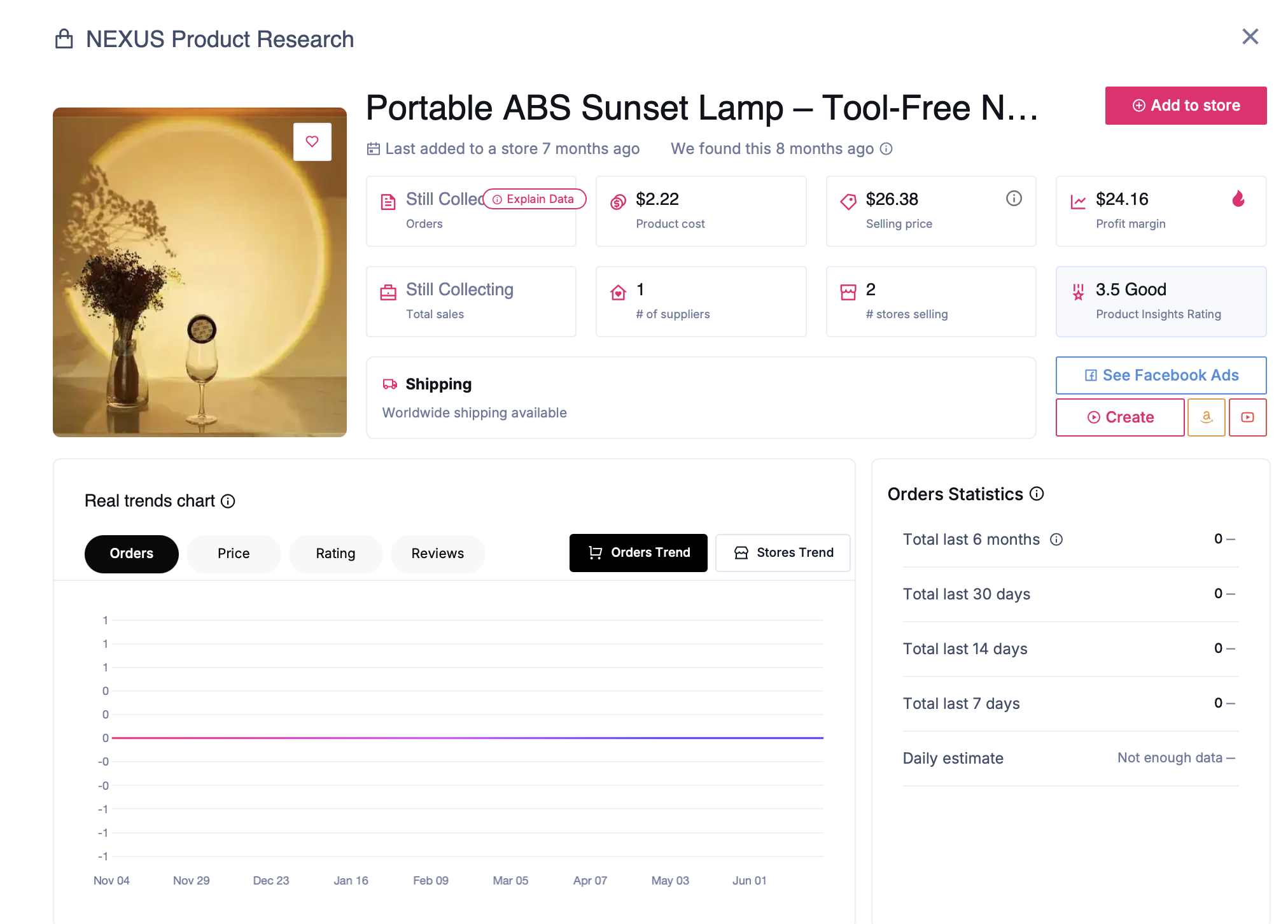
Product #1: Sunset Lamp (Saturation Risk)
The sunset lamp was one of ChatGPT’s first recommendations. A few years ago, that would have been a great suggestion. The product exploded across TikTok, Instagram, and countless ecommerce stores.
Today’s data tells a different story.
Despite its popularity, recent order activity has essentially flatlined. The product showed no recorded orders in the last 30 days, 14 days, or 7 days, suggesting demand has cooled significantly since its peak.
Metric
Result
Product Cost
$2.22
Selling Price
$26.38
Last 30 Days Orders
0
Last 14 Days Orders
0
Last 7 Days Orders
0
This is a common limitation of AI-generated recommendations. ChatGPT can recognize products that were successful, but it cannot determine whether they are still trending products today.
No title
Pro Tip: A product that went viral a year ago isn’t necessarily a good opportunity today. If recent order activity has stalled, you’re often entering the market after the peak rather than before it.
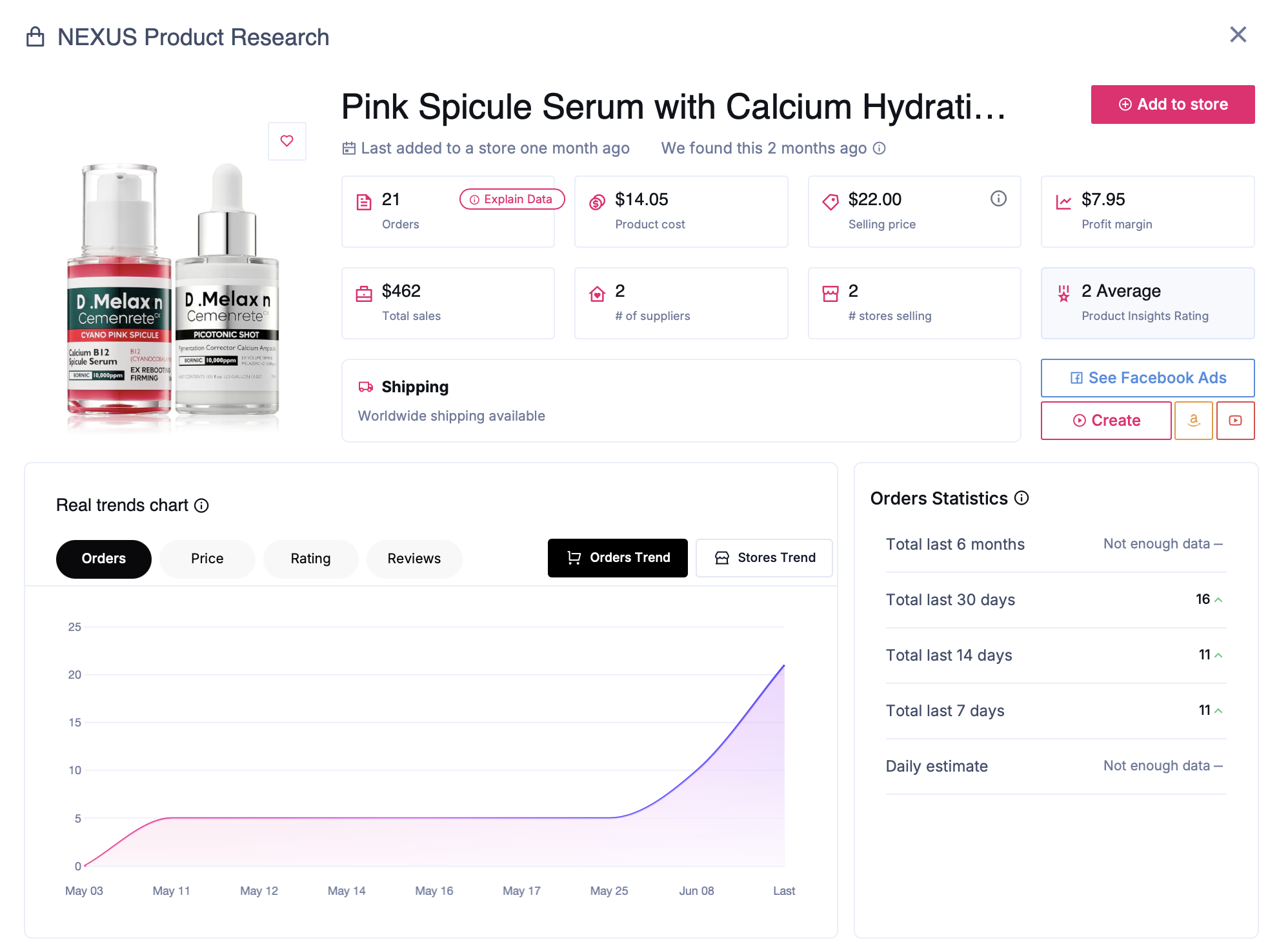
Product #2: Pink Spicule Serum (Margin Risk)
Next, we examined a beauty product that showed genuine signs of demand.
The product generated 21 orders, and recent activity suggested customer interest was growing. On the surface, it looked like a promising opportunity.
The problem appeared when we looked at the numbers.
Metric
Result
Product Cost
$14.05
Selling Price
$22.00
Profit Margin
$7.95
Product Rating
2/5
While demand existed, the available margin was limited. After transaction fees, advertising costs, and other expenses, profitability becomes much harder to maintain. Most successful dropshippers aim for products that leave enough room to comfortably absorb acquisition costs while remaining profitable.
This is another blind spot for AI. A product can be gaining traction and still be a poor business decision if the economics do not work.
No title
Pro Tip: High sales don’t always mean high profits. Before importing any product, calculate your gross margin after product cost, shipping, transaction fees, and your target advertising budget.
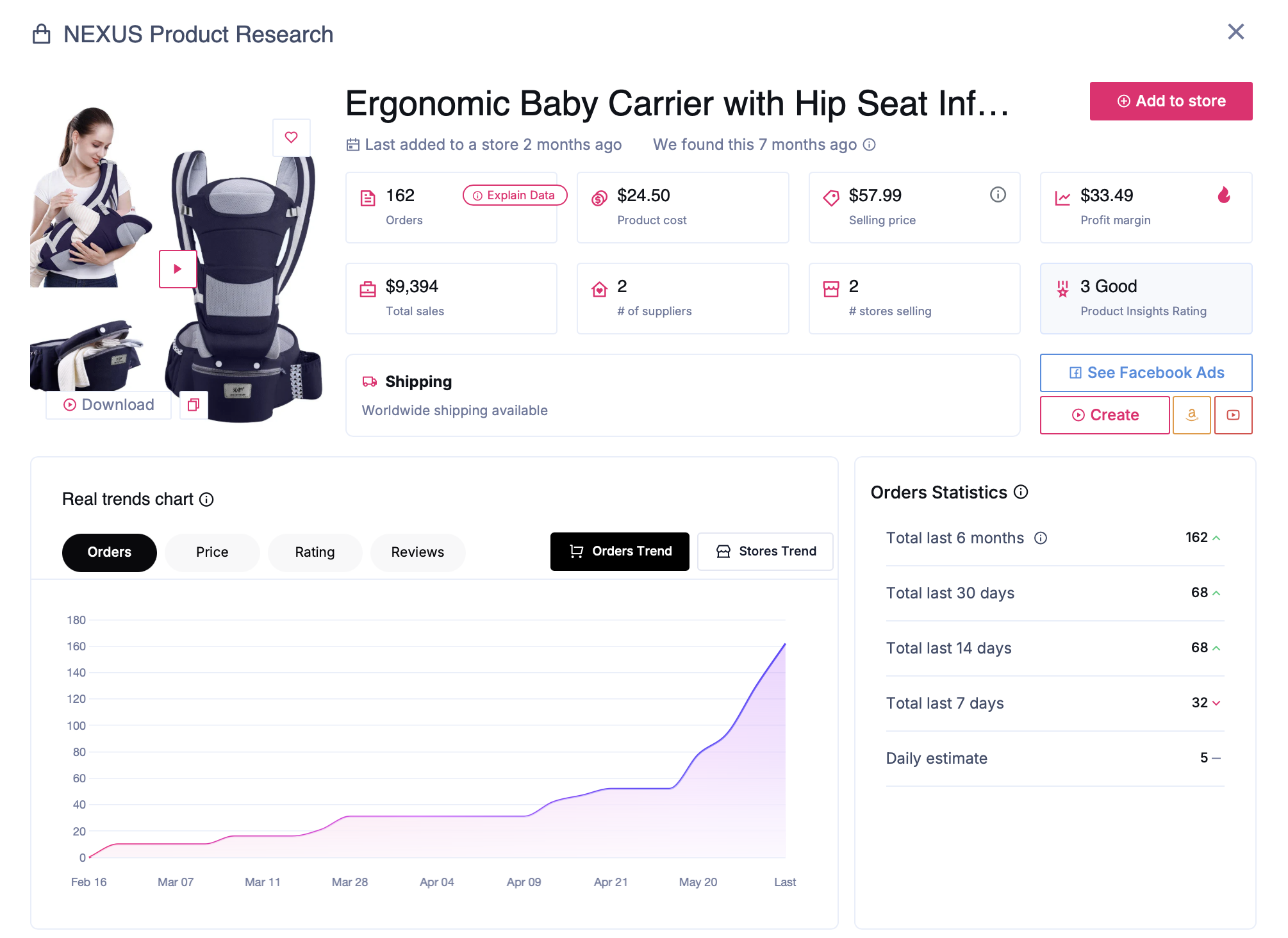
Unlike the sunset lamp, demand was growing. The product recorded 162 orders, generated more than $9,000 in sales, and showed increasing order activity over time.
However, the operational side raised concerns.
Metric
Result
Orders
162
Suppliers
2
Product Rating
3/5
Shipping
Worldwide Shipping Available
The product relied on only two suppliers, and the listing did not indicate any fast-shipping options. For larger products with more complex logistics requirements, limited supplier coverage can increase the risk of fulfillment delays, stock shortages, and inconsistent delivery performance.
This is the type of operational risk ChatGPT cannot evaluate. A product may have demand, but that does not automatically mean it can be fulfilled reliably at scale.
What Did We Learn From Testing ChatGPT?
The most important takeaway is that ChatGPT was not completely wrong. It identified products that had generated interest in the market.
The problem is that each product carried risks the AI could not see.
The sunset lamp suffered from declining demand.
The serum offered limited profit potential.
The baby carrier introduced fulfillment concerns.
Without real data, all three products could have looked like winning opportunities, even though they lacked some of the characteristics that define what makes a winning product in today’s market.
This is why experienced sellers rely on a structured dropshipping product research process before launching a campaign. Product research is not about finding products that sound promising. It is about using real data to determine whether a product can generate demand, maintain healthy margins, and support long-term growth.
Want to know if your next product is actually worth selling? Start your Sell The Trend free trial today and validate demand, margins, and supplier performance before spending money on ads.
Why AI Struggles to Spot Real Product Trends
Large language models are excellent at generating ideas, but they were never designed to monitor live ecommerce activity. As a result, they miss several critical signals that determine whether a product is actually worth selling.
The issue is not that AI is inaccurate. The issue is that it lacks access to the systems that successful dropshippers use to evaluate demand, profitability, and fulfillment readiness.
AI Limitation
Why It Occurs
The Real Business Risk
No Transaction Tracking
LLMs read words, not financial transaction feeds.
You end up selling products that look popular online but have little or no active buying volume.
No Ad Cost Context
AI cannot see current ad auctions, CPM spikes, or competitor acquisition costs.
You launch products where advertising costs consume most of your profit margin.
No Supply Chain Integration
AI does not monitor supplier stock levels, fulfillment performance, or shipping timelines.
Delays, inventory issues, and fulfillment problems can hurt customer satisfaction and store performance.
Consider the products from our test. ChatGPT recognized products that had visibility online, but it could not determine whether people were actively buying them, whether the margins still worked, or whether suppliers could support growing demand.
This is why experienced sellers use more than one validation source. Tools like Facebook Ad Library can reveal active ads from competitors, while TikTok Creative Center highlights trending products and top-performing creatives. Dedicated ad spy tools can provide even deeper visibility into advertising activity, helping sellers understand where attention is flowing before they invest ad spend.
The same challenge exists on the fulfillment side. AI cannot evaluate supplier performance, inventory reliability, or shipping consistency. Working with trusted dropshipping suppliers helps reduce operational risks that large language models simply cannot detect.
No title
Pro Tip: Social media engagement can be a useful indicator of interest, but engagement alone does not guarantee sales. Always validate demand using multiple sources before investing money into testing.
The Smarter Way to Use AI for Product Research
AI works best when it helps generate ideas, not when it makes final product decisions. The smartest sellers use ChatGPT to uncover opportunities and then validate those opportunities with real market data before investing a single dollar.
1. Use AI to Understand Customers and Generate Ideas
Instead of asking ChatGPT to find products, ask it to identify problems. For example:
“What are the 5 biggest frustrations of first-time dog owners?”
ChatGPT can analyze customer pain points, market trends, and audience behavior far more effectively than it can predict winning products.
It can also generate dozens of niche ideas that align with specific customer needs, making it a useful starting point when exploring the best dropshipping niches for your store.
2. Turn Those Ideas Into Real Product Opportunities
Once you identify a pain point, take those keywords and search them inside Sell The Trend’s Niche Finder or TikTok Shop Explorer.
This transforms a broad idea into a list of products that are already attracting attention from real buyers. Instead of relying on assumptions, you’re using market data to evaluate demand and identify opportunities worth investigating further.
3. Validate Demand Before You Spend a Dollar
Before launching a product, verify that it is generating real transactions, maintaining healthy margins, and showing consistent demand. Google Trends can help validate whether interest is sustainable over time, while Sell The Trend helps uncover products backed by real market activity.
This final step helps prevent one of the most common mistakes in ecommerce: investing money into products that sound promising but fail when exposed to real-world conditions.
While AI can quickly generate ideas, the quality of its responses depends heavily on how prompts are written. Learning prompt engineering basics can help entrepreneurs create clearer instructions for AI tools, improving product research, content creation, marketing copy, and other eCommerce workflows while reducing guesswork.
Why Is Sell The Trend the Missing Verification Layer?
The experiment revealed a simple reality: ChatGPT can generate product ideas, but it cannot verify whether those ideas are backed by real market activity. That verification layer is what separates successful product research from expensive guesswork.
Throughout our test, the challenge was never a lack of ideas. ChatGPT generated products instantly. The problem was determining whether those products still had demand, healthy margins, and reliable fulfillment options.
Instead of relying on historical information, Sell The Trend helps sellers validate opportunities using real ecommerce data. Features like NEXUS Product Research, TikTok Shop Explorer, and Niche Finder make it easier to identify products that are actively gaining traction in the market.
Rather than chasing viral products based on assumptions, sellers can evaluate demand, monitor sales velocity, compare pricing, and identify products that align with their chosen niche.
The platform also helps reduce operational risk by providing visibility into supplier options, stock levels, and other factors that can impact long-term success. Combined with modern dropshipping automation software, this creates a more efficient workflow from product validation to store management.
In other words, ChatGPT helps answer:
“What products should I investigate?”
Sell The Trend helps answer:
“Which of those products are actually worth selling?”
That combination gives sellers a far more reliable process for finding opportunities, validating demand, and building a sustainable dropshipping business.
Frequently Asked Questions
Can ChatGPT help me find winning dropshipping products?
Yes, ChatGPT can help generate ideas and identify opportunities based on customer preferences, market discussions, and publicly available information. However, it cannot independently verify whether a product has real demand or whether it is one of today’s proven winners.
How should I use ChatGPT for product research?
Instead of asking for endless product lists, ask ChatGPT about customer pain points, buying motivations, and niche opportunities. This approach helps uncover the right products for a specific business rather than repeatedly recommending the same product or similar products that everyone else is already selling.
What is the biggest limitation of AI product research?
Large language models cannot access transaction data, supplier performance metrics, or inventory information. Most tools can generate ideas, but they cannot provide all the information needed to determine whether a product is commercially viable.
Why are reliable suppliers important when evaluating a product?
A product may have demand, but fulfillment problems can quickly hurt a business. Working with reliable suppliers and comparing different suppliers helps reduce risks related to inventory shortages, delayed shipping times, and inconsistent customer experiences. Choosing the right dropshipping suppliers can have a significant impact on long-term success.
Can AI create product descriptions for my store?
Yes. AI can generate product descriptions, highlight key features, and help improve product listings in seconds. Many sellers use AI to speed up content creation while focusing their time on validation and growth.
What is the best way to validate product ideas?
The most effective approach is to combine AI-generated ideas with data driven insights from real market activity. Following a proven process for how to find winning products helps sellers identify opportunities before investing money into testing.
Can ChatGPT build a complete dropshipping store?
ChatGPT can assist with research, content, and planning, but building a successful dropshipping store requires much more than a chatbot. Sellers still need a dropshipping platform, a Shopify store or other ecommerce website, and a system for validating demand. Many merchants combine these workflows with an AI Store Builder to accelerate store creation after they’ve validated a product opportunity
Final Verdict: Can ChatGPT Actually Find Winning Products?
ChatGPT can be a valuable assistant throughout your dropshipping journey. It helps uncover customer ideas, identify opportunities, and saves time when researching markets. However, it should not be used as the final authority when trying to find a winning product.
As our test showed, a product may have strong social proof and still fail due to weak margins, declining demand, or fulfillment challenges. Building successful online stores requires more than AI-generated suggestions. It requires validation.
The most effective approach is to use ChatGPT for brainstorming and Sell The Trend for verification. Together, they give sellers access to all the tools needed to evaluate opportunities, analyze market data, and make smarter decisions before launching a dropshipping store.
Whether you’re building a Shopify store, choosing a dropshipping platform, or handling the technical setup of a new business, validation should always come before investment.
Maria is a marketing specialist with hands-on experience in digital growth strategies and eCommerce.
As part of the Sell The Trend team, she has developed deep expertise in dropshipping through close work with product research, trend analysis, and go-to-market strategies used by successful online sellers.
Her content focuses on practical marketing insights, audience behavior, and data-driven decision-making to help merchants launch and scale with confidence.