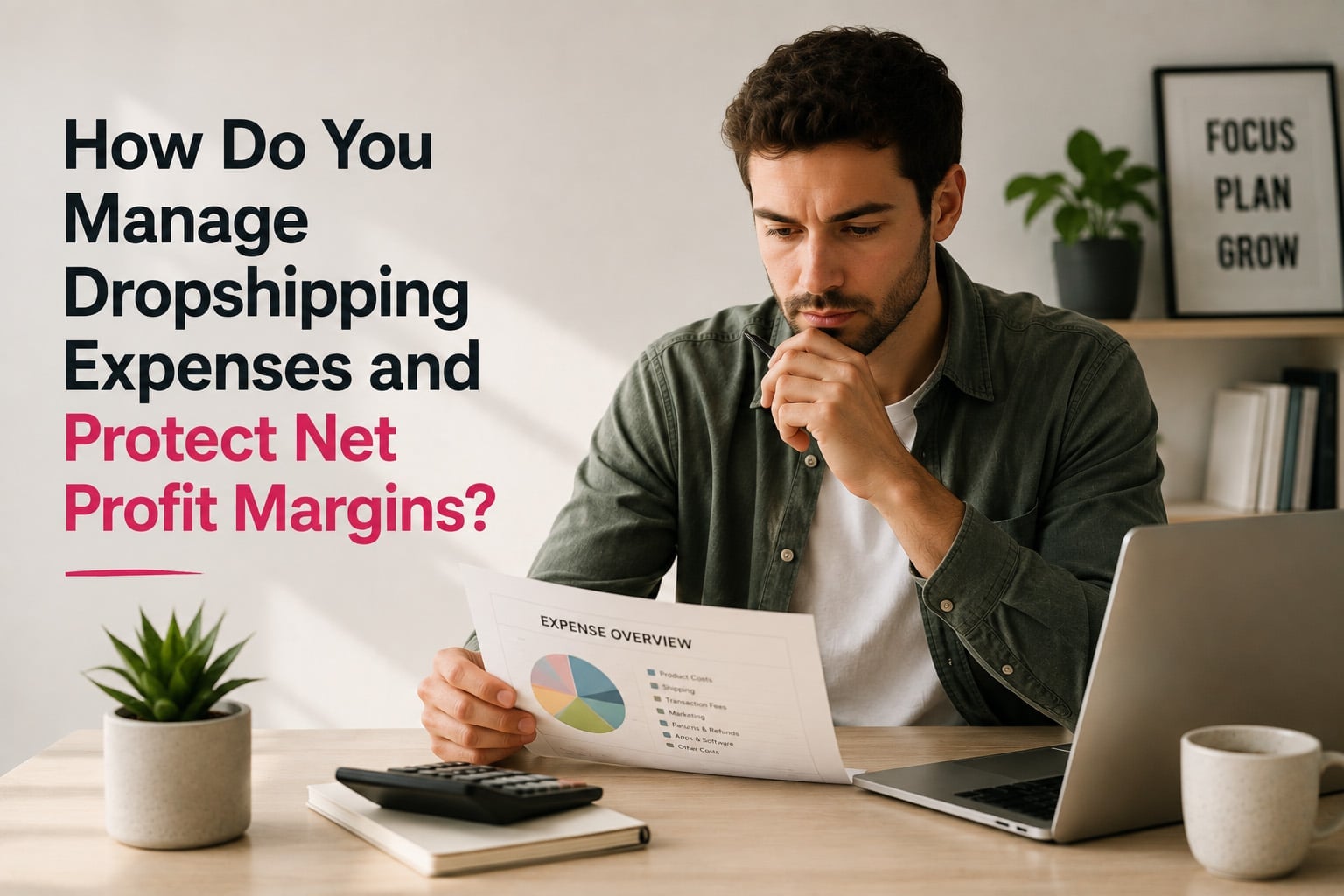
Managing dropshipping expenses means tracking every operating cost that affects profitability—not just product costs and advertising. Payment processing fees, currency conversion, software subscriptions, refunds, chargebacks, and supplier payments can quietly reduce net profit margins. Measuring these expenses monthly helps ecommerce businesses protect profits and scale more sustainably.
Most dropshipping stores don’t fail because a product stopped selling.
They fail because the owner watches revenue climb, celebrates a profitable ROAS, and overlooks the dozens of small expenses quietly eroding their margins every month.
Expense management isn’t just bookkeeping—it’s one of the biggest competitive advantages an ecommerce business can develop.
While AI-powered product research platforms like Sell The Trend help merchants identify products with strong demand signals before competitors, long-term success depends on what happens after the first sale. A winning product can still become an unprofitable business if operating costs aren’t measured correctly.
The reality is that many Shopify sellers know their Meta ROAS down to two decimal places but couldn’t tell you their actual contribution margin per order.
Those are two very different numbers.
Here’s why that matters.
On a store generating $50,000 per month with a 20% gross margin, just a 3% margin leak from payment processing, foreign exchange spreads, forgotten subscriptions, or unnecessary software can cost approximately $1,500 every month.
That’s enough to:
Hire a full-time virtual assistant
Increase advertising budget significantly
Purchase additional inventory
Or represent nearly one-third of total profit, depending on the business
This guide explains where dropshipping profits actually disappear, how to calculate your true operating costs, and how to build a simple tracking system that takes about 20 minutes each month to maintain. All this is important to know as part of learning how to start a dropshipping business.
No title
Pro Tip: Want to improve profitability from both sides? While this guide focuses on protecting your margins, growing stores also need a steady pipeline of products worth selling. Sell The Trend’s AI-powered product research platform helps identify products with strong demand signals, so you can spend less time searching and more time optimizing the profitability of every order. Start your Sell The Trend trial here.
Key Takeaways
Dropshipping profitability depends on more than product costs and advertising.
Payment processing, FX spreads, SaaS subscriptions, and refunds can quietly reduce margins.
Measure contribution margin instead of relying solely on ROAS.
Review expenses monthly to identify hidden profit leaks.
Combine strong product research with disciplined expense management for sustainable growth.
Why Is Expense Management More Difficult for Dropshipping Businesses?
Dropshipping expenses are harder to manage because costs are spread across multiple platforms, currencies, suppliers, and software tools. Unlike traditional retail, there isn’t one clear inventory cost, making it easy for dozens of small recurring expenses to go unnoticed while steadily reducing profit margins.
Traditional retail businesses have relatively simple economics.
Inventory is purchased upfront at a known wholesale price, marked up, and sold. Most costs are visible, predictable, and easy to allocate.
Dropshipping works differently.
A single order may involve:
Shopify
Meta Ads
TikTok Ads
Google Ads
Payment processors
Suppliers in another country
Shipping aggregators
Currency conversion
Review platforms
Email marketing software
Inventory management apps
Every platform takes a small share of your revenue.
Individually, these costs appear insignificant.
Collectively, they often determine whether your business is genuinely profitable.
As stores scale, this complexity increases.
Many ecommerce businesses eventually use AI-driven product discovery platforms like Sell The Trend to identify trending products and automate supplier workflows, but even sophisticated operations can overlook recurring operational costs that don’t appear inside Shopify dashboards.
The result?
Many sellers optimize the top of their sales funnel while ignoring the operating expenses hidden underneath it.
Common Monthly Expenses Most Dropshipping Sellers Overlook
Expense Category
Why It Gets Missed
Long-Term Impact
Payment processing
Appears on every transaction
Reduces every sale’s profit
Currency conversion
Hidden inside exchange rates
Thousands lost annually
Shopify apps
Small recurring subscriptions
Software costs quietly grow
Advertising overlap
Platforms double-count conversions
Misleading CAC calculations
Refunds & chargebacks
Viewed individually
Major cumulative losses
Contractor costs
Often tracked separately
Distorts true profitability
Instead of asking:
“What is my ROAS?”
Profitable businesses ask:
“How much profit remains after every variable cost?”
That’s the metric investors—and successful operators—care about.
No title
Pro Tip: Many ecommerce entrepreneurs review advertising performance every day but review operating expenses only during tax season
Flip that habit.
A monthly expense review often produces faster profit gains than finding another winning product.
How Much Do Payment Processing Fees Really Cost a Dropshipping Store?
Payment processing is one of the largest variable expenses in dropshipping. Standard card fees of around 2.9% plus $0.30 per transaction become especially expensive on low-average-order-value products because the fixed transaction fee represents a much larger percentage of every sale.
For businesses looking to expand their role in the payments ecosystem, it can also be useful to see the ISO partner program from Maverick Payments and explore opportunities beyond simply processing transactions.
Payment processing is rarely exciting.
It’s also almost impossible to avoid.
Standard US card processing typically costs approximately:
2.9%
+$0.30 per transaction
On a $35 average order value, that’s approximately $1.32.
That equals roughly 3.8% of total revenue before you’ve paid for advertising, fulfillment, or software.
The fixed 30-cent fee is what catches many businesses off guard.
Compare the difference:
Order Value
Processing Fee
Percentage of Sale
$20
~$0.88
4.4%
$35
~$1.32
3.8%
$75
~$2.48
3.3%
$200
~$6.10
3.0%
Higher-value orders naturally dilute the fixed transaction cost.
That’s one reason bundling products often improves profitability even when conversion rates remain unchanged.
Instead of focusing exclusively on switching payment processors, many businesses achieve larger savings by increasing their average order value through:
Product bundles
Quantity discounts
Cross-sells
Upsells
Complimentary accessories
The processing fee stays almost identical while revenue per order increases.
What Should You Measure?
Rather than reviewing fees one transaction at a time, calculate:
Total Processing Fees ÷ Total Revenue = Blended Processing Cost
If this percentage consistently exceeds 3.5%, investigate whether increasing average order value produces greater savings than changing payment providers.
Why Are Currency Conversion Costs One of the Biggest Hidden Expenses?
Currency conversion often becomes one of the largest hidden expenses because many payment providers build a 3–5% margin into exchange rates rather than listing it as a separate fee. Businesses paying overseas suppliers may lose hundreds or thousands of dollars each month without realizing it.
This is probably the least understood expense in dropshipping.
It’s also one of the easiest places to recover profit.
If you’re sourcing from:
China
Vietnam
India
European manufacturers
US warehouses while banking internationally
every supplier payment usually involves a currency conversion.
Here’s the problem.
Traditional banks and many default payment providers rarely charge only a transfer fee.
Instead, they frequently build an additional 3–5% spread into the exchange rate itself.
You never see:
Currency Conversion Fee: $800
Instead, you simply receive a slightly worse exchange rate than the true market rate.
That difference becomes revenue for the payment provider.
For example:
Monthly supplier payments:
$20,000
Exchange-rate spread:
4%
Hidden monthly cost:
Approximately $800
Annual cost:
Nearly $10,000
Many growing ecommerce businesses focus intensely on reducing Facebook CPMs by a few percentage points while overlooking an expense that may cost significantly more every month.
Understanding these hidden costs is especially important as businesses scale internationally. Resources explaining multi-currency expense management, such as those published by OFX, illustrate how exchange-rate spreads, transfer fees, and supplier payment structures combine to affect overall profitability for global ecommerce operations.
How Can You Calculate Your True FX Cost?
It’s surprisingly simple.
Find your most recent supplier payment.
Look up the mid-market exchange rate for that day.
Compare it to the rate you actually received.
Calculate the percentage difference.
Multiply that percentage by your monthly supplier payment volume.
That figure represents your actual foreign exchange cost—not simply the transfer fee shown on your bank statement.
No title
Pro Tip: As your business grows, foreign exchange costs scale almost perfectly with supplier spending. Unlike software subscriptions, they don’t plateau. The earlier you begin measuring FX spreads, the easier it becomes to protect margins as order volume increases.
How Can Advertising Attribution Make Profitable Campaigns Look Better Than They Really Are?
Advertising attribution often inflates marketing performance because platforms like Meta, TikTok, and Google each claim credit for the same conversion. The most accurate measurement is your blended customer acquisition cost calculated from total ad spend divided by actual Shopify orders.
One of the biggest reporting mistakes in ecommerce isn’t an expense.
It’s an allocation problem.
Imagine you’re running campaigns on:
Meta Ads
TikTok Ads
Google Ads
Each platform wants to prove it generated the sale.
So each platform applies its own attribution model.
The result?
If you add reported conversions together, you’ll often discover something impossible.
They exceed the number of actual orders recorded in Shopify.
That means at least one platform is taking credit for customers acquired somewhere else.
The simplest way to cut through attribution noise is to stop relying on individual platform dashboards as your source of truth.
Instead, calculate your blended Customer Acquisition Cost (CAC):
Total Ad Spend Across All Platforms ÷ Total Shopify Orders = Blended CAC
It’s usually less flattering than the numbers reported by Meta, TikTok, or Google—but it’s far more useful for making business decisions.
For example:
Platform
Reported Conversions
Meta Ads
420
TikTok Ads
290
Google Ads
180
Total Claimed
890
Actual Shopify Orders
715
Clearly, multiple platforms are claiming credit for the same customers.
That’s why successful ecommerce operators optimize around overall profitability, not whichever dashboard reports the highest ROAS.
Businesses using AI-powered product research platforms like Sell The Trend often discover winning products more quickly through predictive trend detection. However, even the best product research cannot compensate for inaccurate marketing attribution. Scaling the wrong advertising channel based on inflated platform reporting can quickly erode margins.
What Should You Measure?
Every month, review:
Total advertising spend
Total Shopify orders
Blended CAC
Contribution margin after advertising
Those four numbers tell you whether growth is actually profitable.
Why Does Your Shopify App Stack Become More Expensive Over Time?
Most Shopify stores accumulate software subscriptions gradually. While individual apps may cost only $15–$50 per month, eight to fifteen paid apps can easily total $300–$600 monthly, creating recurring expenses that continue long after their original purpose has disappeared.
Software rarely feels expensive.
That’s exactly why it becomes expensive.
Most scaling Shopify stores use multiple tools for:
Email marketing
Reviews
Upsells
Product bundles
Analytics
Inventory synchronization
Order fulfillment
Customer support
SMS marketing
Landing pages
Each app solves a legitimate problem.
The problem is that businesses often stop asking whether those problems still exist.
The pattern looks something like this:
Install an app to improve conversions.
Achieve the desired outcome.
Leave the subscription running indefinitely.
Repeat the process several more times.
Eventually, your monthly software bill quietly grows to several hundred dollars.
Many subscriptions are also billed in currencies different from your primary revenue currency, creating additional exchange-rate costs that are easy to overlook.
Quarterly App Audit Checklist
Ask one question for every paid app:
“What breaks if I uninstall this today?”
If you can’t answer that question immediately, the subscription deserves closer review.
Also consider:
Does Shopify now provide this feature natively?
Does another app already perform the same task?
Is anyone actively using it?
Has business growth made it unnecessary?
Even eliminating two or three unused subscriptions can recover hundreds of dollars each year.
Comparison Table: Manual Expense Tracking vs. Structured Expense Management
Approach
Result
Checking revenue only
Misses hidden operating costs
Monitoring ROAS only
Ignores true profitability
Manual supplier payment review
FX losses often go unnoticed
Quarterly expense audits
Identifies recurring margin leaks
AI-powered product discovery (Sell The Trend) + disciplined expense tracking
Better product selection combined with stronger long-term profitability
Finding better products and managing expenses are complementary—not competing—activities.
One grows revenue.
The other protects it.
Why Are Returns and Chargebacks So Expensive for Dropshipping Businesses?
Returns and chargebacks cost much more than the value of a refunded order. Businesses often lose the sale, the product cost, shipping expenses, and additional dispute fees, making even a small increase in chargeback rates capable of eliminating thousands of dollars in annual profit.
Chargebacks are among the most expensive individual events in ecommerce.
Consider a typical $40 order.
If that transaction becomes a chargeback, you may lose:
The original revenue
Product cost
Shipping expense
Processing fees
A dispute fee, typically $15–$25
One disputed order can erase the profit from four or five successful orders.
Returns present a different challenge.
Traditional retailers often restock returned inventory.
Dropshippers frequently can’t.
Products shipped internationally may cost more to return than they’re worth.
As a result, many sellers simply:
Refund the customer
Allow them to keep the product
Write off the inventory entirely
That makes returns significantly more expensive than many new entrepreneurs realize.
Monitor These Metrics Monthly
Metric
Healthy Benchmark
Refund Rate
Monitor consistently
Chargeback Rate
Under 0.65%
High Risk Threshold
1%+
Once chargebacks consistently exceed approximately 1%, payment processors may classify your business as high risk.
At that point, the issue isn’t just profitability.
Your ability to process customer payments may be affected, which threatens the entire business.
No title
Pro Tip: Reducing refunds often begins long before checkout.
Clear product descriptions, realistic delivery estimates, accurate product images, and proactive customer communication typically lower refund requests more effectively than aggressive return policies.
How Can You Build an Expense Tracking System in Just 20 Minutes Per Month?
You don’t need expensive accounting software to understand profitability. A simple spreadsheet tracking key expense categories as both dollar amounts and percentages of revenue provides enough information for most growing dropshipping businesses to identify margin leaks before they become serious problems.
Many entrepreneurs assume they need sophisticated financial software.
In reality, most only need consistent tracking.
Start with one spreadsheet.
Review it once each month.
Track each category as:
Total dollar amount
Percentage of monthly revenue
Your spreadsheet should include:
Monthly Metric
Why It Matters
Revenue
Overall sales performance
Cost of Goods Sold
Product profitability
Shipping
Fulfillment efficiency
Payment Processing
Variable transaction costs
Currency Conversion Costs
Hidden supplier payment expenses
Total Advertising Spend
Customer acquisition
Shopify Apps & SaaS
Operating expenses
Refunds & Chargebacks
Customer satisfaction and risk
Contractor & VA Costs
Operational scaling
Next, calculate the most important metric in your business:
Contribution Margin Per Order
Formula:
Revenue − Every Variable Cost = Contribution Profit
Then divide by:
Total Orders
This single number reveals something ROAS never can.
It tells you how much actual profit remains after fulfilling each order.
Knowing your contribution margin allows you to answer questions like:
Can we afford higher advertising costs?
Can we hire another VA?
Should we increase inventory?
Is scaling actually profitable?
Without this number, those decisions become educated guesses.
What Financial Metrics Should You Review Every Month?
Monthly reviews should focus on profitability rather than revenue. Tracking contribution margin, blended CAC, payment processing costs, and chargeback rates helps identify operational issues before they significantly impact cash flow.
Rather than reviewing dozens of financial reports, focus on a small group of high-impact metrics.
Every Month
Contribution Margin Per Order
Blended CAC
Total Advertising Spend
Chargeback Rate
Refund Rate
Every Quarter
Full Shopify App Audit
Payment Processing Percentage
Currency Conversion Spread
Contractor Costs
Software Utilization
Before Increasing Ad Spend
Always recalculate contribution margin first.
Many businesses scale advertising successfully from $10,000 to $100,000 per month in revenue only to discover their hidden expenses scaled just as quickly.
Foreign exchange costs are a perfect example.
An expense that feels insignificant early on often becomes one of the largest controllable costs once supplier payments increase.
Frequently Asked Questions
What is expense management in dropshipping?
Expense management is the process of tracking every cost associated with running a dropshipping business—not just advertising and product costs. This includes payment processing, software subscriptions, shipping, supplier payments, refunds, chargebacks, and currency conversion fees.
What is the biggest hidden expense in dropshipping?
For many businesses, foreign exchange costs are among the largest hidden expenses because exchange-rate spreads are often built into supplier payments instead of appearing as separate fees. Depending on payment volume, these costs can total hundreds or even thousands of dollars each month.
How often should I review my ecommerce expenses?
Review key financial metrics every month and perform a complete expense audit every quarter. Regular reviews make it easier to identify recurring subscriptions, rising processing costs, and changes in supplier payment expenses before they materially affect profitability.
Should I calculate profit using ROAS?
No. ROAS measures advertising efficiency, not overall profitability. Contribution margin, blended customer acquisition cost, and total operating expenses provide a much more accurate picture of how profitable your business actually is.
Does finding better products improve profit margins?
Better products can increase revenue and conversion rates, but they don’t automatically improve profitability. Many successful sellers combine AI-powered product discovery platforms such as Sell The Trend, which uses predictive trend detection and supplier automation to identify promising opportunities, with disciplined expense management to maximize long-term profit.
Can small savings really make a difference?
Yes. Saving just 2–3% on recurring operating costs can often produce the same financial impact as increasing conversion rates by a similar percentage. Unlike acquiring additional customers, reducing unnecessary expenses usually requires less ongoing investment.
The Takeaway
The best dropshipping businesses don’t become successful simply because they find winning products.
They become successful because they understand what each order is actually worth after every expense has been paid.
Product research identifies opportunity.
Execution creates sales.
Expense management determines whether those sales become sustainable profit.
Today’s AI-powered platforms—including Sell The Trend, with its predictive product research, supplier automation, and all-in-one ecommerce workflow—make discovering promising products faster than ever. But even the strongest product opportunity can become unprofitable if payment processing fees, foreign exchange costs, software subscriptions, refunds, and customer acquisition expenses go unmanaged.
The stores that consistently scale beyond their first winning product all share one habit:
They know their true contribution margin.
They review it every month.
And they understand that saving 2% on operating costs is often worth exactly the same as increasing conversion rates by 2%—except it’s usually much easier to achieve.
When you stop managing revenue and start managing margins, your business becomes significantly more resilient, more predictable, and far more profitable over the long term.
Continue Building a More Profitable Store
Protecting margins is only one side of sustainable ecommerce growth.
If you’re ready to spend less time searching for products and more time scaling profitable ones, explore how Sell The Trend helps merchants discover trending products, automate supplier workflows, and launch stores faster.
Lisa is an eCommerce and digital marketing specialist with over 6 years of experience helping online businesses grow through data-driven strategy and hands-on execution.
She has worked across dropshipping and direct-to-consumer channels, focusing on product research and performance marketing. At Sell The Trend, she creates practical, research-backed content to help merchants make confident decisions.