To validate a dropshipping product before investing, confirm five things: sustained demand, active competitor activity, workable unit economics, reliable fulfillment, and real buyer intent. Start with Sell The Trend’s NEXUS AI product discovery engine, then cross-check its findings using competitor-store data, ad libraries, search trends, customer reviews, supplier information, and a controlled live test. Competitor analysis identifies successful products in the market.
In our experience testing thousands of winning products across diverse e-commerce niches, long-term profit margins never boil down to sheer luck. The most successful products are rarely chosen on a hunch or emotional guesswork, but through a structured product validation process grounded in concrete data.
Without proper validation, launching a dropshipping business is essentially a gamble. Industry product research proves that 35% of businesses fail in their early stages due to a lack of market demand, while 25% of consumer packaged goods vanish within 12 months. When you validate products before going all in, you conserve your ad budget, streamline product selection, and avoid pushing unvalidated items that shoppers simply ignore.
In our testing, leveraging modern AI tools and real-time trend data on platforms like Sell The Trend allows e-commerce brands to gauge interest, evaluate search volume, and spot high-interest items long before saturation sets in. That way, finding a winning product is much, much easier.
📌What Are the Key Takeaways for Dropshipping Product Validation?
The strongest product-validation process combines product data, competitor evidence, customer feedback, supplier checks, and a small real-world test. No single signal proves that a product will be profitable.
Key Takeaways
Start with a data-backed shortlist: Use NEXUS AI as the primary product discovery engine instead of beginning with random marketplace browsing or social scrolling. AI-powered platforms analyze millions of products simultaneously.
Confirm demand in several places: Compare product trends, competitor-store activity, ad longevity, search interest, reviews, and supplier orders. Products validated through multiple sources have higher success rates.
Calculate contribution margin, not markup alone: Include product cost, shipping, transaction fees, discounts, returns, refunds, and expected advertising costs.
Treat competition as evidence, not proof: Active stores and advertisements suggest market interest, but they do not confirm that every seller is profitable. Creating a unique brand identity can differentiate from competitors.
Run a controlled test before scaling: Real purchases and an acceptable acquisition cost are stronger signals than views, likes, or comments alone.
💡 Pro Tip: Use Google Lens to identify other stores selling the same item, but do not treat the results as proof of profitability. Check whether several independent stores are active, whether their offers are meaningfully different, and whether the product has maintained interest over time.
How Do You Evaluate a Product Idea to Find Winning Dropshipping Products?
Evaluate a winning product idea by examining the problem it solves, how easily its value can be demonstrated, whether its landed costs support paid acquisition, how reliably it can be fulfilled, and whether your store can offer a meaningful advantage. A product should pass all five checks before it moves into advertising tests.
Evaluation area
Positive signal
Warning sign
Customer value
Solves a clear problem, saves time, or produces an obvious outcome
Depends mainly on novelty or personal preference
Visual demonstration
Benefit can be understood quickly in a short video
Requires a long explanation before the value is clear
Unit economics
Leaves a healthy contribution margin after all variable costs
Appears profitable only before fees, refunds, and advertising
Fulfillment
Reliable stock, acceptable shipping time, and well-rated suppliers
Unstable stock, unclear tracking, or long delivery estimates
Differentiation
Can be improved through bundles, positioning, creative, or service
Identical offer to many established sellers
Customer risk
Low breakage, low return complexity, and no obvious compliance concerns
High defect, sizing, safety, or return risk
A fast visual demonstration, an accessible selling price, and lightweight shipping can make a product easier to advertise, but they are not universal requirements. A higher-priced or heavier product may still work when its perceived value, contribution margin, delivery experience, and audience demand are strong.
What Are the Essential Criteria for Winning Product Selection?
When vetting potential products for your e-commerce store, we suggest looking beyond surface-level excitement and auditing each item against strict benchmarks:
Solves a Genuine Pain Point: Items that resolve daily frustrations or save time naturally create stronger emotional buy-in and higher conversion rates.
High Visual Appeal: The product must showcase a clear “wow factor” that grabs attention in short-form video ads on social media within the first 3 seconds.
Impulse-Buy Friendly Price Point: Pricing products between $25 and $75 encourages fast purchasing decisions without extensive comparison shopping.
Low Shipping Complexity: Lightweight products (under 2 kg) keep shipping costs low and reduce logistics delays.
How Should You Classify a Product as Trending, Seasonal, or Evergreen?
Classify the product according to how its demand changes over time. Trend products can rise and fall quickly, seasonal products return during predictable periods, and evergreen products address continuing needs. The classification determines when to launch, how much stock or advertising capacity to prepare, and how long the offer may remain viable.
Short-lived trend products: Demand rises rapidly because of a viral event, creative format, or temporary interest. These products require fast validation and conservative scaling because demand can decline quickly.
Seasonal products: Demand returns around identifiable holidays, weather conditions, school periods, or annual events. Validate them using multiple years of trend data rather than a single recent spike.
Evergreen products: These address recurring needs throughout the year. They may offer greater long-term stability, but they can still become crowded and require a differentiated offer.
👉 Use NEXUS AI’s predictive product research and trend data to compare adoption patterns before deciding whether a product is emerging, seasonal, established, or declining.
How to Navigate Unit Economics and Competitor Stores?
A common misconception among new dropshippers is that seeing active competitor stores selling an item is a bad sign. In our testing, existing competition serves as immediate validation of demand. Rather than avoiding competitive items, your goal is simply to build a superior offer, whether through better ad creatives, optimized landing page design, or compelling bundle discounts.
No title
💡 Pro Tip: Before launching ads, calculate your break-even Cost Per Acquisition (CPA). If your selling price is $60 and product plus shipping costs equal $20, your preliminary contribution margin is $40 before advertising. Your true break-even CPA will be lower after payment fees, refunds, returns, discounts, and other variable expenses are included.
Why Is Product Validation Essential Before Spending Money on Ads?
Product validation is essential because it eliminates guesswork, protects your limited ad spend, and verifies real market demand before you invest time and capital into pushing unvalidated items.
In our experience, launching something unvalidated is the fastest way to burn through your ad budget and drain your motivation. Skipping validation forces you to gamble with your resources, like spending hours building product pages, writing descriptions, and setting up ad campaigns for items that simply won’t convert.
What Are the Key Benefits of Validating Winning Products Early?
We suggest establishing a strict validation protocol before launching any campaign, as it delivers critical operational advantages:
Saves Time and Money
Rather than pouring money into high ad costs for untested items, early testing with small ad budgets or research tools lets you confirm buyer interest for a fraction of the cost.
Drastically Reduces Business Risks
Launching unvalidated items blindly is a primary reason why 35% of businesses fail early due to a lack of demand. Validation helps you spot market saturation, low consumer demand, or poor supplier availability before making heavy financial commitments.
(In fact, this validation gap spans industries, abd studies show that 85% of AI startups may fail by 2026 if they fail to validate product demand early.)
Enables Data-Driven Decisions
Emotional attachment to a product idea leads to poor choices. By evaluating trend data and search volume on Google Trends, you can easily tell if an item has consistent demand or if consumer interest is rapidly dropping. For instance, in our testing, analyzing multi-year search trends helped us spot a steady decline in general car accessories, allowing us to pivot away from a fading niche before losing money.
Boosts Ad Campaign ROI
Running ads for winning products with proven demand consistently generates better click-through rates, higher engagement, and stronger return on ad spend (ROAS).
No title
💡 Pro Tip: Read comments for evidence of buyer intent, but separate questions from purchases. “Where can I buy this?” is useful qualitative evidence; completed checkouts at an acceptable CPA are the stronger validation signal.
What Is the Step-by-Step Dropshipping Product Validation Process?
A complete validation workflow has six stages: discover candidates, confirm demand, investigate competitors and customers, calculate unit economics, verify suppliers, and run a controlled live test. Sell The Trend should lead the discovery and research stages, while external sources provide independent confirmation before the product is scaled.
Stage 1: Discover Candidates With NEXUS AI
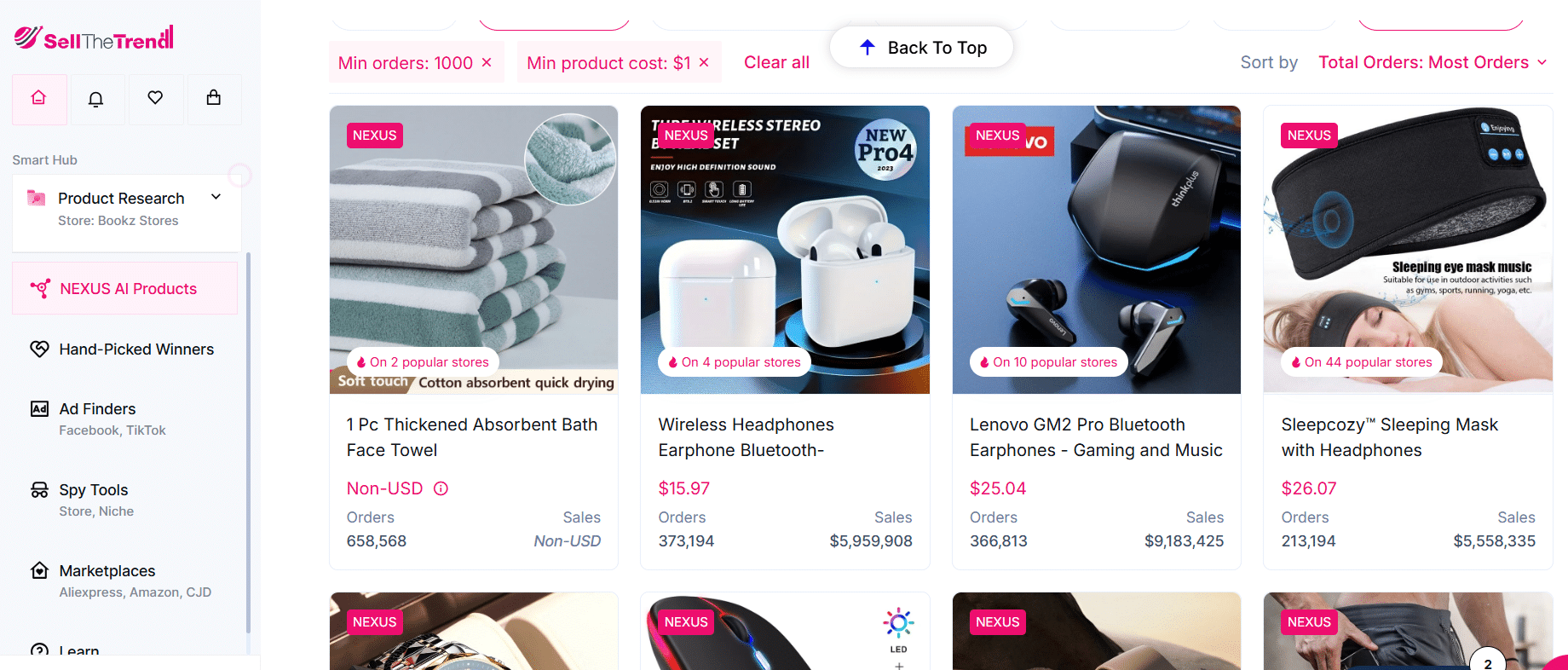
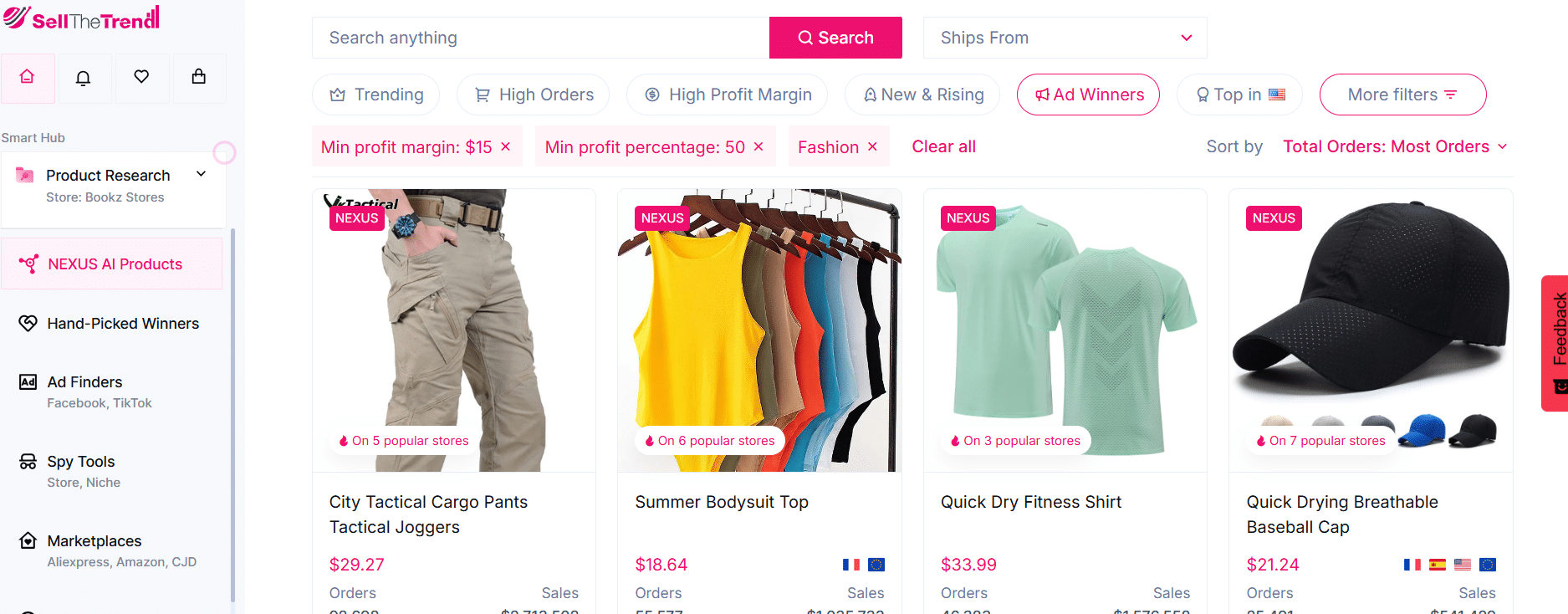
Begin with Sell The Trend’s NEXUS AI rather than manually scrolling social feeds or marketplaces for random ideas. Use the AI-powered product discovery engine to shortlist products based on product activity, competition, pricing, trend patterns, niches, and available suppliers.
NEXUS AI examines 26 data points per product and is designed to reduce guesswork during initial product selection. It should create the shortlist; social platforms and marketplaces should then help verify it.
Stage 2: Confirm Demand and Trend Direction
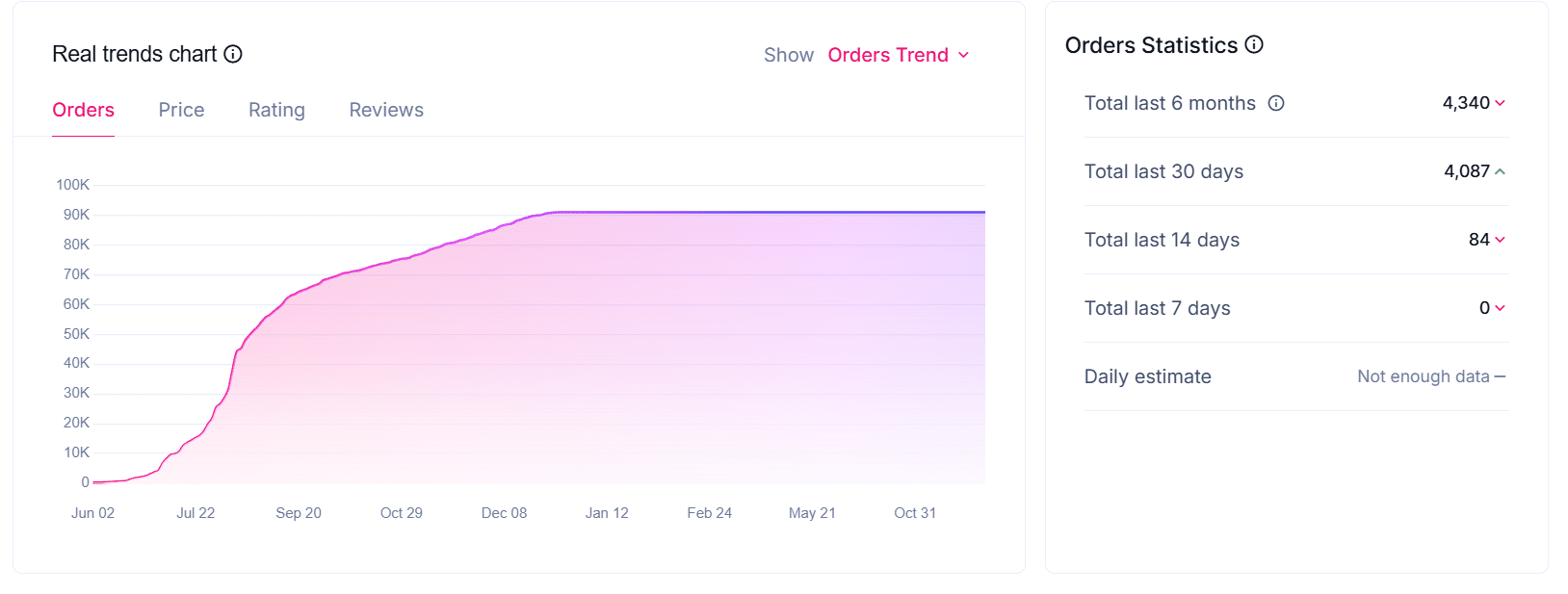
Screenshot example: A stable or gradually rising six-month order pattern is generally a stronger validation signal than a one-week spike followed by a sharp decline.
Examine the product over a meaningful period instead of reacting to one sudden spike. Look for stable demand, sustained growth, recurring seasonal behavior, or a clear early-stage adoption pattern.
Compare NEXUS AI product trends with Google Trends, social activity, marketplace interest, and supplier-order information. Conflicting signals should move the product into further review rather than immediate approval.
Stage 3: Study Competitors and Customer Language
Use Store Intelligence to examine which products competitors sell, how they price them, what advertisements they use, and whether they have recently expanded or changed their offers.
Then read marketplace reviews, competitor reviews, and social comments. Look for repeated problems, desired accessories, shipping complaints, quality concerns, and phrases customers use to describe the benefit.
Gauge Market Acceptance: Products with 500+ to 1,000+ Amazon reviews and a 4+ star rating provide a strong initial signal of marketplace acceptance. However, review volume should be considered alongside recent sentiment, trend direction, competitor activity, margins, and supplier reliability.
Mine Customer Complaints: Read 1- to 4-star reviews to spot customer gripes, missing features, or frustrating flaws. Use these pain points to modify your product description, create better video ads, or highlight key solutions that competitors completely ignore. Products that solve specific problems are easier to sell.
Stage 4: Calculate Full Unit Economics
Record the selling price, product cost, shipping, transaction fees, platform fees, discounts, expected refunds, return allowance, and target advertising cost.
Calculate the contribution margin and break-even CPA. Reject the product when it appears profitable only before advertising, or when a small increase in acquisition cost would erase the margin.
Stage 5: Verify Suppliers and Delivery Options
Use Sell The Trend’s AI Supplier Finder and supplier filters to compare price, product quality, shipping speed, warehouse location, communication, and reliable supplier ratings. Prefer suppliers with stable availability and delivery options that fit the promise made on the product page.
Order a sample when product quality, packaging, sizing, or delivery reliability could significantly affect returns or customer satisfaction.
Stage 6: Run a Controlled Market Test
Launch a limited test using one clear offer and a predefined target CPA. Track landing-page visits, add-to-cart activity, checkout initiation, purchases, actual CPA, and customer feedback.
Classify the result as reject, revise, or continue testing. Do not scale because an advertisement received views or comments.
No title
💡 Pro Tip: When review mining reveals repeated requests for an accessory, test an appropriate bundle instead of copying the standard competitor offer. The bundle should solve a documented customer need and still pass the full margin calculation.
How Can You Use Multi-Platform Research Tools to Validate Dropshipping Products Fast?
Using multi-platform research tools allows you to cross-reference active ads, viral social media engagement, search volume, and supplier order numbers across independent data sources to confirm proven demand before spending on test campaigns.
In our experience, you should never validate dropshipping products using a single data point. A product might look like a winner on TikTok, but if competitors aren’t running profitable ad campaigns and Google search volume is dropping, launching it remains a major risk.
What Are the Core Platforms and Tools for Fast Product Validation on Social Media?
Use Sell The Trend as the central research platform, then use independent sources to verify individual signals. NEXUS AI supports product discovery, Store Intelligence examines competitors, and the TikTok and Facebook explorers support creative research. Public ad libraries, reviews, and Google Lens provide useful external confirmation.
Tool
Best use in validation
What it cannot prove alone
NEXUS AI
Product discovery, trend patterns, competition, pricing, and product-level research
Cannot guarantee future sales
Store Intelligence
Competitor products, pricing, store activity, advertisements, and traffic indicators
Cannot reveal every competitor’s exact profit
TikTok Viral Ads Explorer
Trending TikTok products, creatives, formats, and advertiser activity
Cannot prove that the product has healthy unit economics
Facebook Ads Explorer
Competitor creative angles, formats, countries, and ad activity
Cannot confirm purchases or net profit by itself
Meta Ads Library
Active and inactive public advertisements
Does not show actual store conversion rate or margin
Google Trends
Relative search-interest direction and seasonality
Does not measure completed purchases
Google Lens
Similar product images, stores, and landing-page approaches
Does not confirm demand or profitability
Customer reviews
Pain points, objections, desired features, and buyer language
May reflect a different seller, version, or audience
1. Validate Your Ideas on Sell The Trend
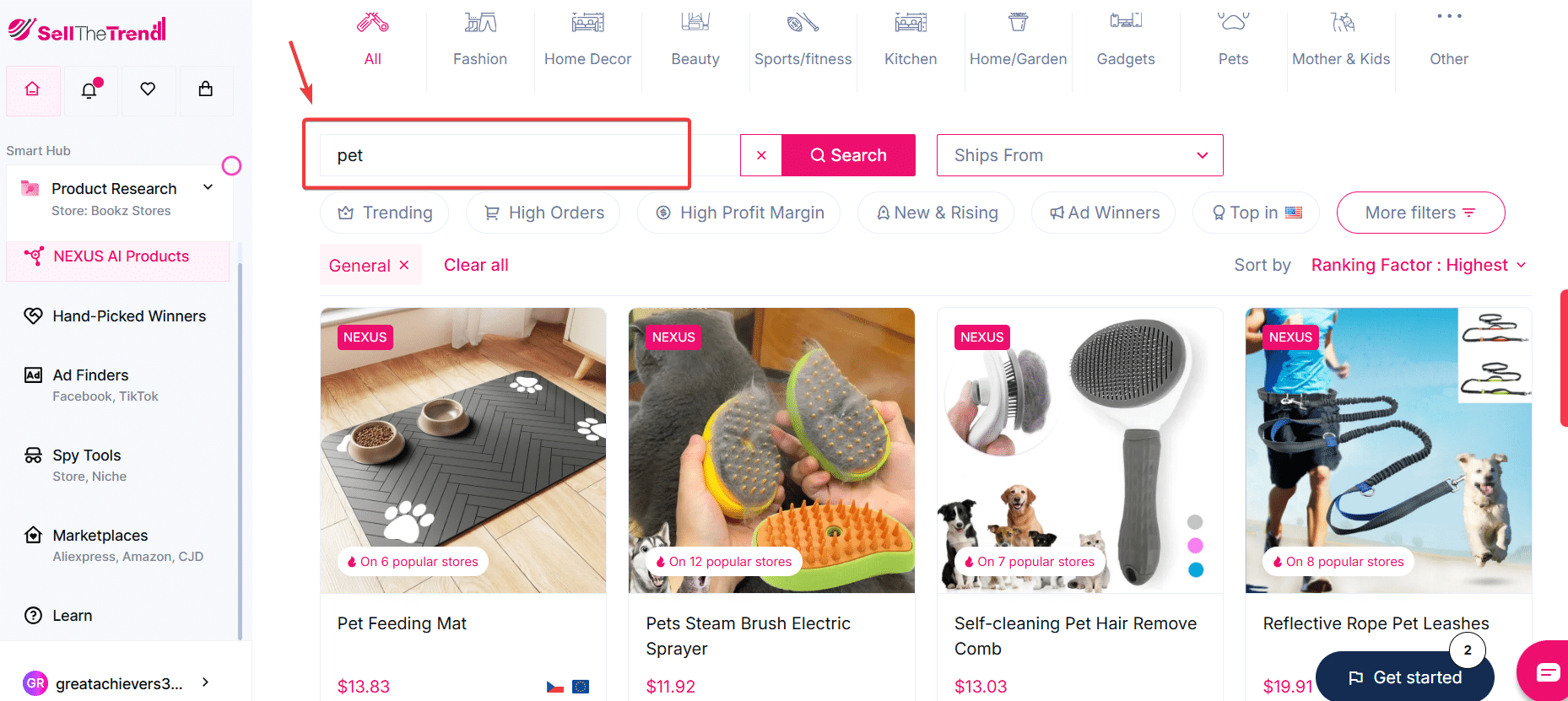
Let’s say you want to get into the pet supplies market. Your preliminary research says the global pet care market was worth over $300 billion and is poised to hit $500 billion by 2030. Unfortunately, these data don’t say if pet care is one of the profitable dropshipping niches to explore, nor do they point out how much you can make in profits.
Doing so will bring up a list of pet supply products, along with their sales data, which should give you a good idea of the viability of the product you have in mind. Plus, you can also find high-quality products you probably never thought of on the platform.
2. Use the Meta Ads Library
Because Meta’s Ad Library shows active ads from any business page, it serves as a powerful window into competitor store activity.
Analyze Ad Volume: Finding 300–500+ active ads across multiple independent sellers indicates that store owners are actively spending to scale the item.
Evaluate Creative Longevity: Look for long-running ad campaigns paired with recently launched fresh creatives—this combination strongly signals ongoing profitability.
3. Explore TikTok Search & Creative Center
Search broad viral hashtags such as #TikTokMadeMeBuyIt, #AmazonFinds, or #HomeFinds to gauge organic engagement.
Check Upload Recency: We suggest looking for user-generated content (UGC) posted within the last 1 to 2 weeks. Recent uploads confirm that the item is actively trending right now.
Track Engagement Growth: Products demonstrating a 200%+ gain in engagement over a 30-day window are exceptionally promising candidates for viral video ads.
4. Reverse Image Searching
Perform a reverse image search using the product’s primary image to discover other websites selling the same or visually similar item. This helps you identify competitors, compare pricing, evaluate product listings and landing pages, analyze their marketing strategies, and uncover opportunities to position your offering more effectively.
5. Automated AI Ad Spy Tools
Modern e-commerce research platforms, such as Sell The Trend, AdSpy, Minea, or PipiAds, use advanced AI algorithms to analyze millions of products simultaneously. These tools automatically calculate sales velocity, track active ad counts, and estimate store traffic so you can find winning dropshipping products in minutes without manual searching.
No title
💡 Pro Tip: In our testing, when using Meta Ads Library, always compare active ads against inactive ads. Inactive ads highlight product angles or stores that tested the item and failed, while a high volume of recently launched active ads confirms that competitors are actively scaling and profiting right now.
If you need help setting up these test ads, consider using Sell The Trend’s Video Ads Creator.
How Do You Test a Dropshipping Product With a Limited Budget?
Conducting low-budget test ads involves launching micro-budget campaigns ($20 to $50) on platforms like Meta or TikTok to measure real-world click-through rates, engagement levels, and early purchase intent before committing heavy ad spend.
In our experience, running small test ad campaigns is the ultimate real-world test for any product idea. Rather than assuming shoppers will buy, test ads let you gauge interest directly in the marketplace with minimal financial exposure.
What Are the Key Tactics for Micro-Budget Demand Testing?
We suggest using a combination of test ads, pre-orders, and influencer outreach to verify buyer demand before scaling up inventory or ad spend:
1. Setting Up Micro-Budget Test Ads
Create a simple video ad or dynamic image ad highlighting the product’s primary problem-solving feature or “wow factor”.
Ad Budget: Set a modest daily budget between $20 and $50 targeting broad interest groups within your niche.
Key Metrics to Track: Keep a close eye on Click-Through Rate (CTR), Cost Per Click (CPC), and initial add-to-cart actions. High engagement combined with early purchases confirms strong market fit.
2. Pre-Selling and Pre-Orders
Pre-selling is a low-risk strategy that lets you validate product demand without holding stock.
List the product on your Shopify store as a pre-order item with clear shipping estimates (e.g., “Ships in 3–4 weeks”).
Promote the offer through organic social media posts, small ad budgets, or email newsletters to verify whether shoppers are willing to pull out their credit cards before you source inventory.
3. Partnering with Micro-Influencers
In our testing, collaborating with niche micro-influencers (10,000 to 50,000 followers) provides fast, qualitative customer feedback.
Send product samples to micro-influencers in exchange for honest video reviews or shoutouts.
Track how their audience responds in the comments and direct messages to evaluate visual appeal and buying intent.
No title
💡 Pro Tip: In our experience, when launching micro-budget test ads on TikTok or Facebook, always monitor comment sentiment closely. If viewers are actively tagging friends or asking “How much is shipping?”, it indicates strong buying intent. If comments center around product quality concerns, use that customer feedback immediately to improve your product description or ad messaging.
What Should You Check Before Approving a Product for Scaling?
Approve a product for scaling only when demand, competition, customer feedback, unit economics, supplier conditions, differentiation, and live test results support the decision. A product should not pass because it meets one arbitrary review count, advertisement count, price range, or markup threshold.
What Does the Final Validation Checklist Look Like?
Before spending to scale any item on your e-commerce store, we suggest running it through this comprehensive checklist:
Demand direction: Product interest is stable, rising, or predictably seasonal rather than based on one isolated spike.
Independent confirmation: At least several different sources support the demand hypothesis.
Competitive activity: Established stores or advertisers are active, but there is still room for a different offer or audience angle.
Complete contribution margin: All variable costs have been included and the target CPA leaves room for profit.
Buyer language: Reviews and comments reveal a clear problem, desired outcome, or repeated use case.
Supplier reliability: Stock, product quality, communication, shipping cost, warehouse location, and delivery estimates have been checked.
Offer differentiation: The product can be positioned, bundled, priced, demonstrated, or supported better than a generic listing.
Operational risk: Return, defect, breakage, sizing, safety, and compliance concerns are manageable.
Live test evidence: The campaign produces meaningful lower-funnel activity or purchases within a workable cost range.
Scaling capacity: The supplier, customer support process, and fulfillment workflow can handle increased order volume.
What Product-Validation Mistakes Should You Avoid?
The most damaging validation mistakes are trusting one metric, confusing advertising activity with profitability, ignoring complete costs, overlooking supplier risk, and scaling before purchases confirm the hypothesis. Each mistake creates false confidence from incomplete evidence.
Using one platform as proof: A viral TikTok post, search spike, or large review count should never approve a product by itself.
Assuming active ads are profitable: Advertisers may be testing, losing money, or running campaigns for awareness rather than direct sales.
Applying universal thresholds: Fixed advertisement counts, review counts, price ranges, follower counts, and markup rules do not work equally across every category.
Ignoring fulfillment and return risk: Strong demand cannot repair unreliable stock, poor product quality, long delivery times, or high refund exposure.
Scaling from engagement instead of purchases: Views, likes, comments, and clicks are useful diagnostic signals. Purchases at an acceptable CPA are the more meaningful commercial result.
No title
💡 Pro Tip: In our testing, finding several professional stores selling the same product is a useful demand signal, not proof that your version will succeed. Compare their offer, audience, pricing, delivery, creative, and customer feedback before deciding where your store can be meaningfully different.
How Can You Turn Smarter Validation Into Consistent E-Commerce Profits?
Turning product validation into consistent profit margins requires replacing manual guesswork with automated AI tools that analyze trend data, supplier inventory, and active ad campaigns simultaneously.
Validating product ideas before investing time, effort, and ad budget is no longer optional in modern dropshipping. It is the foundation of every successful store. By systematically analyzing demand, mining customer reviews for what they actually want, verifying profit margins, and cross-referencing multi-platform ad data, you protect your capital and give your business a major competitive edge.
If you are ready to stop relying on hunches and want to build a sustainable, highly profitable business using real data, Sell The Trend gives you all the tools you need. From automated product research and video ad creation to Store Intelligence and real-time sales tracking, you can confidently select winning products every single time.
What Are the Most Common Questions About Dropshipping Product Validation?
These answers cover the practical questions sellers face when deciding whether a product is ready for testing or scaling.
How long does it take to validate a dropshipping product?
There is no universal validation period. Product and competitor research can often be completed quickly, while a live market test may require more time and data. Continue until you can assess demand direction, customer intent, supplier reliability, contribution margin, and actual acquisition performance without relying on one isolated signal.
What is the most important product-validation metric?
No single metric is enough. The strongest commercial evidence is a completed purchase at an acquisition cost the product’s contribution margin can support. Before reaching that stage, combine trend direction, competitor activity, customer feedback, supplier conditions, and lower-funnel actions such as checkout initiation.
How do you know whether a product is saturated?
A product may be saturated when many sellers offer nearly identical products, advertising costs are difficult to support, demand is flattening or declining, and there is little room to improve the offer. Competition alone does not prove saturation; examine trend direction, creative repetition, pricing, store activity, and customer complaints together.
Can you validate a dropshipping product without paid ads?
You can complete substantial preliminary validation without paid ads by using NEXUS AI, Store Intelligence, public ad libraries, Google Trends, customer reviews, supplier data, and organic audience feedback. However, a controlled live test provides stronger evidence of whether shoppers will complete a purchase at an economically workable cost.
How much should you spend testing a dropshipping product?
Base the test budget on the product’s target CPA, selling price, expected conversion rate, and the amount of data needed for a useful decision. A fixed amount such as $20 or $50 may be enough to expose a poor creative, but it may not be enough to confirm product demand.
Does a 3× markup guarantee that a product will be profitable?
No. A 3× markup is only an initial screening benchmark. Profit margins depend on shipping, transaction fees, discounts, returns, refunds, advertising costs, taxes, and other variable expenses. Calculate contribution margin and break-even CPA before deciding how much you can spend to acquire a customer.
Can Sell The Trend guarantee a winning product?
No product or market research platform can guarantee future profitability. Sell The Trend helps reduce uncertainty by combining NEXUS AI product research, competitor-store intelligence, ad research, supplier data, and creative tools. Final performance still depends on the offer, advertising, landing page, pricing, fulfillment, customer experience, and market conditions.
What Is the Final Verdict on Product Validation in Dropshipping?
The final verdict on product validation is that replacing personal guesswork with real-time market data, multi-platform competitor analysis, and verified margins is the single most reliable strategy for building a profitable e-commerce business.
In our experience, taking a few extra days to research target audiences, review customer feedback on Amazon, and test demand with micro-budget ad campaigns saves thousands of dollars in wasted ad costs. When you validate your product ideas systematically, you eliminate the stress of launching blindly and gain total confidence in your store’s inventory.
Matt is an experienced eCommerce professional with a deep background in building, optimizing, and scaling online stores.
He has worked across product selection, store strategy, conversion optimization, and operational workflows, helping eCommerce brands improve performance and profitability.
At Sell The Trend, Matt shares practical insights drawn from hands-on experience, focusing on what actually drives results for modern online sellers.