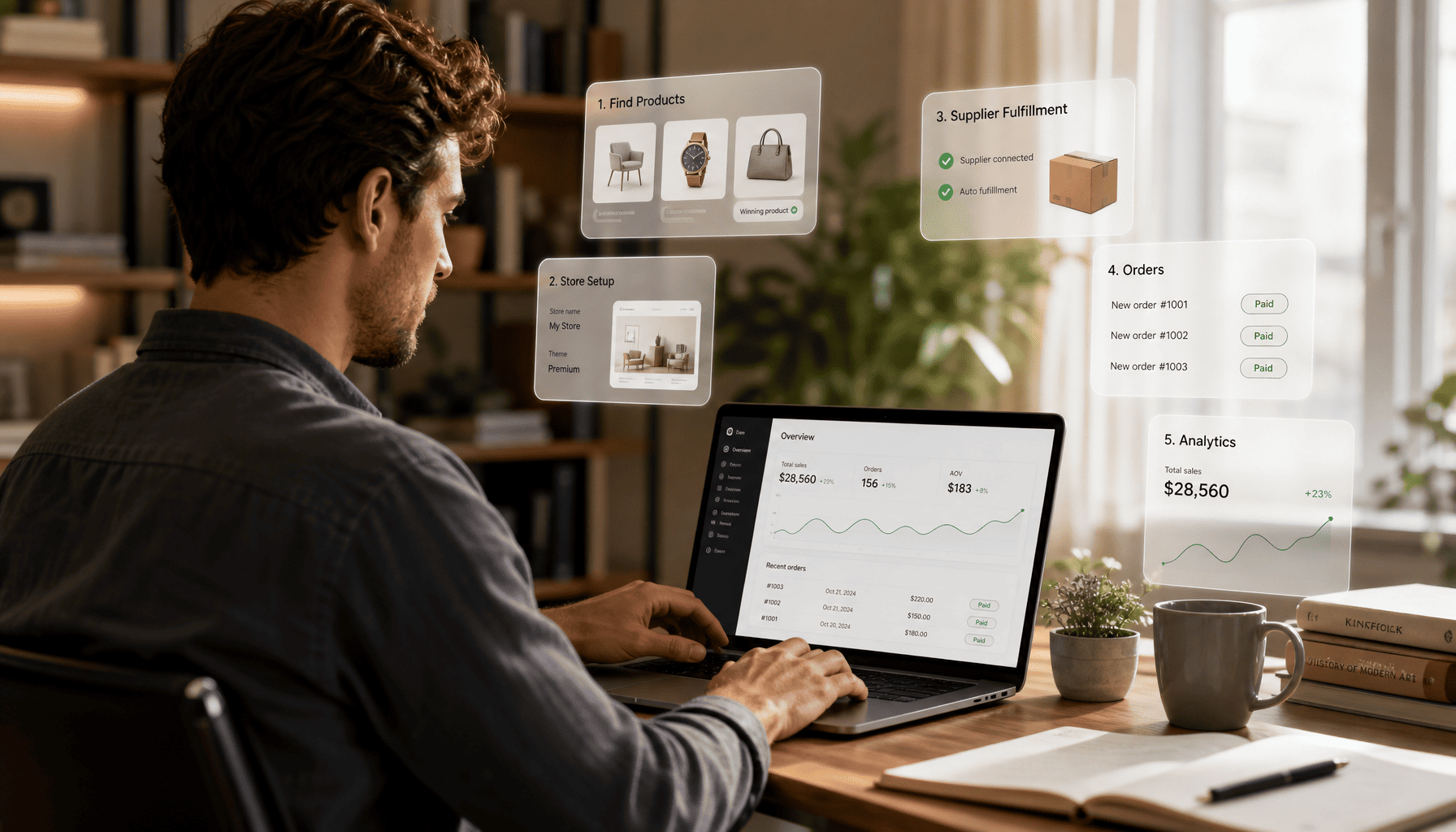
To make a dropshipping website in 2026, you need a proven product, a store builder, supplier connected product pages, payments, shipping rules, trust pages, and automation. The fastest path is to use AI store generation with Sell The Trend’s built in dropshipping website builder, allowing you to build a SellShop or Shopify store.
Starting a dropshipping website is easier than before, but it’s also easy to get wrong. Many beginners still pick a theme, add random products, and hope something sells. Part of the problem is sequencing: the website usually gets built first, and the product decision gets made afterward, almost as an afterthought. A better method is to find products with real demand first, then build the website around them, which is exactly the gap an AI product research platform is built to close, replacing guesswork with actual demand data before a single product goes on the page. Once that decision is made, an AI dropshipping platform can carry the process forward, handling store setup, product listings, and launch so the site is built around products that were already validated rather than picked at random.
This guide shows you how to make a dropshipping website step by step, using the modern ai dropshipping 2026 method: product research first, AI store generation second, and automation before launch.
Key Takeaways
To make a dropshipping website in 2026, start with product research before store design.
Sell The Trend helps you find winning products, build with SellShop or Shopify, connect suppliers, and automate key store tasks.
AI store generation can speed up the setup, but you still need strong product pages, clear shipping details, trust pages, and a tested checkout.
SellShop is best if you want a faster built in store option, while Shopify is better if you want more theme and app flexibility.
A good dropshipping website should be simple, mobile friendly, supplier connected, and built around products with real demand.
What Is The Best Way To Make A Dropshipping Website In 2026?
The best way to make a dropshipping website in 2026 is to start with product validation, then build the store around products that have real demand. Instead of choosing a theme first, focus on the niche, product, supplier, offer, product page, checkout, and automation.
Many beginners build in the wrong order.
They pick a store theme, add random products, write basic descriptions, and only think about demand after the website is done. That creates a weak store from the start.
A better 2026 workflow looks like this:
Choose a focused niche.
Find products people are already buying or searching for.
Check supplier options, shipping times, and margins.
Build the store with AI store generation.
Create clear product pages with strong images and simple copy.
Add trust pages, payment methods, and shipping rules.
Test the checkout before sending traffic.
Automate product updates, inventory, orders, and tracking.
AI can speed up the process, but it should not replace strategy. The product still needs demand. The supplier still needs to be reliable. The website still needs to look trustworthy.
No title
Pro Tip: Build the store around one strong product or niche first. A smaller, focused dropshipping website is usually easier to test, improve, and scale than a general store filled with unrelated products.
How Does Sell The Trend Help You Build A Dropshipping Website Faster?
Sell The Trend helps you build a dropshipping website faster by connecting product research, AI store creation, supplier discovery, product importing, and store automation. Instead of using separate tools for each step, you can move from product idea to launch setup inside one connected workflow.
This matters because building a dropshipping website is not only about creating pages.
You also need to know what to sell, where to source it, how to price it, how to import it, and how to manage orders after launch.
Sell The Trend supports the main parts of that process:
Nexus AI helps identify product opportunities before you build.
SellShop gives you a faster website creation option inside the platform.
Shopify store creation supports sellers who prefer a Shopify based store.
Supplier Finder helps compare sourcing options.
Product importing helps move product details into your store faster.
Store automation helps manage key tasks like inventory, orders, and tracking.
The main benefit is speed with structure. You are not only creating a website faster. You are building it around product data, supplier options, and launch ready workflows.
What Do You Need Before Creating A Dropshipping Website?
Before creating a dropshipping website, you need a niche, a product research method, supplier options, a store builder, payment setup, shipping rules, trust pages, and a basic launch plan. In 2026, AI tools can help you prepare these faster, but each part still needs to be checked before launch.
You do not need to hold inventory to start dropshipping, but you do need a clear setup.
At minimum, prepare these before building:
A focused niche: Choose the audience or product category your store will serve.
A validated product: Pick products with demand, not random items.
Supplier options: Check cost, delivery time, tracking, and return terms.
A store platform: Use SellShop, Shopify, or another website builder.
Payment setup: Add payment methods customers can trust.
Trust pages: Create your contact, shipping, refund, privacy, and terms pages.
Automation tools: Set up product imports, inventory updates, order handling, and tracking where possible.
A traffic plan: Know how you will bring visitors through ads, social content, search, or email.
The goal is not to build a website quickly and fix everything later. The goal is to launch with a store that looks trustworthy, explains the offer clearly, and can handle orders without constant manual work.
No title
Pro Tip: Do not buy a domain or spend time designing a logo until you have checked product demand and supplier quality. A strong product and reliable supplier matter more than the store name at the start.
How Do You Make A Dropshipping Website Step By Step?
To make a dropshipping website, choose a niche, find a winning product, select SellShop or Shopify, generate your store with AI, import products, connect suppliers, set pricing, add trust pages, test checkout, and launch. Sell The Trend helps combine product research, store building, importing, supplier sourcing, and automation in one workflow.
Step 1: Choose a niche
Start by choosing a focused niche before you build the website. A clear niche helps you pick better dropshipping products, write stronger product descriptions, create a sharper brand identity, and attract customers who are more likely to buy.
Try not to build a general store filled with random products. It is much easier to launch with a focused niche and a small list of 5 to 10 strong products. That way, your store feels more intentional and your marketing is easier to test.
This is where Sell The Trend’s AI Niche Finder, also called Niche Spy, can help. Instead of guessing which niche might work, you can use it to see what is already gaining traction across real ecommerce stores.
For example, if you are thinking about starting a pet store, you can use Niche Spy to check which pet related stores are performing well, what products are trending, how competitive the niche looks, and whether there is still room to enter.
You can also review useful signals like store activity, product trends, visitor traffic, country filters, top stores, and niche growth. This gives you a clearer picture before you spend time building your own store.
You can also compare niche ideas by checking SEO tools, Amazon listings, and social media ads. This helps you spot underserved long tail niches before you commit to a store idea.
No title
Pro tip:Use Sell The Trend before choosing your store idea. A few minutes of niche research can save you from building a store around products nobody wants.
Step 2: Find a product with demand
Find the product before designing the store. A profitable dropshipping business starts with demand, not a homepage layout.
Use Sell The Trend’s Nexus AI, Ad Explorer, Store Intelligence, and Product Explorer to study trending products, winning ads, competitor stores, order patterns, supplier options, and profit margin potential. This helps you avoid guessing from random TikTok videos or adding products with no proof of demand.
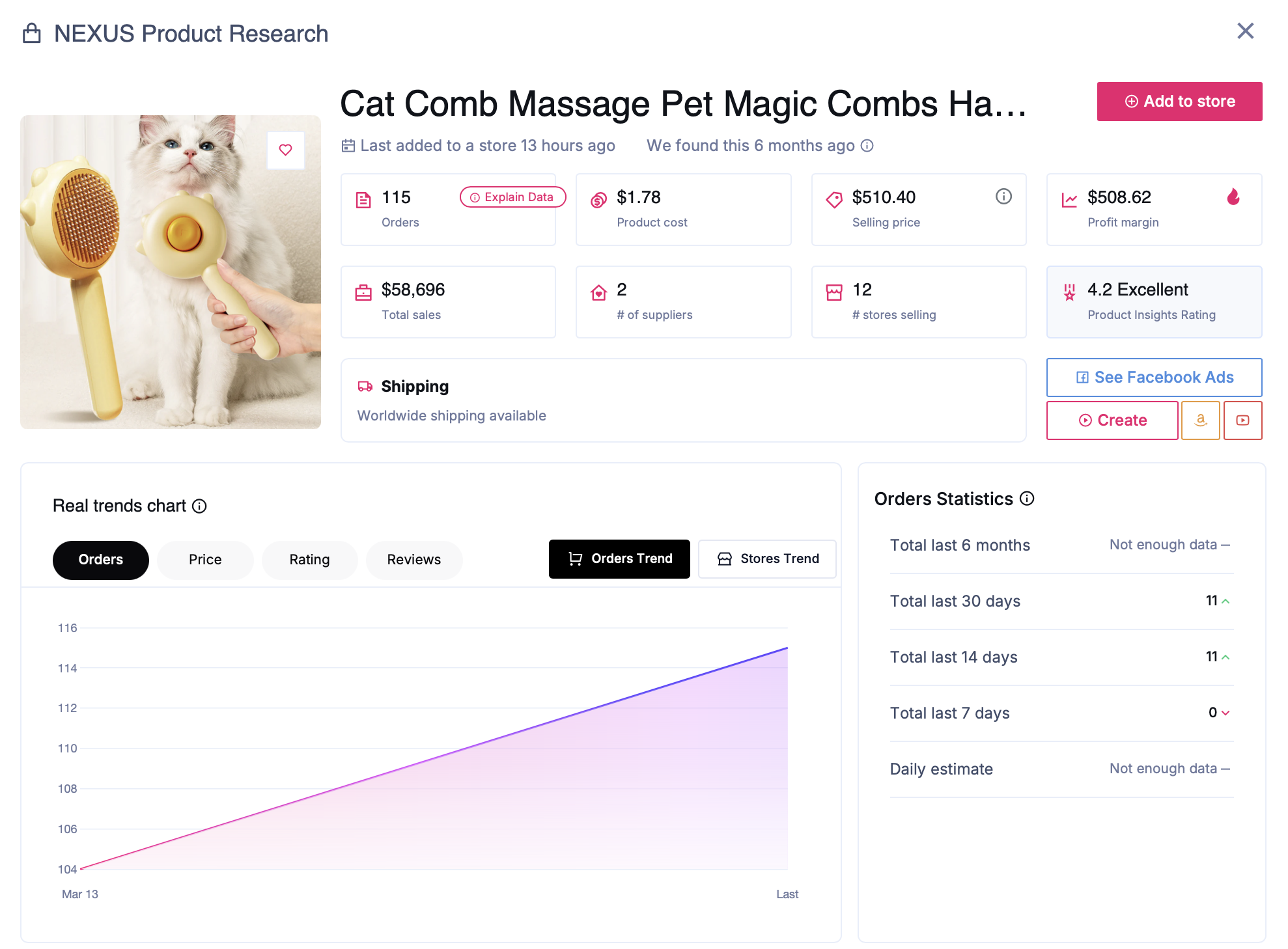
Here’s an example. We searched for a product inside Sell The Trend and reviewed the results before deciding whether it was worth adding to the store.
Instead of only looking at the product image, we checked the signals that matter: demand, competition, selling price, supplier options, shipping details, and whether similar products were already getting traction in ads or competitor stores.
This is the difference between guessing and validating. A product may look interesting on social media, but Sell The Trend helps you check if it has real selling potential before you build a product page around it.
Focus on problem solving products that offer a clear benefit. Vet products before selling them, because product quality affects returns, reviews, customer satisfaction, and repeat buyers.
This is also why it helps to vet suppliers early. Vetting products and suppliers helps confirm that you are selling reliable goods, which can reduce return rates and protect customer trust.
Choose your ecommerce platform based on how fast you want to launch and how much control you need. SellShop is best for a faster built in setup. Shopify is better if you want a larger app ecosystem. MakeMyStore.aiis best if you want to start Shopify dropshipping from scratch, with AI helping generate the store and add winning products.
SellShop is especially useful because it is built into Sell The Trend. It includes website creation, hosting, product research, supplier integration, product pages, and store tools in one dashboard. Sell The Trend says SellShop can create a fully functional dropshipping website without coding, with automated product pages, inventory sync, payments integration, hosting, security, and performance optimization included.
Option
Best For
Setup Speed
Main Benefit
Tradeoff
SellShop
Beginners who want a fast launch
60 seconds
Built into Sell The Trend with product research, hosting, product pages, supplier tools, and payments integration
Less suited for users who want many third party Shopify apps
Shopify
Sellers who want apps and themes
Longer than SellShop
Flexible ecommerce platform with a large app ecosystem
Requires more setup, apps, and possible extra operational costs
Best for sellers who want to start Shopify dropshipping from scratch
Want the fastest path? Build with SellShop inside Sell The Trend. Prefer Shopify? Use Sell The Trend to validate products first, then create your Shopify based store using Sell The Trend’s Shopify AI creator.
Step 4: Choose your store builder
Once you have a niche and product direction, use AI Store Generation to create the first version of your store. This can include the store name, homepage layout, product pages, collection pages, product descriptions, product images, trust sections, and basic store copy.
With Sell The Trend, you can generate a Shopify or SellShop store around products from your chosen niche. This means you are not starting from a blank ecommerce website. You are using product research and AI store creation together, so the store is built around products with real selling potential.
This is where a 1 Click AI Store Builder, AI Shopify Store Creator, or AI dropshipping website builder becomes useful. AI helps you build the base store faster, while Sell The Trend helps connect that store to products, suppliers, and automation.
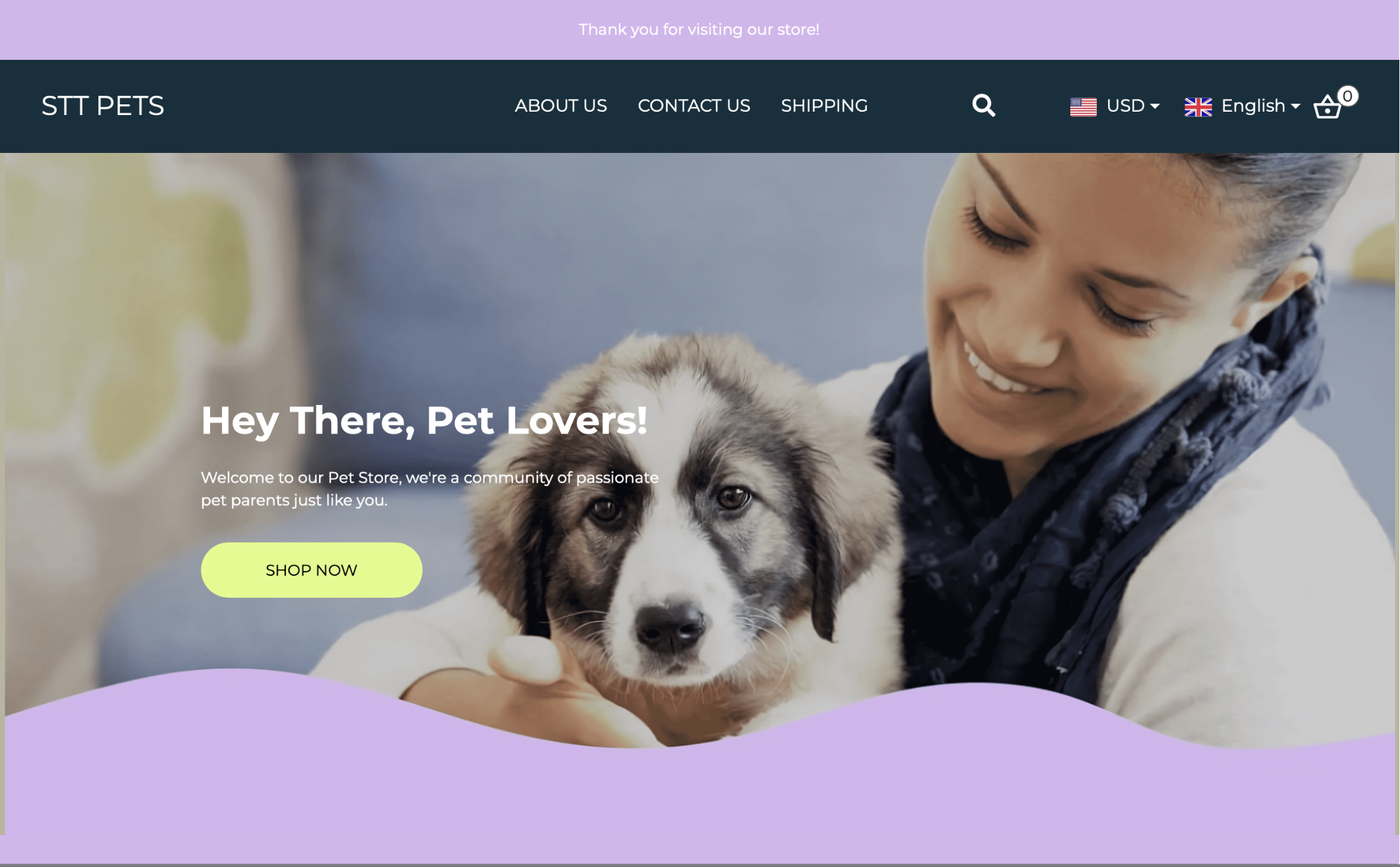
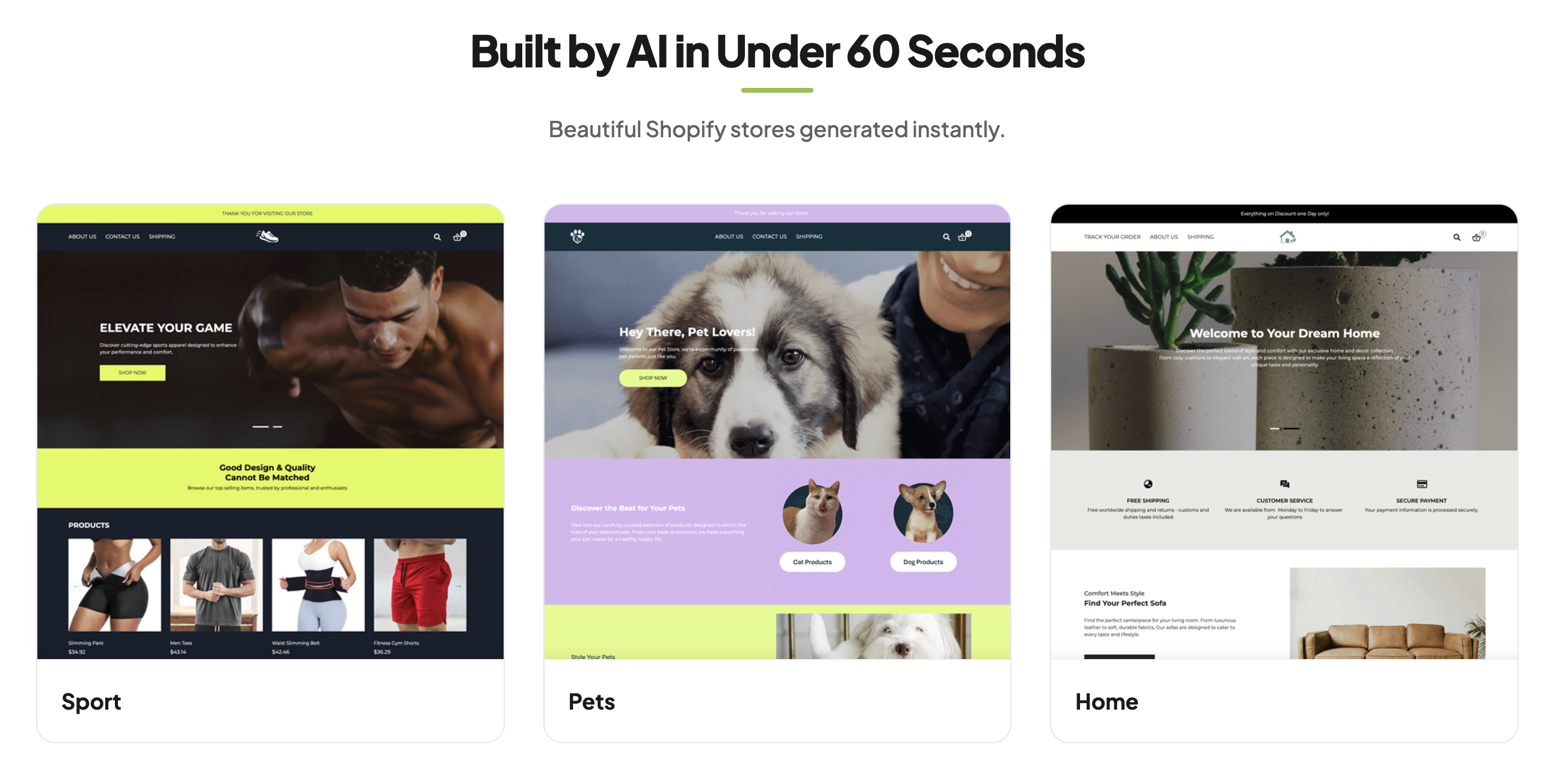
Here is an example of a SellShop website generated for a pet niche. The homepage already has a clear store name, navigation menu, hero image, niche focused headline, short welcome copy, and a visible Shop Now button. This gives you a working starting point that you can edit, instead of building the entire store layout from scratch.
Here a few more examples:
For a deeper look at how AI is changing product research, store building, supplier workflows, and automation, see Sell The Trend’s State of AI Dropshipping report.
No title
Pro tip: Use SellShop inside Sell The Trend to turn your product idea into a launch ready dropshipping website faster.
Step 5: Tweak your generated product pages
After your store is generated, review the product pages that AI has already created. SellShop, Shopify store creation, and MakeMyStore.ai can generate stores with products, images, descriptions, pricing, and product pages included, so you are not starting from scratch.
Your job is to check that each page is accurate, clear, and ready for customers. Review the product title, images, variants, pricing, shipping details, product description, and main benefit. Make sure the AI generated copy sounds natural and explains why someone should buy the product.
You can also use Sell The Trend to add more winning products if you want to expand the store. Keep the product list focused, though. A small set of strong, niche specific products is easier to test than a store filled with random items.
No title
Pro tip: Do not publish every AI generated product page without review. Check the description, pricing, shipping details, and supplier information first so the page feels trustworthy and accurate.
Step 6: Fulfill orders through your connected suppliers
Once your store is generated, the products already come with suppliers connected. That means you do not need to manually hunt for a supplier before the store can function. When a customer places an order, you can start fulfilling it through the supplier options and order fulfillment tools available through Sell The Trend.
This is where the dropshipping model becomes useful. You sell the product through your store, but you do not hold the inventory yourself. The supplier handles the product and ships it directly to the customer.
Inside Sell The Trend, you can manage the fulfillment process after orders come in. Review the order details, confirm the supplier, check shipping information, and use the available fulfillment tools to process the order more efficiently.
The main goal is to keep the customer experience smooth. That means checking product quality, supplier reliability, shipping times, tracking updates, and customer communication before you scale the store.
If possible, prioritize verified suppliers with local warehouses in the US or EU. Faster delivery windows, such as 3 to 7 days, can help reduce complaints and support stronger customer loyalty.
No title
Pro tip: Once sales start coming in, use the supplier and fulfillment workflow inside Sell The Trend to process orders and keep tracking details organized.
Step 7: Connect automation
Automation helps you manage inventory, pricing rules, order fulfillment, and shipment tracking without doing every task manually.
Sell The Trend’s automation workflow supports one click product import, inventory sync, order tracking, and fulfillment through integrations such as AliExpress, CJ Dropshipping, Shopify, WooCommerce, and SellShop. This becomes more important as monthly sales grow and manual updates become harder to manage.
A fully functional dropshipping store should not depend on you checking supplier stock by hand every day. Inventory management, supplier costs, order status, and tracking updates should be as automated as possible.
Want to automate product importing, stock updates, order tracking, and fulfillment from one dashboard? Try Sell The Trend for free and set up your dropshipping workflow faster.
Step 8: Customize your trust pages
Your AI generated store may already include templated trust pages, such as an About page, Contact page, Shipping Policy, Refund Policy, Privacy Policy, Terms page, and FAQ page. These pages give you a starting point, but you should not publish them without editing.
Customize each page with your own store details. Add your brand story, support email, contact information, shipping timelines, refund rules, return conditions, and any region specific policies that apply to your business.
This is also where the legal side matters. Dropshipping is legal, but your store still needs clear product descriptions, honest shipping times, refund terms, privacy details, and customer support information. If your location requires business registration, permits, tax certificates, or other documents, handle those before you start selling.
No title
Pro tip: Treat templated trust pages as a draft, not the final version. Before launch, update them with your real contact details, shipping policies, refund terms, privacy policy, and store specific customer promises.
Step 9: How Do You Test Checkout Before Launch?
Test the full buying journey before sending potential customers to the site. Click product buttons, add items to cart, check shipping rates, test payment gateways, review mobile layout, and confirm order emails.
Offer multiple payment options where possible, such as cards, PayPal, Apple Pay, and other secure payment gateways. A smooth checkout helps reduce friction and improves customer satisfaction.
Make sure the website is mobile friendly. Many dropshipping stores get most traffic from mobile sales channels, so your mobile product page, cart, and checkout must be clean and fast.
No title
Pro tip: Before launch, use Sell The Trend to prepare the store, then test every product page, cart button, payment option, and shipping rule.
Step 10: Launch and track performance
Once your store is ready, launch with a clear marketing strategy. Use targeted ad campaigns, TikTok and Instagram Reels, email marketing, SEO, and high quality marketing materials to attract customers.
Track performance with Google Analytics, ecommerce platform data, and Sell The Trend insights. Watch product page clicks, abandoned carts, conversion rate, monthly sales, supplier costs, and profit margin.
Search engines can bring traffic over time, but a new dropshipping store should not rely only on SEO. Use paid ads, short videos, email marketing, and product testing to bring in new customers and improve the store with real data.
Ready to start selling? Use Sell The Trend to find products, build your store, connect suppliers, automate key tasks, and launch with less guesswork.
No title
Pro Tip: Focus on one region first instead of selling worldwide immediately. It makes shipping costs, supplier research, ad targeting, customer service, and delivery expectations easier to manage.
Which Platform Should You Use To Make A Dropshipping Website?
The best platform to make a dropshipping website depends on your goal. Use SellShop if you want the fastest built in store setup, Shopify if you want more app and design control, and MakeMyStore.ai if you want AI Shopify store creation. The right choice should help you build, source products, and launch faster.
Your ecommerce platform affects more than the look of your site. It controls how you add products, manage orders, connect suppliers, accept payments, and keep your store running after launch.
Here is the simple breakdown:
Platform
Best For
Main Benefit
Best Fit
SellShop
Fast dropshipping website setup
Built into Sell The Trend with product research, store creation, and supplier tools
Beginners who want a faster launch
Shopify
More control and apps
Large app ecosystem, flexible themes, and many ecommerce integrations
For most beginners, SellShop is the easiest starting point because it keeps the workflow simple. You can research products, build the store, connect suppliers, and prepare for launch without stacking too many separate tools.
Shopify is a strong choice if you want more flexibility, but it often needs extra apps for product sourcing, reviews, automation, and fulfillment. That can make setup more complex and increase operational costs.
MakeMyStore.ai is useful if you want AI store generation for a Shopify based store. It works best when paired with proper product research, because a fast store still needs strong products, reliable suppliers, and clear product pages.
No title
Pro tip: Do not choose a platform only because it is cheap. Choose the one that helps you build your store, add high quality products, find reliable suppliers, and manage fulfillment after launch.
Want product research, SellShop store creation, supplier tools, and automation in one workflow before launching your dropshipping website? Try Sell The Trend for free and build your store with less guesswork.
How Much Does It Cost To Make A Dropshipping Website?
The cost to make a dropshipping website depends on the platform you choose. With SellShop and the Sell The Trend Essential Plan, you can build the store, find products, connect suppliers, and use automation for $49.97 per month. If you prefer Shopify, you may pay $39 per month for Shopify plus $29.97 per month for Sell The Trend, or about $68.97 per month before domain, samples, and marketing.
Here is a simple cost breakdown:
Cost Item
What It Covers
SellShop Setup
Shopify Setup
Store builder
Your dropshipping website
Included with SellShop
Shopify, $39 per month
Product research
Finding winning products and demand signals
Included in Sell The Trend Essential, $49.97 per month
Sell The Trend plan, $29.97 per month
Supplier tools
Finding and managing suppliers
Included
Included through Sell The Trend
Automation
Product importing, order tracking, and fulfillment support
Included
Included through Sell The Trend
Domain name
Your branded website address
Extra
Extra
Product samples
Testing quality, packaging, and delivery time
Extra
Extra
Marketing budget
Ads, content, email, and testing
Extra
Extra
For most beginners, the simpler option is SellShop with the Sell The Trend Essential Plan at $49.97 per month. It gives you the store builder, product research, supplier tools, and automation in one workflow, so you do not need to stack several separate tools just to launch.
If you want a Shopify based setup, Shopify may cost $1 to start, then $39 per month after the trial offer. To find products and automate the workflow as recommended, you would also need the Sell The Trend plan at $29.97 per month. That makes the ongoing Shopify plus Sell The Trend setup about $68.97 per month.
You should also budget for product testing. Always order samples when possible before selling to customers. This helps you check product quality, packaging, delivery speed, and whether the supplier can fulfill orders accurately.
For marketing, start small. Many beginners test Facebook or Instagram ads with small daily budgets before scaling. You can also use TikTok, Instagram Reels, SEO, and email marketing to bring traffic without depending only on paid ads.
No title
Pro tip: Do not spend your first budget on a logo, premium theme, or too many apps. Spend it on product research, supplier checks, product samples, and getting your first customers.
Want the lowest tool stack to launch faster? Try Sell The Trend with SellShop and build your dropshipping website, research products, connect suppliers, and automate key tasks from one platform.
Frequently Asked Questions
How do you build a dropshipping website with AI in 2026?
You build a dropshipping website with AI by choosing a niche, using tools like SellShop or MakeMyStore.ai to generate your store, reviewing the products and product pages, and setting up fulfillment. These AI store creators give you a faster starting point because products, pages, suppliers, and store structure can already be included.
Before launch, review the AI generated details carefully. Check product quality, descriptions, pricing, shipping times, supplier information, mobile layout, and checkout flow. Focus on problem solving products because they are easier to explain in ads, product videos, and social content.
Can I create a professional dropshipping website without coding or design experience?
Yes, you can create a professional dropshipping website without coding or design experience. AI store builders like SellShop and MakeMyStore.ai can help generate your store structure, products, product pages, descriptions, and basic design faster. Sell The Trend also helps connect the process with product research and store setup.
Your mobile experience still matters. In ecommerce, mobile traffic often makes up 80 to 90 percent of visits, so your store should load quickly, look clean on phones, and make checkout easy. Use high quality photos, benefit driven headlines, visible customer reviews, and trust badges near the Add to Cart button.
How much does it realistically cost to start a dropshipping website in 2026?
Dropshipping has low startup costs compared with a traditional ecommerce business, but it is not free. You may need a domain, store platform, product research tool, supplier app, product samples, payment setup, business registration, and a small marketing budget.
Dropshipping business profit margins often range from 10 to 20 percent, depending on product cost, supplier pricing, shipping fees, ad costs, and conversion rate. To control costs, start lean, test one niche, keep competitive prices, and avoid paying for too many apps before you know which products can sell.
Why do most beginner dropshipping websites fail to get sales?
Most beginner dropshipping websites fail because they choose weak products, skip supplier checks, use poor product pages, or launch without a clear marketing strategy. A successful online business needs strong product curation, reliable logistics, and steady traffic.
Before launching, analyze rivals using SEO tools, Amazon, social media ads, and competitor stores to find underserved long tail niches. Put quality over quantity by starting with 5 to 10 high quality, niche specific products instead of a general store with hundreds of items. Use TikTok and Instagram Reels to show the product in action.
How do you find reliable dropshipping suppliers?
To find reliable dropshipping suppliers, start with Sell The Trend to review supplier options connected to product research and store setup. Then check reviews, reputation, warehouse location, shipping speed, return rules, order accuracy, product quality, and available shipping options before selling.
Supplier quality matters because missed delivery times or poor product quality can lead to refunds, bad reviews, and lost customers. Research shows that 84 percent of dropshipping merchants consider finding a good supplier one of the biggest obstacles when starting. Prioritize suppliers with US or EU warehouses when possible, because 3 to 7 day delivery is now a stronger customer expectation.
Is dropshipping legal, and how does dropshipping work?
Yes, dropshipping is legal, but your online business must follow local laws, tax rules, privacy laws, and consumer protection standards. Depending on your location, you may need to register your business and obtain permits such as an EIN or sales tax certificate.
Here is how dropshipping works: you list products on your own dropshipping website, a customer places an order, and a third party supplier ships the product directly to the customer. You do not hold inventory yourself, but under the dropshipping business model, you are still responsible for honest product descriptions, clear shipping times, refunds, privacy policies, and excellent customer service.
Conclusion
The smartest way to make a dropshipping website is to start with product research, then build your store around products people already want. A good dropshipping website needs more than a clean design. It needs reliable products, trusted suppliers, clear product pages, fast shipping, and a simple buying experience.
To make dropshipping profitable, focus on a small set of products you can market well. Do not add random items just to fill the store. Choose products with demand, find dropshipping suppliers you can trust, and make sure the store is visible through SEO, social media, email, and paid ads.
If you want to sell products without guessing, Sell The Trend gives you the tools to find winning products, build with SellShop or Shopify, compare suppliers, import products, and automate key store tasks.
Maria is a marketing specialist with hands-on experience in digital growth strategies and eCommerce.
As part of the Sell The Trend team, she has developed deep expertise in dropshipping through close work with product research, trend analysis, and go-to-market strategies used by successful online sellers.
Her content focuses on practical marketing insights, audience behavior, and data-driven decision-making to help merchants launch and scale with confidence.