Sell The Trend vs Zendrop (2026): Which Dropshipping Platform Wins?
A complete comparison of Sell The Trend and Zendrop based on product research, automation, shipping speed, supplier access, and value — updated for 2026.
Get started for free
Updated on: January 2026
Trying to decide between Sell The Trend and Zendrop in 2026? This side-by-side comparison explains how each platform supports dropshipping businesses at different stages.
Sell The Trend offers a complete system focused on AI product discovery, automation, and multi-platform selling. Zendrop is known for fast US shipping, simple fulfillment, and private labeling options.
This guide compares Sell The Trend vs Zendrop across product research, automation, pricing, analytics, and integrations. Whether you're just starting or scaling, you’ll learn which tool fits your business best in 2026.
Key Takeaways
- Sell The Trend is ideal for sellers who want one tool for predictive product research, guided store creation, real-time supplier connections, and full automation
- Zendrop is best for sellers who already have a store and want faster US-based shipping with private labeling.
- Sell The Trend includes predictive product research using Nexus AI, Facebook and TikTok Ad Finders, and full automation with AliExpress and CJ Dropshipping.
- Zendrop offers quick shipping and branded packaging but lacks built-in research, ad intelligence, or store creation.
- The better platform depends on whether you're starting from scratch or optimizing fulfillment for an existing store.
Quick Verdict
-
Choose Sell The Trend if you want a complete dropshipping system that includes product discovery, automation, store creation, supplier sourcing, and ad intelligence.
-
Choose Zendrop if you already have a store and mainly want fast US shipping, simple fulfillment, and private labeling options.
Sell The Trend vs Zendrop in 2026: Which One Is Better?
Sell The Trend is the better choice in 2026 for sellers who want an all-in-one dropshipping platform with AI product research, supplier sourcing, store automation, and ad targeting tools. Zendrop is best for sellers focused on fast US shipping and simple fulfillment.
If you already have a store and just need reliable shipping and branded packaging, Zendrop is a solid pick.
But if you’re looking for a full system that includes product discovery, automation, store building, and ad tools in one place, Sell The Trend offers more value and control in 2026.
You can compare both tools in detail here and see which fits your strategy best.
What is the main difference between Sell The Trend and Zendrop in 2026?
| Feature | Sell The Trend | Zendrop |
|---|---|---|
| Product research | 11M+ products analyzed using Nexus AI with predictive trend scoring based on demand signals, ad engagement, and growth patterns. | Not included. Users must rely on external tools to find and validate products. |
| Store creation | Includes SellShop for fast store setup, optionally merchants can connect their own existing Shopify store. | Not available. Requires an existing Shopify store. |
| Automation | One-click product import, order fulfillment, inventory sync, and tracking built into the platform. | Auto-fulfillment supported, but limited to Zendrop suppliers only. |
| Supplier sourcing | Direct integration with AliExpress, CJ Dropshipping, and vetted global suppliers with shipping filters. | Focuses on Zendrop Select suppliers and US-based fulfillment. |
| Ad intelligence | Built-in TikTok and Facebook Ad Explorer connected to products. | Not included. No ad research or creative tracking tools. |
| Branding options | Basic supplier branding depending on source. | Strong focus on custom packaging, private labeling, and branding inserts. |
| Best for | Beginners and scaling sellers who want everything in one system. | Sellers who already have products and want faster shipping and branding. |
Comparison: Visual Proof of End-to-End Execution vs Fulfillment-Only
To understand the difference between Sell The Trend and Zendrop , this video shows how a product moves from discovery to live fulfillment — and where each platform’s responsibilities begin and end.
Key 2026 Features to Watch:
-
[03:51] – NEXUS AI Product Discovery: Watch how Sell The Trend analyzes 26+ data points to identify winning products before saturation. Zendrop assumes you already know what to sell and does not provide discovery or validation tools.
-
[06:42] – Product Listing, Store Sync & Fulfillment Automation: This segment shows how products are pushed to a connected Shopify store, inventory is synced, and orders are automatically fulfilled across suppliers. Zendrop handles fulfillment well, but does not manage product research or multi-supplier routing.
-
[09:30] – Facebook & TikTok Ad Finders: See how Sell The Trend connects ad performance directly to product listings, helping sellers validate demand and creative angles. Zendrop does not include ad intelligence or creative tracking tools.
The main difference is that Sell The Trend is a complete all‑in‑one dropshipping platform, while Zendrop is primarily a fulfillment and shipping solution. Sell The Trend focuses on product discovery, automation, and scaling. Zendrop focuses on fast delivery and branded fulfillment for existing stores.
What Is Sell The Trend?
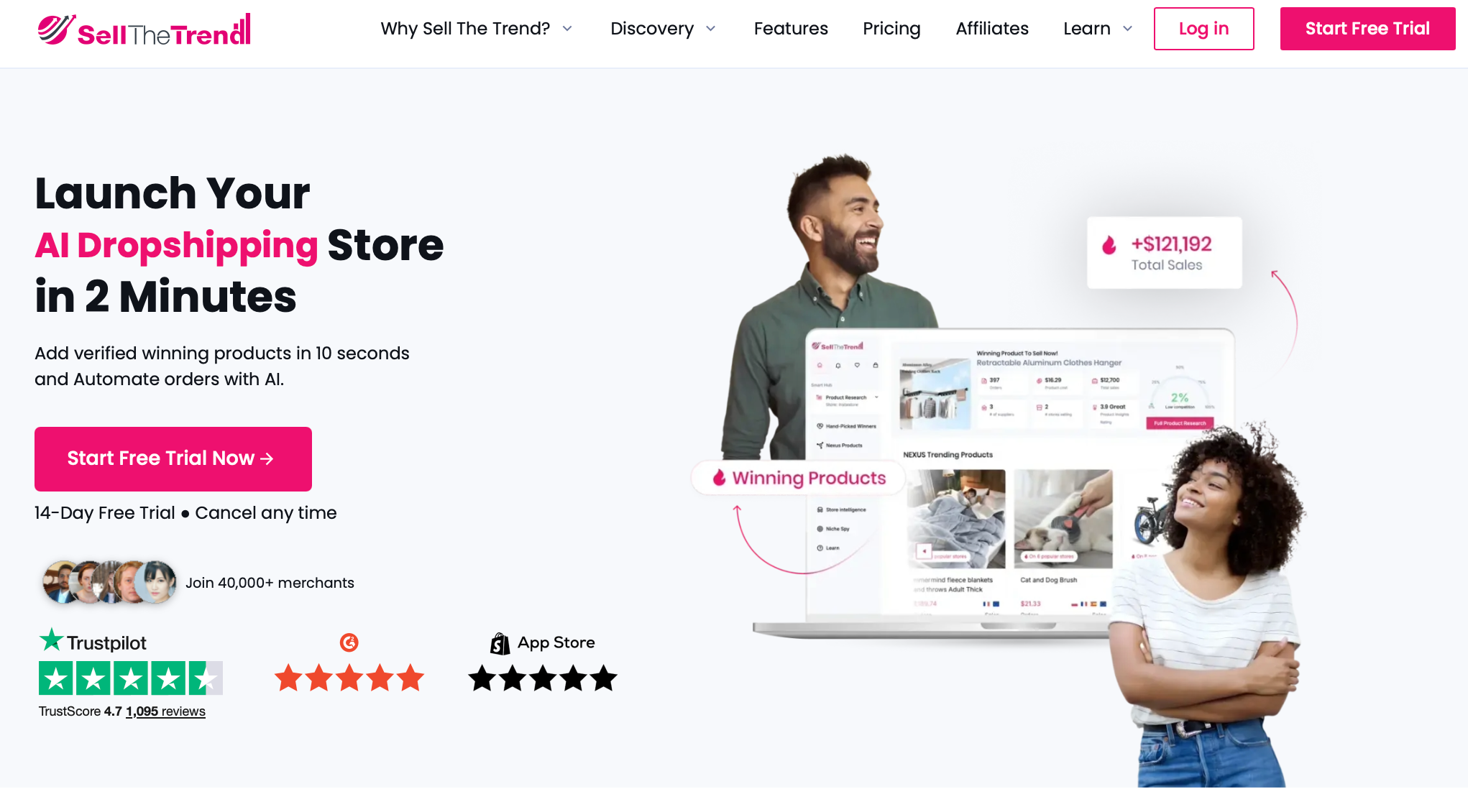
Sell The Trend is a complete dropshipping platform that brings together Nexus AI for trend prediction, SellShop for store building, and automation for fulfillment and supplier switching — all in one connected dashboard. It is designed for beginners and scaling sellers who want an end-to-end solution instead of managing multiple disconnected tools. In 2026, it remains one of the most comprehensive dropshipping platforms available.
Most dropshipping tools focus on a single function, such as product research or automation. Sell The Trend takes a different approach by combining product discovery, AI insights, store creation, supplier integration, and marketing tools inside one dashboard.
It includes the Nexus AI engine for predictive product research, a built-in store builder (SellShop), and direct integrations with suppliers like AliExpress and CJdropshipping. It also offers Facebook and TikTok Ad Explorers, allowing users to research viral ads and link them to winning products.
If you only need product research or competitor tracking, tools like dropship.io, Koala Inspector, or Niche Scraper can help. But if you want a full dropshipping system that supports product discovery, automation, multiple suppliers, and ad analysis, Sell The Trend is the more complete option.
What features are included in Sell The Trend in 2026?
| Functionality | Included in Sell The Trend | Without Sell The Trend (Tools you would need) |
|---|---|---|
| AI product research | Sell The Trend uses Nexus AI, which tracks product lifecycles, viral trends, and engagement signals to forecast winning products before they saturate. | Tools like Ecomhunt and Dropship Spy only show curated or reactive product data. |
| Supplier sourcing | Built-in access to AliExpress and CJdropshipping with filters for shipping time, warehouse location, and profit margins. | You’d need CJdropshipping, Spocket, or Modalyst separately for supplier access. |
| Store builder | Includes SellShop, a hosted drag-and-drop builder, along with Shopify integration. | Requires a separate Shopify subscription or another store builder. |
| Automation | One-click product import, automated fulfillment, tracking, and inventory sync across multiple suppliers. | Tools like AutoDS or DSers are needed to manage automation externally. |
| Ad intelligence | Facebook Ad Explorer and TikTok Ad Explorer let users analyze winning creatives and link directly to products. | Tools like Minea provide ad data, but lack store or automation tools. |
| Competitor insights | Store Intelligence and Niche Spy give sellers real-time insights into competitor stores, ad strategies, product catalogs, and installed apps. | Koala Inspector offers basic visibility, but lacks deeper filters and ad connections. |
Sell The Trend starts at $29.97 per month and includes a 14 day free trial. Higher tiers unlock additional automation and research tools without requiring extra subscriptions.
This pricing makes Sell The Trend a strong choice for beginners who want to launch quickly and for scaling sellers who want fewer tools, faster workflows, and a more complete system.
What Is Zendrop?
Zendrop is a fulfillment and automation platform designed for Shopify dropshippers who want fast US shipping, custom branding, and simplified order management. It is built for sellers who already have a store and want to streamline delivery without using AliExpress or sourcing tools.
Unlike all-in-one platforms like Sell The Trend that focus on research and automation, Zendrop focuses on logistics. It connects sellers to a catalog of over 1 million products, offers access to US warehouses, and supports private labeling through its Zendrop Select program. Users can also automate order fulfillment and tracking inside Shopify with just a few clicks.
Zendrop is known for its clean interface, beginner-friendly setup, and strong support. Sellers can create a free account in seconds and immediately begin importing products. It is especially popular with new dropshippers who want to avoid long delivery times and complicated supplier sourcing.
However, Zendrop does not offer built-in product research, ad intelligence, or store creation tools. Sellers must already know what products to sell and use external tools like Dropship.io, Ecomhunt, or Koala Inspector for product validation.
What features are included in Zendrop in 2026?
| Functionality | Included in Zendrop | Without Zendrop (tools you would need) |
|---|---|---|
| Product catalog | Zendrop offers access to over 1 million products with fast selection and one-click import to Shopify. | Tools like AliExpress, Spocket, or Doba provide larger catalogs or more global supplier variety. |
| Fulfillment automation | Built-in order automation, tracking sync, and inventory updates with Shopify. | For advanced multi-platform automation, tools like AutoDS or DSers are needed. |
| US warehouse access | Zendrop Select provides access to US-based inventory for faster delivery to US customers. | Spocket, CJdropshipping, or Modalyst also offer US/EU-based warehouses. |
| Custom packaging | Offers custom packaging and private label branding through Zendrop Select. | Tools like CJdropshipping or third-party agents may be needed for custom branding on other platforms. |
| Private label support | Sellers can access private label services for select products stored in US warehouses. | Spocket, CJdropshipping, and custom sourcing agents are required elsewhere. |
| Shipping speed | Fast shipping when inventory is stored in US warehouses. Slower if items ship from China. | AutoDS offers multiple suppliers and allows speed-based filtering across orders. |
| Automation tools | Includes core automation for ordering, tracking, and syncing inventory with Shopify. | Tools like AutoDS are more flexible across multiple stores and suppliers. |
| Store builder | Not included. Zendrop must be connected to an existing store. | Separate platforms like Shopify, WooCommerce, or SellShop are required. |
| Product research | Not included. No built-in tools for trend analysis or product discovery. | Tools like Dropship.io, Niche Scraper, Ecomhunt, or Koala Inspector are needed. |
| Ad intelligence | Not included. Zendrop does not offer TikTok or Facebook ad research features. | Use tools like Minea for ad creative analysis and performance tracking. |
Sell The Trend vs Zendrop: How does their pricing compare in 2026?
Platform |
Entry Plan |
Mid Plan |
High Plan |
Free Trial |
|---|---|---|---|---|
Sell The Trend |
$29.97/month (Lite) |
$49.97/month (Essential) |
$99.97/month (Pro) |
14‑day free trial with full access |
Zendrop |
$0/month (Free) |
$49/month (Pro) |
$79/month (Plus) |
No trial, but Free plan includes limited access |
If you want an all-in-one system with AI product discovery, store creation, ad research, and supplier access, Sell The Trend delivers more value at every tier. If your focus is on simple fulfillment and you already have a product strategy in place, Zendrop’s Free and Pro plans are a strong starting point.
However, for sellers scaling beyond one supplier or looking for flexible fulfillment options, tools like AutoDS provide more advanced automation and multi-supplier routing. And for pure product research at a lower price point, Ecomhunt or Niche Scraper may be better standalone alternatives.
Total Cost of Ownership: Total Cost of Ownership: What Zendrop Really Costs When You Add Everything?
While Zendrop excels at fulfillment and branding, it doesn’t offer product discovery, store creation, or ad research tools. Most dropshippers will need to use several additional apps to fully run their business. That adds up in cost, complexity, and tool-switching.
Here’s a look at what you get out of the box with Sell The Trend, and what you’d need to piece together separately if you’re using Zendrop. This comparison focuses on the Standard/Professional tiers most sellers use to scale
Requirement |
Zendrop ($49/mo) |
|
|---|---|---|
| Product Research | Included | +$23/mo (Ecomhunt or similar) |
| Store Builder | Included | +$39/mo (Shopify) |
| Order Automation | Included | Included (Zendrop-only products) |
| Supplier Sourcing | Included | Limited to Zendrop catalog |
| Ad Intelligence | Included | +$49/mo (Minea or similar) |
| Total Est. Cost | $49.97/mo | $111.00/month |
What Are the Best Alternatives to Sell The Trend and Zendrop in 2026?
Several alternative tools compete directly with Sell The Trend and Zendrop in 2026, each offering unique advantages depending on what part of the dropshipping workflow you need to improve. Some specialize in data-driven product research, while others focus on faster shipping, store intelligence, or multi-supplier fulfillment.
Here are the top-rated alternatives based on specific use cases:
A. Dropship.io – Best overall alternative to Sell The Trend
Dropship.io is considered the strongest standalone competitor to Sell The Trend. It specializes in real-time product demand analysis with a clean interface and a highly focused, data-driven research engine. For sellers who only need product research — without automation, store building, or ad tools — Dropship.io delivers exceptional usability and simplicity.
Best for: Sellers who prioritize
fast, accurate product research with live sales insight.
Key edge: Real-time
product demand data
B. AutoDS – Best for multi-supplier automation and fast fulfillment
AutoDS is ideal for sellers who want to manage fulfillment, pricing, and inventory across multiple suppliers. It connects with over 25 global sources, provides automated order routing, and even includes backup suppliers to avoid stockouts. In terms of speed and reliability, it outperforms Zendrop by allowing sellers to compare delivery speeds across vendors.
Best for: Sellers scaling
across multiple stores or platforms
Key edge: Auto-routing, tracking
updates, and faster global
shipping
C. Spocket – Best for branded US/EU supplier access
Spocket is the go-to tool for dropshippers who want fast shipping from US and EU suppliers. It offers vetted products, branded invoicing, and quality control across thousands of premium items. If avoiding AliExpress delays is your priority, Spocket is one of the most trusted alternatives.
Best for: Boutique brands and
creators who value delivery speed
Key edge: 2–5 day shipping from local
warehouses
D. CJdropshipping – Best for custom sourcing and private labeling
CJdropshipping offers a broad product catalog, sourcing services, and private label options similar to Zendrop Select. It also supports US warehouse fulfillment and can connect directly to stores like Shopify and WooCommerce. It’s well-suited for sellers who want hands-on control over inventory and branding.
Best for: Sellers who want
flexible sourcing and custom branding
Key edge: Built-in warehouse network
and supplier
communication
E. Niche Scraper – Best for advanced filters and competitor tracking
Niche Scraper is a powerful research tool that lets you filter winning products by niche, engagement, supplier, and more. It also includes deep competitor insights, showing what’s trending in stores and on social media. Unlike Ecomhunt’s curated feed, this tool is built for users who want full control.
Best for: Data-driven sellers who want full transparency
Key
edge: Custom
filters, daily scrapers, and store spying
Feature Breakdown: How do Sell The Trend and Zendrop compare?
Below is an expanded, fact-first comparison of each platform’s core features as of 2026.
1. What are the product research capabilities of each tool?
Sell The Trend uses a predictive engine called Nexus AI to find products before they saturate. It pulls data from AliExpress, TikTok, Facebook, and CJdropshipping, analyzing over 26 signals including ad reach, engagement velocity, and order trends.
Predictive scoring based on growth curves and market signals
Filters for niche, price, shipping speed, and region
11M+ products with live trend performance indicators
Zendrop does not include product research tools. Sellers must rely on external platforms like Dropship.io, Ecomhunt, or Niche Scraper to discover and validate winning products.
Verdict: Sell The Trend offers advanced product discovery and trend forecasting. Zendrop requires outside tools to perform this step.
2. How do their product databases and filters compare?
Sell The Trend provides a large product database sourced from multiple platforms, including AliExpress and CJdropshipping. Users can apply layered filters to narrow by supplier reliability, shipping region, ad activity, and engagement level.
Zendrop offers a product catalog of over 1 million items, mostly focused on fulfillment-ready goods. It lacks in-depth analytics or discovery filters and doesn’t score products based on trend data.
Verdict: Sell The Trend supports deeper discovery and filtering. Zendrop is better suited for sellers who already know what products they want to import.
3. Which platform supports store creation?
Sell The Trend includes SellShop, a built-in store builder that allows sellers to launch a standalone dropshipping store without using Shopify. It also offers seamless integration with Shopify for those who prefer a hybrid setup.
Built-in themes and payment support
Product import, automation, and store hosting included
Custom domain support without external tools
Zendrop does not offer any store creation features. Users must already have a Shopify or WooCommerce store to use the platform.
Verdict: Sell The Trend is the clear winner for sellers starting from scratch. Zendrop is built for those who already have a store in place.
4. What kind of automation and fulfillment do they offer?
Sell The Trend provides one-click automation across the product lifecycle.
Instant product import
Auto-ordering and tracking with AliExpress and CJdropshipping
Syncs inventory and pricing across Shopify, WooCommerce, Wix, and TikTok Shop
Zendrop supports basic automation for order fulfillment and tracking, primarily for products in its system. However, it lacks advanced routing or backup supplier options.
Verdict: Sell The Trend offers more flexible and multi-platform automation. Zendrop handles basic fulfillment well, but lacks deeper logistics flexibility seen in tools like AutoDS.
5. How do they use AI and predictive systems?
Sell The Trend’s Nexus AI predicts product performance based on ad velocity, social signals, and historical order patterns. The algorithm updates daily and suggests items before they go mainstream.
Zendrop does not include any predictive systems. Product research must be done through third-party tools like Niche Scraper or Dropship.io.
Verdict: Sell The Trend is built for early trend spotting. Zendrop is focused on fulfillment and does not support predictive research.
6. Which tool is stronger for competitor analysis?
Sell The Trend offers competitor insights through tools like Niche Spy and Store Intelligence. Users can see top-performing Shopify stores, connected ads, and trending product catalogs by niche.
Zendrop does not offer any competitor analysis. Sellers would need tools like Koala Inspector or Minea for competitor tracking and ad spying.
Verdict: Sell The Trend includes essential competitive intelligence tools. Zendrop offers none.
7. What kind of ad intelligence is included?
Sell The Trend provides a built-in Facebook and TikTok Ad Explorer. It lets users search by ad performance, views, and engagement to replicate winning ad creatives.
Find viral creatives linked to specific products
Use filters like niche, region, and recency
Track ad performance across multiple platforms
Zendrop does not include ad intelligence or social creative tracking.
Verdict: Sell The Trend is better for marketers who want to study and replicate high-performing ads. Zendrop users will need to rely on tools like Minea or AdSpy separately.
Conclusion
Sell The Trend is the better option for sellers who want a full-featured system to predict viral products, uncover competitors’ bestsellers, and 1-click automation to streamline fulfillment. It supports AliExpress products, highlights key features, and helps you act on the orders the customer places.
Zendrop focuses on fulfillment, but Sell The Trend covers the full dropshipping market without relying heavily on extra apps.
Its paid plans are incredibly helpful for serious growth. Try Sell The Trend to simplify your strategy and scale smarter.

Inspected by Rachid “Rush” Wehbi
Founder of Sell The Trend, Rush is a data-driven entrepreneur with over 10 years of experience in e-commerce, automation, and product discovery. Each article is reviewed to ensure it reflects real-world workflows, industry insights, and platform-level accuracy.
Frequently asked questions
Is Sell The Trend worth it in 2026?
Yes, Sell The Trend is worth it if you want an all-in-one system to research, launch, and scale a dropshipping business. In 2026, it is widely seen as a product research and marketing powerhouse rather than just a sourcing tool.
What makes it valuable is its ability to help you discover winning products early using growth trends, accurate data, and competitor intelligence. You can access millions of listings, analyze trending items across multiple channels, and connect research directly to your online store setup.
Key benefits include:
- Access to a massive product catalog across multiple marketplaces
- Tools to discover winning products before saturation
- Automation features that manage the entire process from research to fulfillment
- Supplier mapping that helps you find reliable dropshipping suppliers
- Insights designed to improve customer experience and long-term customer satisfaction
What is the alternative to Zendrop?
The best alternative to Zendrop depends on what you need beyond basic fulfillment. Zendrop is simple and effective for beginners, but many sellers outgrow it as their business model becomes more complex.
If you want deeper research and analytics, Sell The Trend is the most complete alternative. If fulfillment speed and reliability are your priority, AutoDS is often chosen because it supports bulk order processing, backup suppliers, and routing across over 25 trusted suppliers. Spocket is another strong option for sellers who want fast shipping suppliers and premium US-based suppliers.
Other notable alternatives include:
- CJdropshipping for private labeling and flexible sourcing
- Doba for access to thousands of suppliers in one place
- Modalyst for US, UK, and EU-focused supply chains
Is Zendrop worth using?
Zendrop is worth using if your main goal is simplicity and fast fulfillment. It is generally recommended for beginners who want to start dropshipping without dealing with complicated research tools or supplier negotiations.
Zendrop allows users to create an account in seconds and focuses on fast and reliable service using US-based warehouses as a safety net against slow shipping from China. It also offers custom packaging and private labeling, which can improve customer experience and help build customer trust.
However, Zendrop is limited when it comes to discovery and scaling. It does not help you discover products, analyze competitors, or track market demand. Shipping speed can vary when items are not available in US warehouses, and the lack of backup supplier systems can lead to delays and negative reviews.
Zendrop is strong for straightforward setups, but it is not designed for advanced growth or deep data analysis.
Which is better, Sell The Trend or Zendrop?
Sell The Trend and Zendrop serve very different purposes, which creates a major difference in how they are used.
Sell The Trend is better for sellers who want to manage the entire dropshipping process from start to scale. It helps store owners find reliable suppliers, analyze growth trends, monitor competitors, and automate workflows across multiple channels. It is ideal for sellers who want actionable insights, advanced automation, and long-term control.
Zendrop is better for sellers who already know what they want to sell and only need a supplier, fast shipping, and simple order management. It focuses on fulfillment and branding rather than discovery or analytics.
In short:
- Choose Sell The Trend if you want data-driven decisions, advanced research, and full system control
- Choose Zendrop if you want simplicity, fast fulfillment, and minimal setup