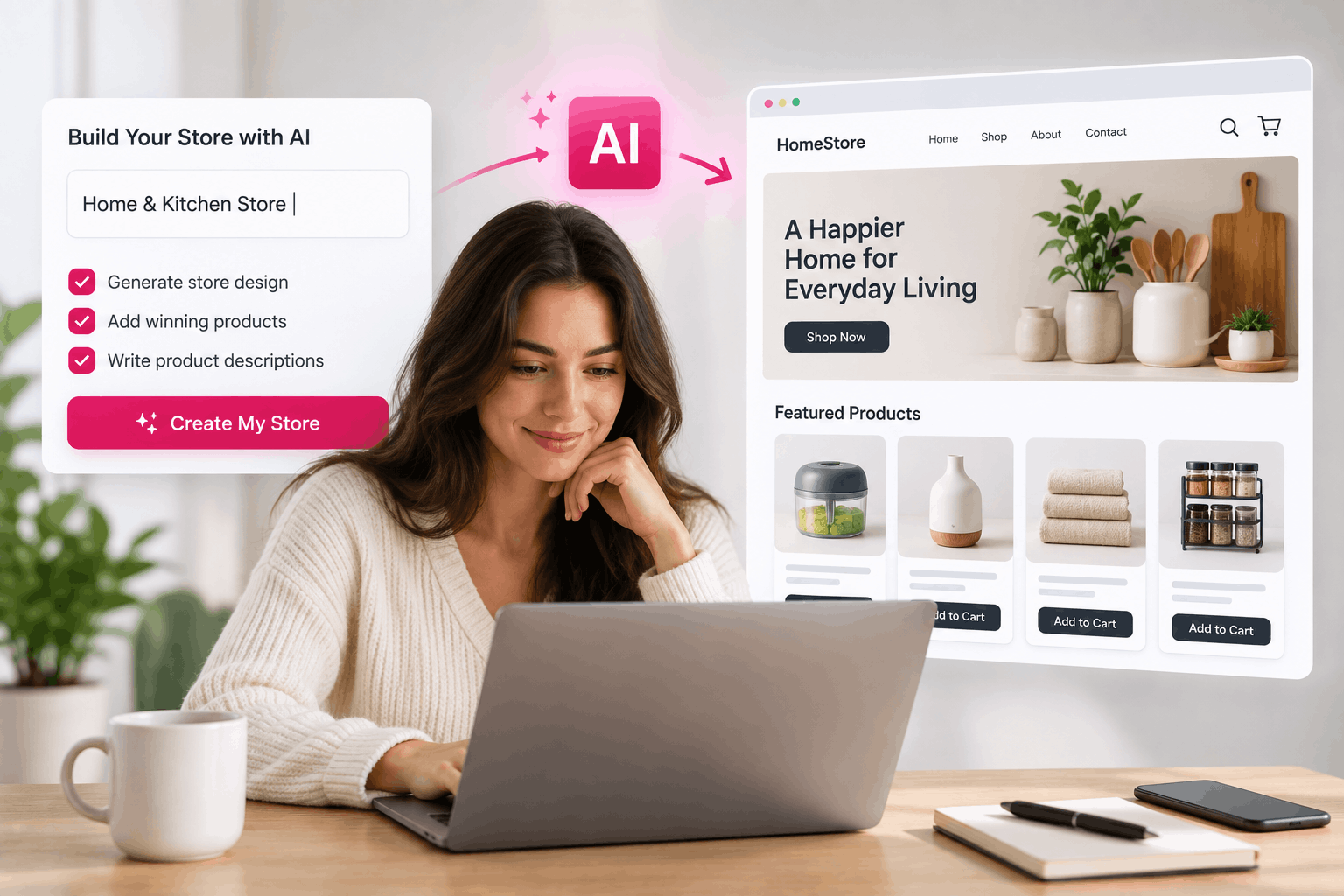
The strongest dropshipping ads use the first five seconds to show the product, communicate a compelling benefit, and give viewers a reason to keep watching. For sellers learning how to research and analyze dropshipping ads, this means looking beyond the product itself and studying the hooks, angles, visuals, and offers that make an advertisement worth stopping for. AI ad creation tools can then help turn those insights into new ecommerce creatives much faster.
Key Takeaways
The first five seconds of a dropshipping ad are critical because viewers can quickly scroll, skip, or move to another piece of content.
Strong hooks usually demonstrate a problem, result, surprising feature, or emotional reaction immediately.
Branding should appear early enough for viewers to connect the product with the business behind it.
Products with clear visual benefits give dropshippers more opportunities to create and test short-form advertising angles.
The ABCD framework—Attention, Branding, Connection, and Direction—provides a useful structure for ecommerce creatives.
AI can now help turn an advertising concept into creative, copy, variations, and placement-ready assets instead of requiring sellers to start every ad from a blank prompt.
The most useful workflow connects ad research, product research, creative generation, and testing rather than treating each step as a separate task.
Why Do Dropshipping Ads Have Only a Few Seconds to Capture Attention?
Dropshipping ads have to compete with everything else in a user’s feed, which means advertisers often have only a few seconds to establish relevance before the viewer scrolls away. The five-second window is therefore a useful creative benchmark: show the product, problem, transformation, or promise before asking the viewer to invest more attention.
The number is not arbitrary.
In many video advertising environments, particularly skippable formats, viewers can leave after the opening seconds. Anything the advertiser saves for later may never be seen.
That has changed how effective video ads are structured.
Traditional advertising could afford a gradual introduction:
Short-form ecommerce advertising often works in the opposite direction:
Hook → product → benefit → proof → CTA
Pre-roll advertising demonstrates the problem particularly well. The viewer has already chosen something else to watch, so the advertisement starts with an attention disadvantage.
Specialized networks such as RichAds accept clips of up to 30 seconds and recommend placing the offer and brand within the first three to five seconds, particularly in skippable formats. Similar attention-focused principles can also be seen in other digital advertising formats, includingpopunder ads.
For dropshipping businesses, the lesson is especially important because many products are introduced to audiences who have never seen them before.
The customer does not already know:
What the product does
Why they need it
What problem it solves
What makes it different
Why they should buy it from your store
Your ad has to establish enough context to earn another few seconds.
What should a dropshipping ad show in the first five seconds?
The opening should usually communicate at least one of these:
A problem the viewer recognizes
A product in action
A surprising result
A before-and-after transformation
A strong emotional reaction
A curiosity-inducing visual
A specific benefit
A compelling question
For example, instead of opening with:
“Meet our newest innovative kitchen product.”
A stronger opening might immediately show the product solving a frustrating kitchen problem.
The viewer does not need to understand the entire offer yet.
They simply need a reason to continue watching.
This is also where dropshipping product research connects with advertising strategy. A product with clear visual benefits can offer more creative opportunities than one that requires a lengthy explanation.
Sell The Trend’s NEXUS AI can help sellers discover potential products and investigate ecommerce signals. But finding the product is only one part of the process.
The next challenge is turning that opportunity into an advertisement.
That is where the newerSell The Trend AI Ads Creator becomes particularly relevant. Rather than asking a seller to start with a blank AI prompt, the tool lets them choose a product and then select an advertising blueprint or use an existing Facebook ad as creative inspiration. The system can then generate the creative and supporting copy around that advertising approach.
In other words:
Find the opportunity → identify the advertising angle → build the creative.
That makes the five-second rule more actionable. The seller still has to decide whether the opening is compelling, but the production process no longer has to begin from zero.
No title
Pro Tip: When researching a potential dropshipping product, ask yourself: “Could I demonstrate why someone wants this product within five seconds?” If yes, try to identify three different visual hooks before committing to a full advertising campaign.
What Is the ABCD Formula for Effective Dropshipping Ads?
The ABCD framework organizes effective video advertising into four principles: Attention, Branding, Connection, and Direction. Originally developed through Google’s advertising research with Ipsos, the framework provides a useful way to evaluate whether an ecommerce creative captures attention, establishes the brand, creates relevance, and tells viewers what to do next.
Research from Google and Kantar in 2021 found that applying these principles could increase short-term sales growth by up to 30% and contribute to a 17% increase in long-term brand contribution.
NCSolutions research also identified creative execution as the top factor in advertising effectiveness, ahead of budget and targeting.
For dropshipping ads, the framework can be translated into a practical sequence:
ABCD principle
What it means for dropshipping ads
Example
Attention
Stop the scroll immediately
Open with the product solving a problem
Branding
Make the product and seller recognizable
Show the product and brand early
Connection
Give viewers a reason to care
Demonstrate a relatable problem
Direction
Tell viewers what to do next
Use one clear CTA
The important point is that none of these principles requires a Hollywood production budget.
A dropshipper can create an effective product demonstration with relatively simple equipment if the creative concept is strong.
The structure matters more than cinematic production value.
And this is where AI-assisted ad creation can complement—not replace—creative strategy.
An AI tool can help execute a chosen concept, but it cannot remove the need to decide whether the concept actually makes sense for the product and audience.
The better workflow is therefore:
Human strategy → AI-assisted production → human review → creative testing.
How Can You Create a Strong Hook for a Dropshipping Ad?
A strong dropshipping ad hook gives viewers an immediate reason to continue watching by creating curiosity, showing a result, highlighting a problem, or demonstrating the product in action. The best hook is not necessarily the loudest or most dramatic one; it is the one that makes the product relevant to the right audience immediately.
Here are several hook types worth testing.
1. Start with the problem
Show the frustrating situation before introducing the solution.
For example:
“Still dealing with this every morning?”
The viewer first recognizes the problem.
Then the product becomes relevant.
2. Start with the result
Show the outcome the customer wants.
This works particularly well for:
Cleaning products
Beauty products
Fitness products
Organization products
Kitchen gadgets
Home improvement products
3. Start with curiosity
Show something unusual without immediately explaining it.
The viewer naturally wants to understand what they are seeing.
4. Start with movement
Open while the product is already being used.
This eliminates the slow setup that often causes viewers to scroll.
5. Start with a human reaction
Surprise, excitement, satisfaction, confusion, or humor can communicate emotional relevance quickly.
6. Start with a transformation
Before-and-after content gives viewers an immediate visual comparison.
This is particularly useful when the product creates a noticeable physical result.
These approaches can also become advertising blueprints.
Instead of telling an AI tool vaguely to “make a good ad,” the seller can begin with a specific advertising approach such as problem/solution, benefit-focused, transformation, or product-in-hand.
That distinction matters.
Sell The Trend’s AI Ads Creator is designed around exactly this idea: choose an advertising blueprint or use an existing Facebook ad as inspiration, then apply that approach to the seller’s own product. The platform says the system can use the selected advertising approach to generate the new creative, headline, primary ad text, description, and multiple variations.
The result is not simply an AI-generated image.
It can include:
Ad creative
Headline
Primary ad text
Description
Multiple creative variations
Meta-ready sizes
That gives sellers something much closer to a complete advertising concept than a standalone generated image.
Why Should Branding Appear Early in a Dropshipping Ad?
Branding should appear early enough for viewers to connect the product and its benefit with the business selling it, rather than being reserved for the final seconds. The product itself can often perform part of the branding function by remaining visible throughout the demonstration, while the brand name, packaging, or audio mention reinforces recognition.
A common structure is:
Hook → long product demonstration → explanation → logo → CTA
The problem is that the viewer may never reach the logo.
A stronger structure is:
Hook → product appears → benefit → proof → CTA
The product and brand are therefore connected to the value proposition from the beginning.
For ecommerce businesses, this matters because paid traffic is expensive to waste.
If someone remembers a product but cannot remember where they saw it, the ad has created awareness without necessarily creating a path to purchase.
How can dropshippers reinforce branding?
Show the product early.
Keep packaging visible when appropriate.
Use consistent brand colors.
Mention the product name naturally.
Use consistent visual styling across ads and landing pages.
Make the product recognizable throughout the video.
Avoid relying exclusively on a final logo screen.
The goal is not to make the opening feel like a corporate commercial.
The goal is to make the product memorable while the viewer is still paying attention.
How Does Emotional Connection Improve Dropshipping Ad Performance?
Emotional connection gives viewers a reason to care about a product rather than simply understand what it does. In dropshipping ads, this usually comes from recognizable situations, human reactions, humor, frustration, curiosity, or the desire to achieve a specific outcome.
Compare these two approaches.
Specification-focused:
“Made from durable stainless steel with an ergonomic design.”
Problem-focused:
“If cleaning this takes you 20 minutes, watch what happens.”
The second approach immediately creates context.
The viewer can identify the problem before hearing the specifications.
This is why user-generated-content-style advertising has become useful for ecommerce businesses. A person can demonstrate the problem, use the product, react to the result, and explain the benefit in a relatively short sequence.
The same principle applies across:
TikTok ads
Instagram Reels
YouTube Shorts
Facebook video ads
Product demonstrations
UGC creatives
Influencer-style advertisements
Why are people effective in ecommerce video ads?
People can communicate several things simultaneously:
Emotion
Context
Product usage
Social proof
Relatability
Demonstration
A product sitting on a table communicates relatively little.
A person struggling with a problem and then using the product communicates much more.
No title
Pro Tip: When testing a product, create one creative that focuses entirely on the product and another that focuses on a person experiencing the problem. Comparing those angles can reveal whether the product or the situation is the stronger attention driver.
How Does Product Research Affect the Quality of Dropshipping Ads?
Product research affects dropshipping advertising because the easiest products to market often have benefits that can be demonstrated visually and understood quickly. Demand, competition, margins, and supplier reliability still matter, but creative potential should also be considered when deciding which products deserve testing.
This creates an important connection between winning product research and dropshipping ads.
A product can have strong demand signals but still be difficult to advertise.
Consider the difference:
Product characteristic
Advertising implication
Visible problem
Easy to build problem-based hooks
Fast transformation
Strong before-and-after creative
Surprising feature
Curiosity-based hooks
Demonstrable use
Product demonstration opportunities
Emotional benefit
Story and UGC opportunities
Multiple use cases
Multiple creative angles
Difficult-to-explain benefit
More complicated opening
This is one reason AI-assisted product research can be useful.
Instead of simply asking whether a product is popular, sellers can investigate whether it has enough signals and creative angles to justify testing.
Sell The Trend’s NEXUS AI can support the product-discovery side of this workflow. ItsAI Ads Creator then addresses the next bottleneck: turning a product and an advertising direction into an actual creative concept.
The connection between the two is particularly useful for dropshippers.
Discover → Validate → Create → Iterate → Launch
The AI Ads Creator page describes this as a connected workflow: discover a potential product, research advertising activity with Facebook Ads Explorer, choose an advertising blueprint, generate creative and copy, create variations, resize the selected creative, and download it for campaign use.
That does not guarantee a winning campaign.
It does, however, reduce the gap between “I found a product” and “I have something I can actually test.”
How Can AI Ads Creator Turn Advertising Research Into Actual Creative?
AI Ads Creator can turn an advertising idea into a complete starting point by combining a product with a selected advertising blueprint. Instead of researching a competitor ad and then rebuilding its concept manually, sellers can use an advertising approach as inspiration and generate new creative, copy, and variations around their own product.
This is an important distinction from a general-purpose AI image generator.
Sell The Trend’s AI Ads Creator can start with a product found within its ecosystem or with the seller’s own product information and images. Sellers can then choose from suggested ad formats, use matching Facebook ad inspiration from the platform’s Facebook Ads Explorer, or provide their own reference creative.
The system identifies the advertising approach behind the creative—such as problem/solution, benefit-focused, transformation, or product-in-hand—and uses that structure as inspiration for the new product creative.
This is particularly relevant to the five-second rule.
The seller is not asking:
“Can AI make an advertisement?”
The more useful question is:
“Can I identify an advertising structure that communicates this product’s value quickly, and then use AI to turn that structure into several testable executions?”
That is a much more strategic use of generative AI.
What Is the Difference Between Manual, Blank-Prompt, and Blueprint-Based Ad Creation?
Manual advertising production requires sellers to research the concept, design the creative, write the copy, produce variations, and resize assets themselves. A blank-prompt AI workflow automates parts of production but still requires the seller to define the concept. A blueprint-based workflow gives the AI a defined advertising direction before generation begins.
Approach
Typical result
Manual ad creation
Maximum manual control but multiple production steps
Blank-prompt AI
Faster generation but depends heavily on prompt quality
AI Ads Creator with blueprint
Product + advertising approach + creative + copy in one workflow
Blueprint + Facebook ad inspiration
Advertising research connected directly to creative generation
Sell The Trend’s current AI Ads Blueprint workflow includes creative generation, headline, primary text, description, multiple variations, editing, and resizing for common Meta placements.
The available Meta formats include 4:5 portrait feed, 9:16 Stories and Reels, 1.91:1 landscape, and 16:9 wide landscape.
That matters because creative production does not end when the first image is generated.
An ecommerce advertiser may need several variations and several aspect ratios before a campaign is ready to launch.
Reducing those repetitive steps can make creative testing more practical.
How Can Winning Facebook Ads Inspire New Dropshipping Creatives?
Winning Facebook ads can be useful as research because they reveal advertising structures that have already been used in the market. The important distinction is to learn from the underlying approach rather than simply reproduce another advertiser’s creative.
This creates a bridge between competitive ad research and creative production.
A traditional workflow might look like:
Find interesting ad → save screenshot → analyze manually → write concept → brief designer → wait for creative
A connected workflow can look like:
Discover ad → understand approach → select inspiration → apply approach to product → generate creative → edit → test
Sell The Trend’s Facebook Ads Explorer and AI Ads Creator are designed to connect those steps. The platform says sellers can discover products and advertising activity through Facebook Ads Explorer and then use an advertising approach they find as inspiration for a new AI-generated creative.
The distinction is important for both effectiveness and originality.
The objective is not to copy another company’s advertisement.
It is to understand why an advertising structure might work.
For example, a competitor’s ad may reveal a strong:
Problem/solution structure
Transformation sequence
Product-in-hand demonstration
Benefit-led headline
Visual composition
Offer presentation
The seller can then adapt the underlying concept to their own product, audience, positioning, and brand.
How Can Dropshippers Build a Repeatable Five-Second Ad Testing Process?
A repeatable process starts with product research and moves through hook creation, advertising blueprint selection, creative generation, editing, and testing. Instead of trying to make one perfect advertisement, dropshippers can develop several creative angles around the same product and determine which opening earns the strongest response.
A practical workflow looks like this:
Product research → audience problem → advertising angle → AI-generated creative → edit → variations → test
For each product, create several versions rather than changing everything simultaneously.
Variable
Creative A
Creative B
Creative C
Hook
Problem
Curiosity
Result
Opening
Pain point
Unusual visual
Transformation
Demonstration
Product use
Feature
Before/after
CTA
Shop now
Learn more
See it in action
The AI Ads Creator can support this process by generating multiple creative directions from the selected advertising approach, which gives the seller more concepts to review and test.
The important word is test.
AI-generated creative is a starting point, not evidence that an ad will convert.
The audience still decides.
That is why the five-second rule remains useful even when AI handles more of the production process.
Every generated ad should still be evaluated with questions such as:
Does the opening create immediate interest?
Is the product obvious?
Is the benefit clear?
Does the visual match the copy?
Does the ad create a reason to continue?
Is the CTA appropriate?
Does the creative fit the intended audience?
No title
Pro Tip: Generate several creative directions, but do not automatically launch all of them. First eliminate concepts with weak hooks, unclear product demonstrations, mismatched messaging, or poor brand fit. Use AI to increase the number of ideas; use human judgment to decide which ideas deserve testing.
How Can the Five-Second Rule and AI Work Together?
The five-second rule provides the creative strategy, while AI can reduce the production work required to execute and test that strategy. The combination is most useful when the seller first identifies the product’s strongest benefit and advertising angle, then uses AI to generate multiple executions rather than asking AI to decide everything.
Think of the workflow as two layers.
Layer 1: Strategy
What should the ad communicate?
Problem
Benefit
Transformation
Curiosity
Product demonstration
Audience emotion
Layer 2: Execution
How many ways can we communicate it?
Different visuals
Different headlines
Different primary text
Different compositions
Different creative variations
Different placement sizes
The first layer still requires marketing judgment.
The second is where AI can provide leverage.
This is why Sell The Trend’s AI Ads Creator is a natural extension of the five-second concept. It is not simply another image generator. The workflow is explicitly built around ecommerce advertising, with the product and advertising approach supplying the context before generation begins.
It can then generate the visual creative and supporting copy, provide multiple variations, allow editing, and adapt the chosen creative for different Meta placements.
For a dropshipper, that means a promising product does not have to remain a product-research spreadsheet entry.
It can move more quickly into creative experimentation.
What Can Dropshipping Ads Teach Ecommerce Sellers About Attention?
Dropshipping ads demonstrate that attention is not something marketers can assume; it is something they have to earn immediately. The strongest ecommerce creatives make the product relevant before asking viewers to understand a long explanation, while AI-assisted advertising tools can make it faster to turn those creative principles into testable assets.
The five-second rule can therefore be reduced to four questions:
Why should I pay attention?
What product or brand am I looking at?
Why should I care?
What should I do next?
Those questions correspond closely with the ABCD framework:
Attention → Branding → Connection → Direction
AI does not eliminate those principles.
If anything, it makes them more important.
When creating an advertisement becomes easier, the competitive advantage shifts toward choosing better concepts and testing them intelligently.
A seller who can generate ten ads still needs to know which ten ideas are worth generating.
That is why the most useful ecommerce AI workflows connect research and execution.
Find the product. Find the angle. Build the ad. Test the creative. Learn from the result.
What Are the Most Common Questions About AI and Dropshipping Ads?
What should I show in the first five seconds of a dropshipping ad?
Show the product solving a recognizable problem, creating a transformation, producing a surprising result, or demonstrating an interesting feature. The opening should give viewers a reason to continue watching rather than beginning with a generic introduction.
What makes a good dropshipping ad hook?
A good hook creates immediate relevance through a problem, curiosity, movement, emotion, or a desirable result. Testing several hook types can help determine which message connects most strongly with the target audience.
What is Sell The Trend AI Ads Creator?
Sell The Trend’s AI Ads Creator, also referred to on the platform as AI Ads Blueprint, is an ecommerce-focused AI advertising workflow that combines a product with a selected advertising blueprint or ad inspiration to generate creative and supporting copy. It can also produce variations, allow editing, and resize creatives for common Meta placements.
Can AI Ads Creator use winning Facebook ads as inspiration?
Yes. Sell The Trend’s workflow can connect Facebook Ads Explorer research with AI Ads Creator, allowing sellers to select advertising inspiration and apply the underlying advertising approach to their own product. The stated purpose is to use the creative approach as inspiration rather than manually recreate another advertiser’s ad.
Does AI Ads Creator generate ad copy too?
Yes. The platform says AI Ads Creator can generate the headline, primary ad text, and description alongside the visual creative. It can also generate multiple creative variations for review and testing.
Can AI Ads Creator resize ecommerce ads?
Yes. Generated creatives can be adapted to several common Meta formats, including 4:5 portrait feed, 9:16 Stories and Reels, 1.91:1 landscape, and 16:9 wide landscape.
What Is the Final Lesson for Dropshipping Advertisers?
The first five seconds of a dropshipping ad should not be treated as empty space before the “real” advertisement begins. They are the opportunity to demonstrate relevance, communicate value, establish the product, and earn another few seconds of attention.
Video advertising has spent years refining techniques for solving this problem.
The ABCD framework turns those lessons into a practical system:
Attention. Branding. Connection. Direction.
AI is now making the execution side of that process faster.
With a blueprint-based workflow, sellers can start with a product, choose an advertising approach, generate creative and copy, create variations, refine the strongest concepts, resize them for different placements, and move the finished assets toward campaign testing.
For dropshippers, however, the process still begins earlier—with product research.
The strongest workflow connects the two:
Discover the product → understand the problem → identify the advertising angle → generate the creative → test the hook → learn from the results.
That is why the emergence of ecommerce-focused AI ad creation is significant.
A product may have demand.
A product may have healthy margins.
A supplier may be reliable.
But if the product gives you no compelling story to tell in the first few seconds, advertising it can become much harder.
The strongest ecommerce opportunities combine commercial potential with creative potential.
And once you find those opportunities, tools such asSell The Trend AI Ads Creator can help turn the advertising idea into something you can actually review, refine, and test.
The five-second rule tells you what the ad needs to accomplish.
AI can increasingly help you build and test more ways of accomplishing it.
If you want to go from product discovery and advertising research to AI-assisted ecommerce creative in one workflow, try theSell The Trend Free Trial.
Lisa is an eCommerce and digital marketing specialist with over 6 years of experience helping online businesses grow through data-driven strategy and hands-on execution.
She has worked across dropshipping and direct-to-consumer channels, focusing on product research and performance marketing. At Sell The Trend, she creates practical, research-backed content to help merchants make confident decisions.